
Table of Contents
- 1. The Neurological Blueprint of Curiosity
- 1.1. The Incidental Learning Effect
- 2. Cultivating Cognitive Flexibility and Multi-Subject Autodidactism
- 3. The Practical Benefits of Autodidactic Problem-Solving
- 3.1. 1. The Dynamic Value of Mistakes
- 3.2. 2. Navigating Absolute Ambiguity
- 3.3. 3. The Predictive Power of Intrinsic Motivation
- 4. Systemic Validation: The Power of Problem-Centered Pedagogy
- 5. Conclusion: The Ideal Cognitive Synthesis
- 6. Frequently Asked Questions
- 6.1. Does this mean self-taught individuals are naturally smarter than college graduates?
- 6.2. How can I make my brain more curious if I am naturally used to structured learning?
- 6.3. How can traditional classrooms incorporate autodidactic principles without losing order?
- 6.4. Is curiosity-driven learning effective for highly technical fields like medicine or engineering?
- 6.5. How does aging affect our capacity for curiosity and neuroplasticity?
Beyond the Syllabus: Why Curiosity-Driven Thinkers Solve Problems Differently
Formal education is an undeniable engine for foundational literacy, structural logic, and specialized expertise. Yet, cognitive psychologists and neuroscientists have long observed that some of the world’s most innovative breakthroughs don’t emerge from strict adherence to a syllabus. Instead, they come from self-directed exploration.
People who build knowledge based on a personal appetite to understand rather than a mandate to pass a test often develop a distinct cognitive architecture. By following curiosity wherever it leads, these self-directed learners build a highly flexible, cross-disciplinary mental toolkit that allows them to navigate uncertainty and solve complex, real-world problems in ways structured classrooms struggle to replicate.
Beyond the Syllabus Why Curiosity-Driven Thinkers Solve Problems Differently
The Neurological Blueprint of Curiosity
Curiosity is far more than a passing urge to ask questions; it is a distinct neurological state that radically changes how the brain processes and retains information.

A seminal neuroimaging study led by Matthias Gruber, Bernard Gelman, and Charan Ranganath at the University of California, Davis, published in the journal Neuron, mapped exactly what happens inside the brain when a person becomes intensely curious.
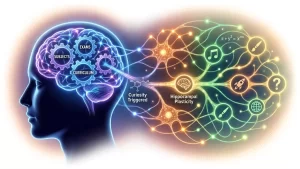
[Curiosity Triggered] ➔ [Dopaminergic Circuitry Activates] ➔ [Enhanced Hippocampal Plasticity] ➔ [Deep Retention of Target & Incidental Data]
Using functional magnetic resonance imaging (fMRI), the researchers scanned participants who were eagerly awaiting answers to complex trivia questions. The scans revealed that high curiosity triggers the brain’s dopaminergic reward pathway, specifically activating the ventral tegmental area and the nucleus accumbens.
This surge of dopamine doesn’t just make learning feel satisfying; it directly enhances the functional connectivity of the hippocampus—the brain’s primary gateway for memory formation.
 Why Building Value Beats Chasing Success
The Incidental Learning Effect
The most surprising discovery from the UC Davis study was that an activated curiosity pathway acts like a cognitive sponge. When the brain is in a state of high curiosity, it doesn’t just memorize the specific answer it was looking for. It also absorbs and retains completely unrelated, incidental information encountered along the way. In a rigid classroom setting where students are told exactly what to focus on, this peripheral, creative absorption is often suppressed.
Cultivating Cognitive Flexibility and Multi-Subject Autodidactism
In cognitive psychology, cognitive flexibility is defined as the mental ability to switch between thinking about two different concepts, or to modify thoughts and behaviors in response to a rapidly changing environment. This is the exact territory where curiosity-driven learning thrives.
Traditional Classroom:   [Subject A] ➔ [Exam] ➔ [Subject B] ➔ [Exam] (Rigid Silos)
Self-Directed Journey:   [Coding] ➔ [Music Theory] ➔ [Mathematics] ➔ [Graphic Design] (Fluid Fusion)
A formal curriculum is inherently designed around structured silos: you study biology at 9:00 AM, history at 10:30 AM, and calculus after lunch. While orderly, these rigid divisions can act as intellectual fences, training minds to look at problems through a single, isolated lens.

An autodidact (a self-taught individual), by contrast, follows a path that is messy, non-linear, and fluid. A single question might pull them from computer programming into music theory, then into fluid dynamics, and finally into historical architecture.
Because their minds are unconstrained by artificial subjects, they naturally build conceptual bridges across wildly diverse fields. When faced with a complex real-world crisis, they don’t look for a single textbook chapter to guide them; they pull diverse tools from their multi-subject toolkit to synthesize entirely novel solutions.
The Practical Benefits of Autodidactic Problem-Solving
A comprehensive literature review published in Acta Psychologica examined the lifelong trajectory of self-motivated learning, showing how internal drive and cognitive agency interact from childhood deep into adulthood. This self-directed approach changes how a person physically handles a problem.
1. The Dynamic Value of Mistakes
In traditional academic settings, errors are penalized with lost points, often fostering a subconscious fear of failure. To a curious learner, a mistake is not a verdict; it is simply high-value data. If an experiment collapses or an explanation fails, it triggers a fresh line of inquiry: Why did it fail, and what does that reveal about the hidden mechanics of the system? This reframing builds an immense resilience against frustration.
2. Navigating Absolute Ambiguity
Real-world crises rarely arrive with a study guide, multiple-choice options, or a neat answer key at the back of a book. They are muddy, ambiguous, and constantly evolving. Because self-directed learners are accustomed to wandering through information deserts, choosing their own sources, and spotting their own gaps, they develop a high comfort level with uncertainty. They don’t freeze when a plan fails; they pivot.
3. The Predictive Power of Intrinsic Motivation
A massive meta-analysis published in Open Praxis investigated the direct relationship between self-directed learning skills and intrinsic motivation (the internal drive to do something because it is inherently interesting, rather than for an external reward).
The statistical data revealed that a learner’s level of self-direction predicted roughly one-fifth (20%) of the total variance in their intrinsic motivation.
| Metric Evaluated | Extrinsic Motivation (Classroom-Driven) | Intrinsic Motivation (Curiosity-Driven) |
| Primary Fuel Source | Grades, degrees, career status, or fear of failure. | Genuine fascination and a biological urge to resolve uncertainty. |
| Stamina Over Time | Drops sharply once the external reward (the exam) is completed. | Sustains itself long-term, driving hours of practice after a workday. |
| Problem-Solving Habit | Looks for the quickest path to a standard, approved answer. | Explores unusual angles and welcomes structural surprises. |
Systemic Validation: The Power of Problem-Centered Pedagogy
To understand the broader educational implications of this mindset, a massive meta-analysis evaluated the effectiveness of problem-centered learning models. The study systematically screened 19 rigorous pedagogical studies, extracting 77 distinct effect sizes to get a definitive, comprehensive look at how problem-solving mechanics alter human intelligence.
The meta-analysis conclusively demonstrated that when educational environments step away from static rote memorization and instead orient their entire teaching structure around solving multi-layered, open-ended problems, student creativity and structural retention skyrocket.
Crucially, the data showed that the greatest cognitive gains occurred when the learners themselves were given the agency to help identify and define the problems, rather than simply being handed a pre-packaged assignment by an instructor.
Conclusion: The Ideal Cognitive Synthesis
The takeaway from modern psychology and neuroscience is not that formal classrooms should be abandoned. Structure, testing, and institutional curricula are vital for scaling baseline literacy and tracking national educational benchmarks.
The real lesson is that the most powerful learners are those who treat education as a dual-engine system. They use formal tools to build a steady structural foundation, but they retain the insatiable appetite of the autodidact to chase a question across borders. By leaving room for unscripted curiosity, messy exploration, and the freedom to fail, we allow the human brain’s natural neuroplasticity to build fresh, innovative pathways—ensuring we don’t just memorize the past, but actively invent the future.
Frequently Asked Questions
Does this mean self-taught individuals are naturally smarter than college graduates?
Not necessarily. Autodidactism is not a measure of baseline IQ; it is a description of an intellectual strategy and motivational drive. A formal university graduate can be deeply curiosity-driven, just as a self-taught individual can sometimes develop narrow blind spots if they only read materials that confirm their existing biases. The cognitive advantage belongs to the habit of self-directed exploration, regardless of whether you hold a degree.
How can I make my brain more curious if I am naturally used to structured learning?
Curiosity is a cognitive muscle that responds directly to conditioning. To stimulate your dopaminergic learning pathways, practice entering what psychologists call “the information gap”—the zone between what you currently know and what you want to know. Start by picking a random topic you know nothing about, write down three open-ended “Why” questions about it, and spend 30 minutes following hyperlinks down a research rabbit hole without looking for a specific test answer.
How can traditional classrooms incorporate autodidactic principles without losing order?
Educators can safely integrate self-directed learning by dedicating a specific percentage of class time to “Genius Hours” or open-ended project-based learning (PBL). In these frameworks, the teacher establishes the core criteria (e.g., demonstrating a principle of physics), but the student chooses the specific real-world problem to solve, selects their own research mediums, and presents their unique findings, fostering personal agency within a structured boundary.
Is curiosity-driven learning effective for highly technical fields like medicine or engineering?
Yes, it is arguably critical. While fields like orthopedic surgery or aerospace engineering require rigorous, standardized formal certification to ensure public safety, the most innovative advancements within those fields—such as inventing a new minimally invasive surgical tool or engineering a more efficient rocket propulsion system—are driven entirely by professionals who step outside standard protocols to ask highly curious, cross-disciplinary questions.
How does aging affect our capacity for curiosity and neuroplasticity?
While the brain’s natural baseline neuroplasticity is at its peak during childhood, structural remodeling remains active throughout a human lifetime. Engaging in regular, self-directed learning acts as a cognitive buffer against age-related decline. Forcing your brain to navigate new, unstructured concepts—like learning a new language, picking up a musical instrument, or mastering complex software in late adulthood—continually stimulates the creation of fresh neural pathways and keeps the mind responsive.
To see a real-world example of how curiosity-driven exploration can revolutionize modern problem-solving and lead to unexpected, world-changing breakthroughs, you can watch this presentation on The Power of Autodidactic Learning. This video profiles how individuals who took control of their own education crossed traditional disciplinary boundaries to innovate in areas where formal structures had plateaued, illustrating the exact cognitive flexibility discussed by modern neuroscientists.