
Table of Contents
- 1. Why Rowing Feels So Intense: Driving Your Aerobic Engine
- 1.1. What the Science Says: Rapid Vo2 Max Progression
- 2. The Full-Body Advantage: More Muscles, Same Clock
- 3. High Intensity Meets Low Impact
- 3.1. Clinical Relief for Bad Knees
- 4. Rower vs. Treadmill: A Direct Comparison
- 4.1. The Nuance: Where the Treadmill Wins
- 5. How to Start: Master the Technique First
- 5.1. 1. The Benchmark Progress Test
- 5.2. 2. The Full-Body Conditioning Circuit
- 6. Conclusion: Reclaiming the Corner of the Gym
- 7. Frequently Asked Questions (FAQs)
- 7.1. 1. What damper setting should I use on the rowing machine?
- 7.2. 2. Can rowing help fix bad posture from office desk work?
- 7.3. 3. Is rowing safe for individuals with lower back pain?
- 7.4. 4. How many times a week should I use the rowing machine?
- 7.5. 5. Why do my feet keep slipping out of the straps when I row?
Why the Gym’s Most Ignored Machine Delivers a Better Workout Than Running
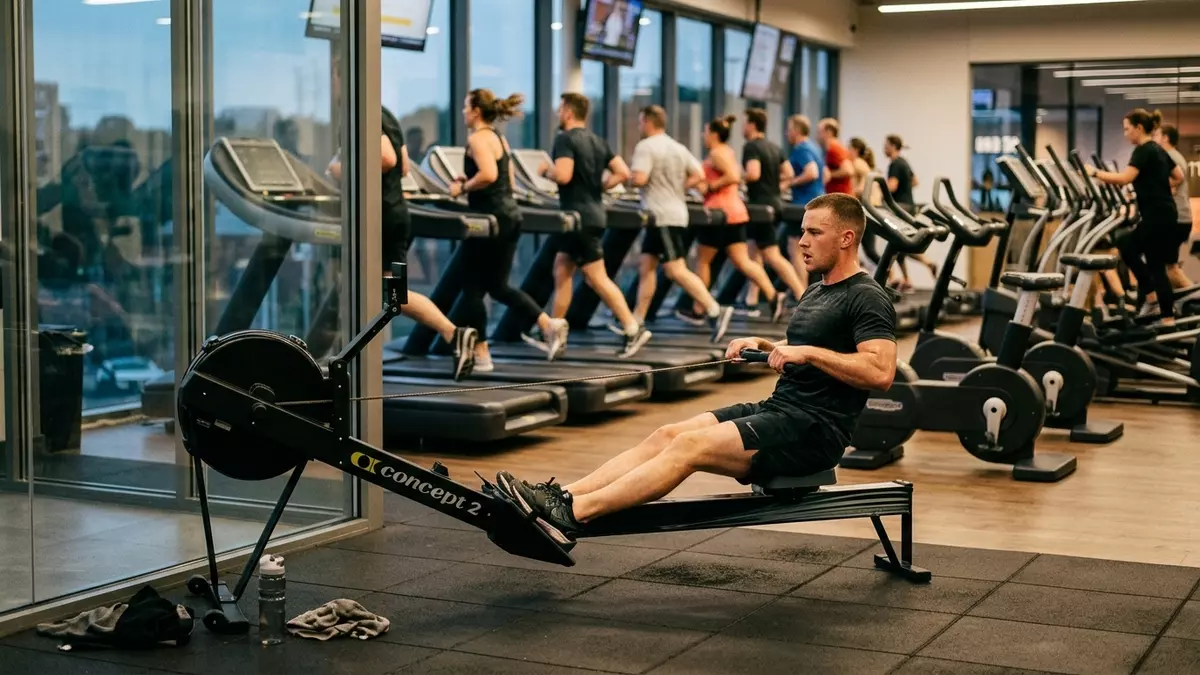
Walk into almost any fitness center, and you will notice a highly predictable pattern. The treadmills are packed with runners logging miles, the stationary bikes are spinning at capacity, and the elliptical machines are heavily occupied. Yet, tucked away in the corner of the gym, the indoor rowing machine—often called the ergometer or “erg”—frequently sits completely empty, waiting for someone brave enough to strap in and pull.
For years, everyday fitness enthusiasts have vastly underestimated the rower, viewing it as an obscure, overly difficult specialty tool reserved exclusively for competitive water athletes.
However, that perception is changing rapidly. Fueled by its inclusion in intense global fitness racing circuits like HYROX—where competitors must complete a grueling 1-kilometer (0.62-mile) row as a mandatory race station—the rowing machine is finally getting the mainstream respect it deserves.
As a growing body of sports science confirms, this single piece of equipment solves a classic exercise dilemma: it delivers intense cardiovascular conditioning, builds full-body muscular endurance, and bulletproofs your posture, all while protecting your joints from the brutal impact of traditional cardio.

Why the Gym’s Most Ignored Machine Delivers a Better Workout Than Running
Why Rowing Feels So Intense: Driving Your Aerobic Engine
If you have ever hopped on a rowing machine and found yourself completely out of breath after just two minutes, you aren’t alone. Rowing feels uniquely exhausting because it forces your body to maximize its $\text{VO}_2$ max.
What is $\text{VO}_2$ Max?
$\text{VO}_2$ max is the scientific gold standard for measuring cardiovascular fitness. It represents the maximum volume of oxygen your body can efficiently extract from the air, transport through the bloodstream, and utilize within your muscles during periods of high-intensity exercise. In short, it is the ultimate measure of your aerobic engine.

When you run or cycle, you are primarily asking your lower body to carry the entire metabolic workload. Rowing completely changes the game by spreading the physical demand across your entire frame.
[ Lower Body Drive ] ──► [ Core Stabilization ] ──► [ Upper Body Pull ]
 (Quads, Glutes, Hips)     (Abs, Obliques, Spine)    (Lats, Shoulders, Arms)
Because rowing simultaneously recruits multiple massive muscle groups—including your legs, hips, core, back, shoulders, and arms—your heart and lungs are forced to work at peak capacity. Every single stroke demands a massive surge of oxygen-rich blood, forcing your cardiovascular system to adapt rapidly.

What the Science Says: Rapid Vo2 Max Progression
This intense demand produces rapid, measurable results. A notable study published in Sports led by researcher Timo Kirchenberger and a team of medical specialists from Charité-Universitätsmedizin Berlin, the University of Bern, and the Medical Center Berlin, tracked well-trained young athletes over an eight-week training block.
The researchers discovered that incorporating high-intensity interval training (HIIT) on the rowing machine yielded profound advancements in overall oxygen-utilization efficiency and slashed personal record times on standard 2-kilometer (1.24-mile) rowing time trials.
The Full-Body Advantage: More Muscles, Same Clock
The ultimate superpower of the indoor rower is its efficiency. If you are short on time and want to hit as many muscle groups as possible without splitting your workout into separate cardio and weightlifting sessions, the rower stands in a class of its own.
       [ CATCH ] ──► Shins vertical, core braced, lats engaged.
          │
          ▼
       [ DRIVE ] ──► 60% Leg Power (Quads & Glutes explode).
          │
          ▼
[ TORSO LEAN ] ──► 20% Core Power (Hips hinge back to a 11 o'clock angle).
          │
          ▼
      [ FINISH ] ──► 20% Upper Body Pull (Lats, shoulders, and arms engage).
To map exactly how much muscle tissue is involved, a 2023 electromyography (EMG) study utilized advanced body sensors to track real-time neuromuscular activity throughout the rowing stroke. The data confirmed that a proper rowing motion activates nearly 86% of the body’s total muscle mass, dividing the mechanical work across distinct phases:
The Quad and Glute Drive: The stroke begins with an explosive leg press, engaging the quadriceps, hamstrings, and glutes to generate raw horizontal power.
The Core Brace: As the legs straighten, the mechanical load transfers through the hips and torso, forcing the abdominals, obliques, and lower back muscles to lock in to protect the spine and transfer momentum.
The Upper Body Pull: The stroke finishes with a powerful pull from the upper back, deeply engaging the latissimus dorsi (lats), rear deltoids, rhomboids, biceps, and forearms.
By distributing the physical stress across your entire muscular system, you aren’t just burned out in one isolated spot. You are building balanced, functional strength and muscular endurance across your entire body simultaneously.
High Intensity Meets Low Impact
For a large percentage of everyday exercisers, the most compelling reason to choose the rower has nothing to do with muscle activation—it is about what rowing avoids doing to the human skeletal system.
Running is a high-impact sport. Every time a runner’s foot strikes the asphalt, a shockwave equivalent to three to four times their total body weight travels directly up through their ankles, shins, knees, and lower back. Over time, this repetitive pounding can cause chronic joint inflammation, shin splints, or accelerate wear-and-tear arthritis.
[ High-Impact Cardio (Running) ] ──► Ground Strike ──► 3-4x Body Weight Shockwave ──► Joint Strain
[ Low-Impact Cardio (Rowing)  ] ──► Seated Motion ──► Zero Gravitational Pounding  ──► Joint Protection
Because rowing is performed in a smoothly gliding, seated position, it removes gravitational pounding entirely.
As fitness director Cameron Harris points out, this low-impact environment allows you to train at extremely high cardiovascular intensities because your performance is no longer restricted by your physical body weight. For example, an individual carrying an extra 20 to 30 pounds of weight may be forced to cut a run short because their knees or lower back begin to ache, long before their heart and lungs are actually challenged. The rower bypasses this limitation completely, allowing anyone to maximize their cardiovascular output without punishing their joints.
Clinical Relief for Bad Knees
This joint-friendly architecture is strongly backed by clinical rehabilitation research. In a 2022 randomized controlled trial led by researcher Pei-Ling Lin, medical experts examined the impact of a 12-week structured rowing program on older adults suffering from mild knee osteoarthritis (the chronic degenerative joint disease frequently referred to as “wear-and-tear” arthritis).
The trial revealed that the rowing cohort experienced significant advancements in overall knee joint health, marked increases in surrounding quad and hamstring strength, and drastically improved daily physical function compared to a control group performing standard static resistance exercises.
Rower vs. Treadmill: A Direct Comparison
To make an informed decision for your personal fitness goals, it helps to look at how the rowing machine stacks up against other classic cardio equipment based on recent exercise science:
| Fitness Metric | Indoor Rowing Machine | Traditional Treadmill | Stationary Exercise Bike |
| Primary Physical Focus | Full-body conditioning, posture, & strength | Lower-body endurance & vertical impact | Lower-body power & localized endurance |
| Total Muscle Activation | Exceptional (~86% of total muscle mass) | Moderate (Legs, hips, & core stabilization) | Targeted (Quadriceps, hamstrings, & glutes) |
| Impact Level on Joints | Extremely Low (Seated, fluid motion) | High (Repetitive gravitational pounding) | Low (Fixed-axis circular pedaling) |
| Peak Caloric Burn / Fat Loss | High (Spreads metabolic load evenly) | Highest (Drives maximum fat oxidation) | Moderate to High (Dependent on resistance) |
The Nuance: Where the Treadmill Wins
While the rower is an elite package deal, it isn’t a magical shortcut that wins every single category. A 2021 study published in the Journal of Sports Science and Medicine found that treadmill exercise produced slightly higher rates of fat oxidation (lipid burning) compared to both rowing and elliptical training in healthy male subjects, even though peak oxygen utilization remained largely identical across all three machines.
Furthermore, a comprehensive 2024 study in Frontiers in Sports and Active Living confirmed that among middle-aged men, the treadmill naturally elicited the highest absolute heart rates and overall energy expenditures during maximum-effort intervals.
The Takeaway: If your singular, isolated goal is to burn the absolute highest number of calories per minute, or if you are training specifically for a running event, the treadmill remains the gold standard. But if your goal is overall conditioning, functional full-body strength, improved posture, and long-term joint longevity, the rower stands completely uncontested.
How to Start: Master the Technique First
To reap the rewards of the rower without injuring your lower back, you must abandon the desire to chase raw speed on day one. Technique and rhythm are everything.
The easiest way to internalize proper rowing form is to memorize a simple three-word sequencing cue for both halves of the stroke:
[ THE POWER DRIVE ]  ──►  1. Legs Press  ──►  2. Torso Leans  ──►  3. Arms Pull
[ THE RECOVERY    ]  ──►  1. Arms Extend ──►  2. Torso Hedges ──►  3. Legs Bend
1. The Benchmark Progress Test
To track your cardiovascular growth over time, use this simple, unglamorous test every six weeks:
Perform a thorough 10-minute progressive warmup.
Set your rower monitor to a fixed distance of 2 kilometers (1.24 miles).
Row the distance at a steady, sustainable, and challenging pace.
Record your total time and your average “500-meter split time.” This gives you a completely clean, data-driven metric to measure your cardiovascular engine’s true capacity over time.
2. The Full-Body Conditioning Circuit
If you want to incorporate the rower into a dynamic, metabolic workout that builds muscle while keeping your heart rate sky-high, try executing 5 rounds of the following circuit, resting for 60 seconds between each round:
[ 400-Meter Row ] ──► [ 10 Kettlebell Deadlifts ] ──► [ 8 Strict Pushups ]
This specific movement combination keeps your metabolic output incredibly high while safely distributing the mechanical workload across your legs, hips, back, chest, and core, preventing localized muscle failure.
Conclusion: Reclaiming the Corner of the Gym
The indoor rowing machine deserves a permanent spot at the center of your fitness routine because it elegantly solves a major modern exercise problem. It allows you to challenge your cardiovascular system, build real athletic power, and reverse the rounded-shoulder posture caused by sitting at office desks all day—all without subjecting your joints to structural wear and tear.
It is vital to remember that rowing is not a casual shortcut; it is a demanding, honest workout that requires coordination, patience, and effort. But if you are willing to walk past the crowded treadmills, step into the corner of the gym, and strap your feet into the rower, the physical rewards are well worth the pull.
Frequently Asked Questions (FAQs)
1. What damper setting should I use on the rowing machine?
A common rookie mistake is cranking the mechanical damper setting on the side of the flywheel all the way up to 10, assuming it equals a better workout. A setting of 10 creates an artificially heavy, sluggish drag that can rapidly strain your lower back. For an optimal balance of aerobic conditioning and smooth power delivery, set the damper between 3 and 5—this closely mimics the physical resistance of an elite rowing shell moving smoothly through open water.
2. Can rowing help fix bad posture from office desk work?
Yes, exceptionally well. Working at a computer causes your shoulders to round forward and your chest muscles to tighten. A proper rowing stroke forces you to actively sit tall, engage your core, and pull with your upper back muscles (rhomboids and mid-traps) at the finish of every stroke. This motion actively strengthens the precise structural muscles required to pull your shoulders back into correct alignment.
3. Is rowing safe for individuals with lower back pain?
Rowing can be highly beneficial or potentially harmful to the lower back, depending entirely on your execution. If you slump forward, round your spine at the catch, or try to pull exclusively with your lower back instead of driving with your legs, you will experience lower back pain. However, if you keep your spine straight, brace your core, and allow your legs to generate the power, rowing safely strengthens the entire posterior chain.
4. How many times a week should I use the rowing machine?
For balanced fitness benefits, incorporating 2 to 3 sessions per week lasting between 20 and 30 minutes is ideal for most exercisers. This frequency provides ample cardiovascular stimulus and muscular endurance conditioning while allowing your muscles and grip strength sufficient time to recover between workouts.
5. Why do my feet keep slipping out of the straps when I row?
If your feet are sliding around or lifting out of the footplates during the recovery phase, it is a definitive sign that you are “rushing the slide” or pulling yourself forward using your hamstrings and hip flexors. Your feet should remain flat and securely pressed against the footplates throughout the entire movement sequence. Focus on using a controlled, smooth glide forward driven by momentum, rather than yanking your body back to the starting position.