
Table of Contents
- 1. The Clinical Trial: Comparing Identical Sugar Profiles
- 2. 15 Minutes Later: How the Bloodstream Told Two Different Stories
- 2.1. Analyzing the Peak Glucose Levels
- 3. Unlocking the Mystery of the Whole Fruit Matrix
- 4. The Rise of Personalized Nutrition: High vs. Low Responders
- 4.1. High Responders
- 4.2. Lower Responders
- 5. Why This Is Not a Free Pass for Unlimited Juice Consumption
- 6. Smarter Strategies for Steady Energy
- 7. Understanding the Limitations of the Research
- 8. Conclusion
- 9. Frequently Asked Questions
- 9.1. Does this mean 100% orange juice is completely safe for people with Type 2 diabetes?
- 9.2. Can I get the same blood sugar protection if I drink a fruit juice cocktail or an orange-flavored soda?
- 9.3. Why is the “fruit matrix” partially lost when fruit is turned into juice?
- 9.4. Does store-bought, pasteurized 100% orange juice still contain these protective polyphenols?
- 9.5. Should I completely stop drinking orange juice if I am trying to lose weight?
1 Simple Drink Swap That Tames Blood Sugar Spikes in 15 Minutes
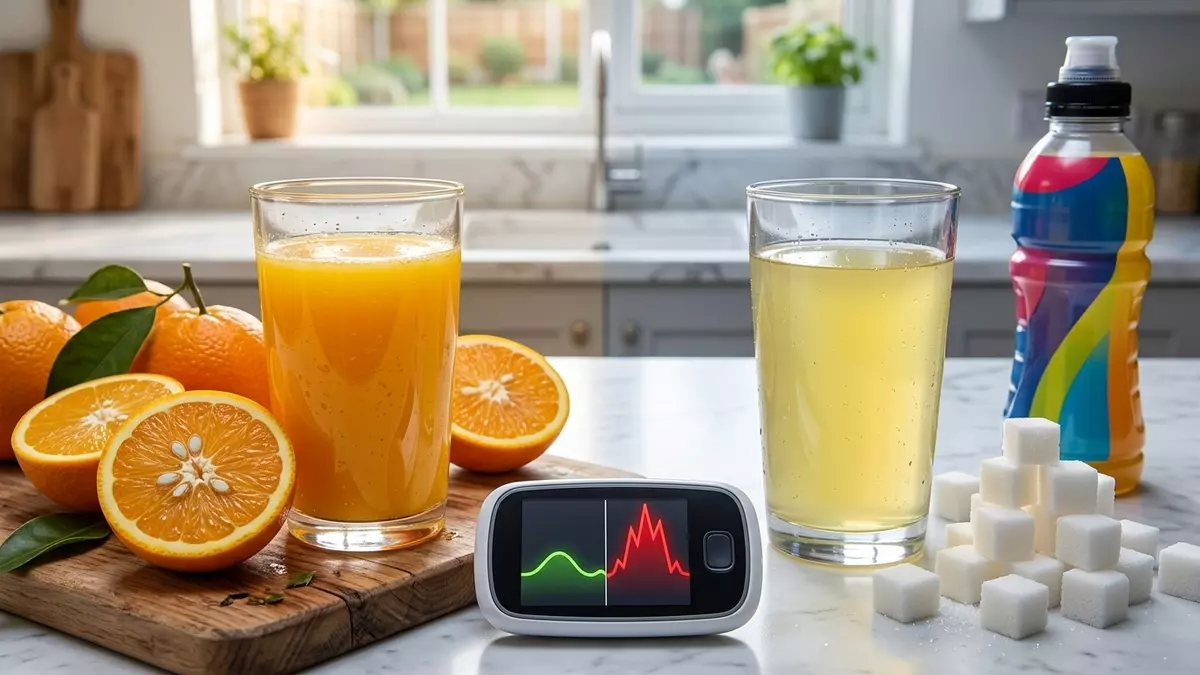
When you scan the nutrition facts panel on the back of a beverage container, the numbers can often paint an incomplete picture. If you place a glass of 100% pure orange juice directly next to a standard commercial soda or a sweetened fruit cocktail, their profiles might look surprisingly identical on paper. Both options frequently display a high carbohydrate count and a heavy dose of total sugars, a reality that causes health-conscious shoppers to hesitate given the widespread warnings from public health organizations regarding liquid sugar intake.
However, an intriguing clinical trial suggests that our metabolic systems do not treat all sweet beverages with the same broad brush. Medical researchers discovered that drinking 100% orange juice triggered a significantly lower and slower increase in blood glucose levels when compared to a synthetic, sugar-matched beverage lacking a natural fruit structure. These compelling findings introduce an essential layer of nuance to the conventional belief that “sugar is simply sugar,” proving that the biological framework surrounding our food dictates how our bodies process it.
1 Simple Drink Swap That Tames Blood Sugar Spikes in 15 Minutes

The Clinical Trial: Comparing Identical Sugar Profiles
The study, which was conducted by a research team in Spain and published in the Royal Society of Chemistry journal Food & Function, utilized a rigorous randomized crossover design. To explore how different beverage structures alter human metabolism, investigators recruited a group of healthy young men to consume four distinct beverages on completely separate testing days:
100% Pure Orange Juice: An all-natural juice with its native fruit components completely intact.
50% Orange Juice Blend: A diluted nectar mix representing intermediate juice products.
Synthetic Sugar-Only Drink: A custom-formulated beverage designed to mirror the exact sweetness and chemistry of juice, but without any fruit content.
Pure Glucose Control Solution: A standard laboratory benchmark used to evaluate baseline insulin and glucose responses.

The crucial element of this scientific experiment lay in the exact matching of the nutritional profiles. Both the 100% pure fruit juice and the synthetic sugar drink contained precisely 25 grams of total carbohydrates (equivalent to roughly six teaspoons of sugar) within a 10-fluid-ounce (300 ml) serving. Furthermore, the researchers ensured that the specific ratio of individual sugar molecules—namely glucose, fructose, and sucrose—was identical in both test beverages.
Despite having identical chemical sugar signatures on paper, the drinks triggered completely different metabolic responses once they entered the digestive tract.
15 Minutes Later: How the Bloodstream Told Two Different Stories
The most striking divergence between the two test drinks occurred almost immediately after consumption. Just 15 minutes after the volunteers finished their drinks, laboratory blood draws revealed a noticeable split in average blood glucose levels.
For the volunteers who drank the 100% pure orange juice, their average blood glucose sat at a stable 95.9 mg/dL. Meanwhile, on the day the exact same men drank the synthetic, juice-free sugar beverage, their average blood glucose had already jumped up to 108.7 mg/dL. Within a very short quarter-hour window, the body demonstrated that it recognized a profound difference between the two liquids.
Analyzing the Peak Glucose Levels
The protective metabolic effect of the natural fruit juice persisted throughout the entire monitoring period, dampening the overall intensity of the post-meal blood sugar surge. The researchers recorded distinct maximum glucose peaks across the different test days:
Pure Glucose Control: Reached the highest average peak at 134.6 mg/dL.
Synthetic Sugar-Only Drink: Climbed to an average peak of 121.6 mg/dL.
100% Pure Orange Juice: Maintained the lowest average peak at 113.8 mg/dL.
This distinct variance in postprandial (post-meal) glucose responses is incredibly meaningful to metabolic health experts. While a single isolated study cannot rewrite foundational nutritional science, it clearly demonstrates that evaluating a food or beverage solely by the total grams of sugar listed on its label misses a critical element of human digestion. The structural context of how those sugars are delivered changes the entire biological experience.
Unlocking the Mystery of the Whole Fruit Matrix
How does a glass of orange juice manage to alter the speed of sugar absorption so effectively? The answer lies in a concept scientists refer to as the fruit matrix. When you consume a food in its natural, unrefined state, you are not just consuming isolated molecules of carbohydrates, fats, or proteins. Instead, you are ingesting a complex, interconnected physical and chemical web created by nature.
In the case of 100% pure orange juice, this biological matrix contains an array of co-occurring elements that are entirely missing from a synthetic beverage:
The Matrix Components: Micro-traces of soluble dietary fiber, essential vitamins (such as Vitamin C), crucial minerals (like potassium and magnesium), natural organic acids, and a rich concentration of bioactive plant compounds known as polyphenols.
The study authors explicitly noted that these natural nutrients and polyphenols act essentially like an internal traffic control system for the digestive tract. Instead of allowing free glucose and fructose molecules to flood through the intestinal wall and rush into the bloodstream all at once, the unique chemistry of the fruit matrix slows down the gastric emptying rate and inhibits certain digestive enzymes. The researchers concluded that the fruit matrix actively “attenuates postprandial glucose peaks,” meaning it blunts the sharp, erratic spikes that can overtax the pancreas and lead to energy crashes.
The Rise of Personalized Nutrition: High vs. Low Responders
One of the most fascinating revelations to emerge from the clinical trial data was that human bodies do not respond uniformly to identical dietary inputs. Even though the study group was intentionally uniform—consisting exclusively of young, structurally healthy male subjects—their individual metabolic pathways handled the test beverages uniquely.
Upon closer analysis of the data, the investigators identified two distinct sub-groups among the participants:
High Responders
For these individuals, the presence of the natural fruit matrix made a massive, undeniable difference. When they drank the synthetic sugar beverage, their blood sugar spiked aggressively, but when they drank the 100% orange juice, their metabolic curve flattened dramatically.
Lower Responders
This group demonstrated a much more uniform response across the board. Their bodies processed both the synthetic sugar mixture and the natural fruit juice with minimal variation in their overall blood glucose curves.
This phenomenon highlights a major paradigm shift occurring within modern nutritional medicine. Science is steadily moving away from rigid, one-size-fits-all dietary directives and heading toward personalized nutrition. It underscores the reality that a specific food item can interact with different biological systems in profoundly distinct ways based on individual genetics, gut microbiomes, and baseline insulin sensitivity.
Why This Is Not a Free Pass for Unlimited Juice Consumption
While this research provides an excellent defense for the biological value of natural foods, it is crucial not to misinterpret the findings as a license to drink fruit juice without boundaries. Pure fruit juice remains a highly concentrated source of liquid calories and natural sugars. In everyday life, it is incredibly easy to drink a large 12-ounce or 16-ounce glass of juice in a matter of seconds, whereas sitting down to manually peel and chew the three or four whole oranges required to produce that same volume of liquid would take considerable time and effort.
Furthermore, a sharp distinction must always be maintained between 100% pure fruit juice and commercial “fruit drinks,” sodas, or energy beverages that are fortified with added sugars like high-fructose corn syrup. The Centers for Disease Control and Prevention (CDC) continuously emphasizes that sugar-sweetened beverages (SSBs) represent a leading source of dangerous added sugars in the standard American diet. Chronic, heavy intake of these unbuffered added sugars is strongly linked to an array of systemic health concerns, including:
Unhealthy weight gain and visceral obesity
The development of insulin resistance and Type 2 diabetes
Elevated cardiovascular risks and heart disease
Dental cavities and enamel erosion
Smarter Strategies for Steady Energy
The ultimate takeaway from this research is that we should stop categorizing foods through a simplistic lens of being entirely “good” or completely “bad” in isolation. Instead, the focus should shift to assessing the quality, the portion size, the timing, and the specific individual consuming the food.
If you want to include 100% fruit juice in your lifestyle while maintaining stable energy levels, consider implementing these balanced, real-world habits:
Watch the Pour: Keep your juice portions limited to a modest 4-to-6-ounce serving rather than filling a massive tumbler.
Prioritize Whole Fruit: Whenever possible, choose a whole orange over a glass of juice. Eating the whole fruit ensures you get the full benefit of insoluble structural fiber, which slows down sugar absorption even better than juice.
Pair Wisely: Avoid drinking juice on a completely empty stomach first thing in the morning. Instead, pair a small glass of juice with a meal rich in healthy fats, protein, or complex fibers—such as scrambled eggs, avocado toast, or plain Greek yogurt—to add an extra layer of protection against glucose spikes.
Hydrate with Water First: Make clean, filtered water your primary beverage choice throughout the day, reserving small amounts of 100% juice as a flavorful addition to a well-rounded meal.
Understanding the Limitations of the Research
Every piece of scientific research carries specific boundaries, and recognizing those boundaries is what keeps an exciting scientific discovery from turning into an exaggerated headline. Because this specific crossover trial was conducted using a small, specialized cohort of healthy young men, the clinical outcomes cannot be automatically applied across the entire population.
Further, larger, and more demographically diverse studies are required to verify these glucose responder patterns across wider populations, including:
Women of all ages
Older adults and seniors
Children and adolescents
Individuals living with pre-existing metabolic conditions, such as insulin resistance, prediabetes, or Type 2 diabetes.
This scientific caution does not diminish the value of the study; rather, it highlights the integrity of the data. For the time being, the takeaway remains clear and encouraging: the natural packages created by nature matter immensely to our health, and the sugar found inside a whole fruit matrix behaves differently than the isolated sugars found in a factory-made beverage.
Conclusion
This study serves as a powerful reminder that our bodies are sophisticated biological systems, not simple mathematical calculators. We cannot fully judge the health value of a beverage by looking at a single number on a nutritional panel. While a glass of 100% pure orange juice and a synthetic sugary drink may appear identical on a spreadsheet, the natural fruit matrix transforms the juice into a completely different experience for your metabolism. By embracing whole, minimally processed foods and respecting the natural structures built into our dietary choices, we can enjoy steady energy, support our long-term health goals, and move past restrictive mindsets into a world of balanced, conscious eating.
Frequently Asked Questions
Does this mean 100% orange juice is completely safe for people with Type 2 diabetes?
While the natural fruit matrix does help blunt the blood sugar spike compared to a sugary soda, 100% orange juice still contains a substantial amount of fast-acting natural sugars. Individuals managing Type 2 diabetes, prediabetes, or severe insulin resistance must still monitor their portions closely and consult with their primary healthcare provider or a registered dietitian before introducing regular portions of fruit juice into their specific management plans.
Can I get the same blood sugar protection if I drink a fruit juice cocktail or an orange-flavored soda?
No. The protective metabolic benefits observed in this clinical trial are strictly unique to 100% pure fruit juice because they rely entirely on the natural fruit matrix. Commercial fruit cocktails, flavored sodas, and sports drinks are primarily made of water mixed with isolated added sugars, artificial flavorings, and chemical colorings. They completely lack the complex web of polyphenols, organic acids, and micro-nutrients that allow the body to slow down carbohydrate absorption.
Why is the “fruit matrix” partially lost when fruit is turned into juice?
When a whole orange is squeezed to create juice, the insoluble structural fiber—the tough cellular walls that make up the orange pulp and segment membranes—is left behind. This structural fiber is the most powerful component for slowing down sugar digestion. While 100% juice still retains its soluble nutrients, organic acids, and protective polyphenols, it will always cause a faster blood sugar rise than eating a whole, intact piece of fruit.
Does store-bought, pasteurized 100% orange juice still contain these protective polyphenols?
Yes, high-quality, store-bought 100% orange juice still contains a significant concentration of the natural plant compounds and vitamins found in the original fruit. However, minimal processing is always ideal. To get the highest possible concentration of active nutrients and polyphenols, look for options that are minimally processed, organic, and include natural orange pulp whenever possible.
Should I completely stop drinking orange juice if I am trying to lose weight?
Not necessarily, as long as you account for the liquid calories within your overall daily energy balance. A small, 4-ounce serving of 100% orange juice provides a fantastic boost of Vitamin C and antioxidants. However, because liquid calories are absorbed very quickly and do not trigger the same psychological and physical sensations of fullness as solid food, individuals focusing on weight management generally find it much easier to stay within their goals by eating whole fruits rather than drinking juices.