
Table of Contents
- 1. Moving Beyond the Paycheck: A Personal Call to Care
- 2. Inside an Unforgettable 70-Year Age Gap Friendship
- 3. Managing Dementia at Eye Level: The Power of Patient Connection
- 4. The Demographic Shift Driving the Eldercare Crisis
- 5. A Reciprocal Education: How Clients Forge the Providers of Tomorrow
- 5.1. The Global Author
- 5.2. The Diplomat’s Memoirs
- 6. Conclusion: Rewriting the Eldercare Paradigm
- 7. Frequently Asked Questions (FAQ)
How Student Caregiving Transforms Elder Support and Medical Training
When families across the United States begin the daunting process of searching for home health support for their aging relatives, they typically arrive with a clinical checklist. They look for professionals who can manage pill reminders, schedule transportation, prepare low-sodium snacks, and ensure physical safety. While these mechanical tasks are undeniably necessary, the current institutional framework of eldercare frequently leaves out a foundational human element: genuine companionship.
A unique professional arrangement in Durham, North Carolina, highlights how bridging this gap can completely redefine the care experience. What began as a simple part-time job for a local graduate student quickly evolved into a profound intergenerational friendship that exposes what standard home health models often overlook. The experience demonstrates that the future of eldercare relies on treating older adults as complex individuals with rich histories, rather than passive tasks on a medical chart.
How Student Caregiving Transforms Elder Support and Medical Training

Moving Beyond the Paycheck: A Personal Call to Care
For 26-year-old Jake Benoit, entering the healthcare field was a natural progression rather than a sudden decision. As a child growing up in Durham, he spent his afternoons volunteering and observing at the outpatient clinic where his mother worked as a dedicated occupational therapist. Watching her guide patients through the frustrating process of reclaiming ordinary daily skills—such as brushing their teeth, getting dressed, and cooking meals safely—left an indelible mark on him. Hearing patients consistently tell his mother that her work had completely changed their lives instilled in Benoit a deep respect for patient-centered therapy.
Years later, while pursuing a rigorous master’s degree in nursing at Duke University, Benoit needed a sustainable way to support himself financially. Seeking flexible hours that aligned with his heavy class schedule, he joined a specialized senior care registry called CareYaya. The platform matches families looking for dependable in-home support with background-checked student caregivers and companions who are studying medicine, nursing, or physical therapy.
While the job offered a competitive student wage ranging between $18 and $26 an hour, the true value of the work quickly surpassed financial compensation. Benoit found himself stepped into the lives of older adults whose emotional and cognitive needs extended far beyond the boundaries of standard clinical protocols.

Inside an Unforgettable 70-Year Age Gap Friendship
One of Benoit’s very first assignments through the registry introduced him to John, a highly accomplished 96-year-old retired ophthalmologist who had successfully practiced medicine until the age of 94. When the two men first crossed paths in the spring of 2024, John was navigating the early stages of mild dementia. What was initially structured as a standard caregiving routine quickly transformed into an intense, mutual bond that defied their seven-decade age difference.
Benoit’s responsibilities went far beyond simply managing pill containers or driving to medical appointments. Every Sunday morning, Benoit would chauffeur John to his local church services. Although Benoit does not consider himself a religious individual, the ritual became a cornerstone of their relationship. Following the service, the pair would head to a local diner to share a meal and spend hours dissecting the theological and philosophical nuances of the morning sermon. Benoit described these extended conversations as deeply inspiring, challenging his own worldviews and offering him a rare window into a century’s worth of lived human wisdom.
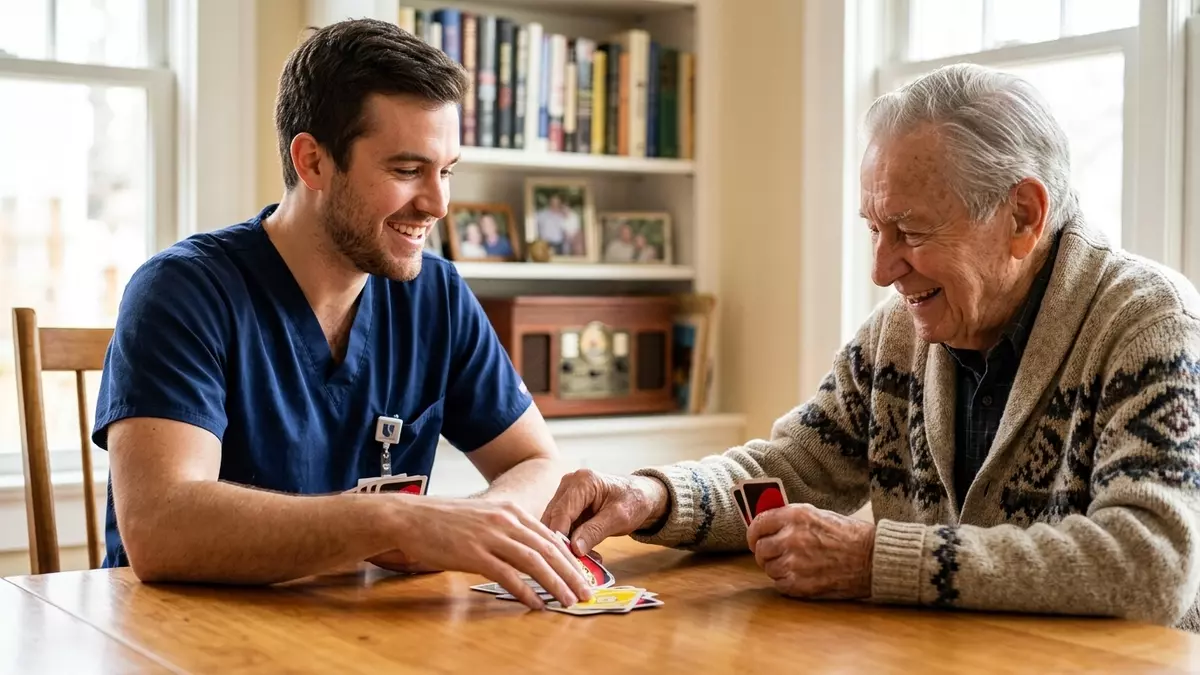
When they weren’t debating philosophy or exploring the local community, the duo spent hours sitting at the kitchen table playing competitive rounds of the card game Uno. Despite the vast cognitive and generational differences between them, Benoit proudly considered the 96-year-old retired physician to be one of his closest friends—a sentiment he describes as a true intergenerational win-win.

Managing Dementia at Eye Level: The Power of Patient Connection
Caring for an individual living with neurodegenerative decline requires a high degree of emotional intelligence and adaptability. Like many individuals navigating dementia, John would occasionally experience sudden waves of cognitive confusion, disorientation, and emotional agitation. Rather than relying on cold, authoritative clinical commands or mechanical directives, Benoit utilized his advanced nursing training to meet John at eye level.
Benoit discovered that the most effective tool for clearing these mental fog patches was personalized sensory redirection. The moment he noticed John’s anxiety rising, Benoit would ask him about his favorite historical musical eras. He would pull out his phone, open Spotify, and play familiar melodies from John’s youth.
Dementia-Driven Agitation ──> Sensory Redirection via Music ──> Neurological Calm Restored
The localized acoustic therapy worked like a charm, instantly soothing John’s nervous system and restoring a sense of calm and safety to the room. This approach represents caregiving at its most authentic: it is less about rigidly checking off a sequence of medical tasks and more about recognizing precisely when a vulnerable human being requires patience, meaningful conversation, or the simple comfort of a familiar tune.
The Demographic Shift Driving the Eldercare Crisis
Benoit’s caregiving journey unfolds against the backdrop of a massive demographic shift across the United States. The American population is aging at a historic pace, placing unprecedented pressure on both families and formal healthcare infrastructure.
According to formal data compiled by the U.S. Census Bureau, the demographic of American adults aged 65 and older reached a staggering 55.8 million individuals in 2020. This massive cohort expanded by an incredible 38.6 percent in just a single decade, completely outpacing the growth rates of younger generations.
This demographic wave is fundamentally reshaping daily family life. A joint national report published in 2025 by AARP and the National Alliance for Caregiving revealed that 63 million Americans were actively serving as unpaid family caregivers—representing roughly one in four adults across the nation. Millions of adult children find themselves squeezed between the demands of their careers, raising their own children, and managing the complex physical decline of their aging parents.
Concurrently, the professional medical supply chain is facing severe labor shortages. The U.S. Bureau of Labor Statistics projects that employment opportunities for professional home health and personal care aides will expand by 17 percent from 2024 to 2034. This growth rate is vastly faster than the average for all other occupations, translating into approximately 765,800 critical job openings each year on average. As the traditional workforce struggles to keep pace with demand, innovative models that tap into the energy and empathy of medical and nursing students represent a crucial lifeline for overwhelmed families.
A Reciprocal Education: How Clients Forge the Providers of Tomorrow
The educational benefits of these caregiving bonds are entirely reciprocal. While older adults receive reliable, empathetic support, the student caregivers harvest an invaluable clinical and human education that no textbook or lecture hall could ever replicate. Following John’s passing, his daughter sent Benoit a detailed, emotional letter expressing her family’s profound gratitude for the dignity and joy he brought into her father’s final years—a message that moved the young nursing student to tears and permanently solidified his dedication to geriatric medicine.
As Benoit continued his work through the student care registry, each subsequent client added another layer to his clinical perspective:
The Global Author
Benoit provided dedicated mobility support to an 85-year-old female author who had spent her life traveling the world. While his technical duties required him to manage her physical circulation by keeping her lower legs elevated and operating a mechanical compression device, the human reality of the shift looked entirely different. Benoit sat with her through hours of classic mid-century cinema, watching masterpiece films like Breakfast at Tiffany’s, Roman Holiday, and Lawrence of Arabia. Between scenes, the author would narrate real-life tales of her global adventures, turning a routine physical therapy session into a rich cultural exchange.
The Diplomat’s Memoirs
He also provided cognitive companionship to an 86-year-old former United States Ambassador to the Middle East who was actively trying to draft his personal memoirs. As the ambassador struggled with short-term memory blocks, Benoit would sit with him and read through the drafted pages aloud. Benoit used his clinical training to ask open-ended questions about historical global events. This structured conversational therapy actively helped the former diplomat sustain longer, more cohesive thoughts, sharpening his cognitive retention and allowing him to preserve his life’s work on paper.
“Working closely with these extraordinary individuals is the primary reason I am pursuing a career as a specialized Nurse Practitioner. The registry gave me a front-row seat to the raw realities of aging, memory preservation, human dignity, and deep gratitude.”
— Jake Benoit, Duke University Graduate Nursing Student
Conclusion: Rewriting the Eldercare Paradigm
Ultimately, Jake Benoit’s caregiving journey offers a profound lesson for the future of medicine in America. The traditional healthcare landscape often reduces elder support to an sterile exercise in symptom management and physical maintenance. Yet, true caregiving requires a holistic approach that honors the emotional, intellectual, and social architecture of the patient.
By matching the financial and educational needs of motivated medical students with the companionship needs of our elders, we can forge a supportive framework where everyone wins. When caregiving moves beyond the basic checklist and embraces card games, shared movies, deep sermon debates, and genuine friendships, it does more than just sustain life—it preserves the fundamental dignity that makes life worth living.
Frequently Asked Questions (FAQ)
What is a senior care registry, and how does it differ from a traditional home care agency?
A senior care registry operates as a specialized matching service that screens and connects independent caregivers directly with families looking for support. Unlike traditional home care agencies that employ aides directly and dictate strict care packages, a registry allows families to directly select, hire, and manage their companions, resulting in more customized matches and greater flexibility over daily routines.
Why are medical and nursing students uniquely suited for senior companionship roles?
Students pursuing degrees in nursing, medicine, or physical therapy bring a high baseline of empathy, scientific understanding, and professional discipline to the home. They are already background-checked and trained to recognize subtle physiological and cognitive shifts, such as dementia-driven agitation or circulation changes. Furthermore, they view caregiving as invaluable clinical exposure that shapes their future medical careers rather than just an entry-level job.
How can families use music to safely manage dementia-related anxiety at home?
Music taps into deep, resilient networks of the brain that often remain completely undamaged by dementia. To utilize this strategy effectively, avoid playing generic background music. Instead, discover the specific songs, artists, or religious hymns that resonated with your loved one during their formative teenage and young adult years (typically between the ages of 15 and 25). Playing these tracks during periods of transition or confusion can rapidly alleviate stress and restore emotional stability.
What are the primary benefits of intergenerational programming for older adults?
Extensive sociological research indicates that regular, structured interactions with younger generations provide older adults with immense mental and physical benefits. These connections directly combat the chronic epidemic of senior loneliness, stimulate cognitive longevity through diverse conversations, boost daily mood scores, and instill a profound sense of purpose by allowing seniors to pass down their lived wisdom and life stories to the next generation.
When should a family transition from basic companionship care to skilled nursing support?
Non-medical companionship care is ideal for assisting with daily activities, meal prep, cognitive stimulation, and basic transportation. However, a family should consult a physician to transition to skilled home health nursing if their loved one requires advanced clinical interventions. This includes managing complex, open wound dressings, administering intravenous (IV) medications, managing feeding tubes, or navigating rapid, unexplained physical and cognitive decline that requires continuous diagnostic monitoring.