
Table of Contents
- 1. Inside the NIH Data: Moving Past the 12-Year Horizon
- 2. The Longevity Leaderboard: Which Activities Surpassed the Rest?
- 2.1. 1. Racquet Sports (The Ultimate Longevity Catalyst)
- 2.2. 2. Running and Jogging
- 2.3. 3. Walking, Cycling, and Swimming
- 3. The Safe Integration Blueprint: Exercising with Intention After 70
- 3.1. Honor Your Body’s Internal Signals
- 4. Conclusion
- 5. Frequently Asked Questions
- 5.1. Can I really improve my life expectancy if I don’t start exercising until my 70s?
- 5.2. Is pickleball considered a racquet sport according to longevity studies?
- 5.3. How do I know if my exercise intensity is “moderate” enough to count?
- 5.4. What should I do if severe knee arthritis prevents me from walking or running?
- 5.5. How does exercising in a group setting enhance the health benefits for seniors?
The Ultimate 12-Year Study Reveals the Best Exercises for Seniors Over 70
When we think about physical fitness in our 70s and 80s, the conversation often centers on basic mobility—being able to get out of a chair comfortably or stroll through a grocery store. While maintaining independence is incredibly important, groundbreaking research funded by the National Institutes of Health (NIH) reveals that physical movement does something far more profound: it directly extends your lifespan.
Following a massive cohort of more than 250,000 older adults for over a decade, scientists discovered that engaging in specific recreational activities dramatically slashes the risk of mortality, even if an individual doesn’t begin exercising until much later in life.
By analyzing how different sports and movement patterns impact longevity, this landmark study provides an inspiring, data-driven roadmap for anyone over 70 looking to optimize their health, build physical resilience, and add high-quality years to their life.

The Ultimate 12-Year Study Reveals the Best Exercises for Seniors Over 70
Inside the NIH Data: Moving Past the 12-Year Horizon
To understand the weight of these findings, it helps to examine the scale of the research. Scientists analyzed comprehensive lifestyle data from a large-scale national health survey, tracking participants whose average age reached 70 by the conclusion of the 12-year monitoring window.
The investigative team meticulously categorized the participants’ physical habits into seven distinct types of recreational movement: walking, running/jogging, swimming, cycling, racquet sports, golf, and general aerobic exercise.

The baseline conclusion of the study was definitive: older adults who met standard public health guidelines—accumulating roughly 150 minutes of moderate-intensity exercise per week—experienced a 13% lower risk of all-cause mortality compared to their inactive peers.
Sedentary Lifestyle          ===================> Baseline Mortality Risk
150 Min/Week Moderate Cardio ===> 13% Reduction in All-Cause Mortality Risk
While every single form of physical movement tracked by the researchers provided a clear survival advantage, the data revealed a fascinating hierarchy of benefits, with certain activities outperforming the rest.
The Longevity Leaderboard: Which Activities Surpassed the Rest?
1. Racquet Sports (The Ultimate Longevity Catalyst)
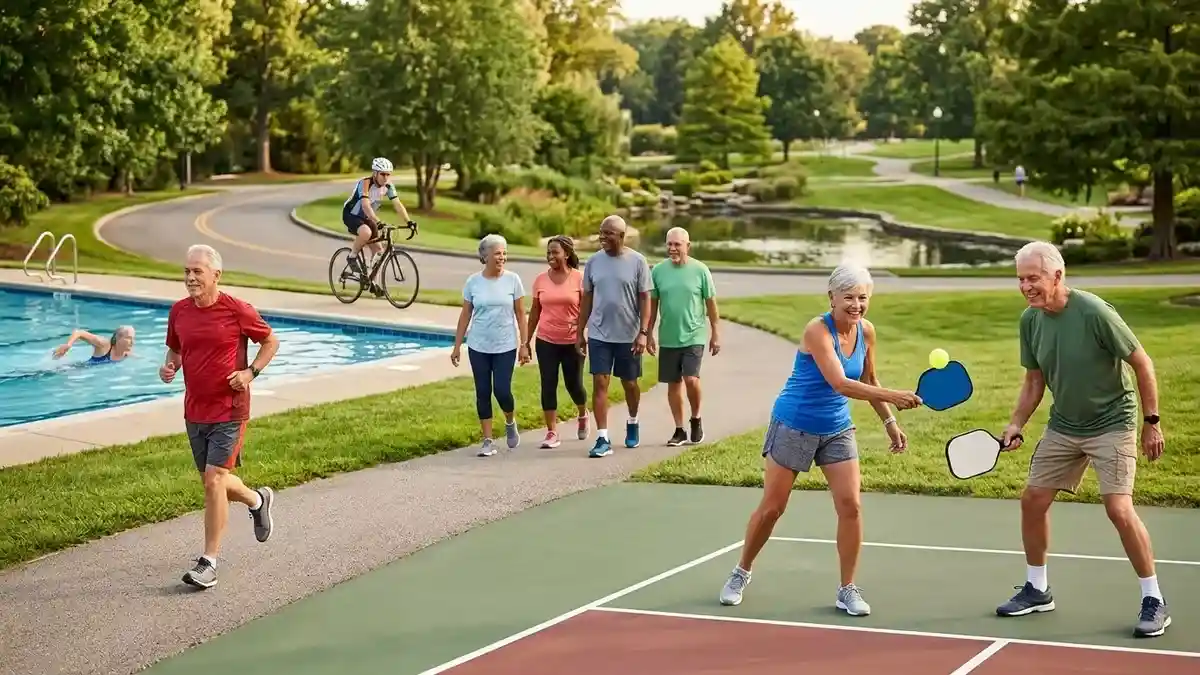
Topping the entire NIH list, racquet sports like tennis, badminton, and pickleball delivered the most significant reductions in mortality risk. Sports medicine experts attribute this superior performance to the complex, multi-dimensional demands these sports place on the human body.

Playing a racquet sport isn’t just cardio; it requires rapid hand-eye coordination, constant mental processing of ball trajectories, and swift lateral footwork. This unique combination sharpens neurological reflexes, builds core stability, and trains dynamic balance, which directly prevents accidental falls—one of the leading causes of injury in seniors.
2. Running and Jogging
Ranking exceptionally high on the leaderboard, running combines intense cardiorespiratory conditioning with muscular strength. The impact forces of jogging, when managed safely, help stimulate bone density retention, while the continuous oxygen demand dramatically expands the efficiency of the heart and lungs.
3. Walking, Cycling, and Swimming
For individuals seeking lower-impact alternatives, the research brought highly encouraging news. Continuous walking, swimming laps, and cycling were all strongly associated with significantly longer lifespans. Swimming, in particular, offers a full-body resistance workout that is completely weightless, making it an ideal choice for adults navigating joint stiffness or arthritis.
The Expert’s Takeaway: Dr. Eleanor Watts, the lead NIH researcher who spearheaded the 12-year investigation, emphasized that your routine doesn’t need to be flawless to be lifesaving. As she directly noted: “The most important thing an inactive older adult can do to improve their health is find an activity that they enjoy and can stick with.”
The Safe Integration Blueprint: Exercising with Intention After 70
If you are eager to leverage this research and inject more movement into your weekly routine, approaching the gym or the court with a clear, structured safety plan will ensure you stay injury-free and consistent.
| Fitness Step | Actionable Execution | Longevity Benefit |
| 1. Clinical Clearance | Discuss your exercise plans, joint health, and current medications with your physician. | Ensures your heart and joints are fully ready for a new activity tier. |
| 2. Progressive Pacing | Begin with gentle 10-to-15 minute blocks of walking or swimming, slowly scaling up. | Allows tendons and muscles to safely adapt without acute strain. |
| 3. Balanced Variation | Alternate your aerobic days (walking, cycling) with gentle resistance training. | Preserves critical skeletal muscle mass and supports metabolic function. |
| 4. Balance Specialization | Integrate dedicated balance practices like Tai Chi, yoga, or single-leg stands. | Actively reinforces your center of gravity to minimize fall risks. |
Honor Your Body’s Internal Signals
Conditioning your anatomy in your 70s is about building resilience, not pushing through extreme physical distress. If you ever experience sudden dizziness, sharp localized pain, chest tightness, or overwhelming exhaustion during a workout, stop immediately and rest. Health optimization works best when you listen to your body’s feedback loop, adjusting your pace to stay safe and moving smoothly.
Conclusion
The profound revelation of this 12-year NIH study is that your body never loses its capacity to heal, adapt, and grow stronger. Longevity is not a fixed genetic script; it is an active, daily choice shaped by how much you move. Whether you choose the lively camaraderie of a local pickleball court, the peaceful rhythm of a morning swim, or a brisk walk around your neighborhood with a friend, every minute of movement accumulates to protect your health. Find an activity that brings you joy, embrace the power of consistency, and look forward to a vibrant, independent future.
Frequently Asked Questions
Can I really improve my life expectancy if I don’t start exercising until my 70s?
Absolutely. The NIH data explicitly highlighted that previously sedentary individuals who introduced regular movement into their routines later in life still experienced a powerful, statistically significant drop in mortality risk. Your cells, blood vessels, and heart respond positively to conditioning at any age.
Is pickleball considered a racquet sport according to longevity studies?
Yes. While historic studies focused heavily on traditional tennis, contemporary sports medicine expands this category to include pickleball and badminton. They share identical physical characteristics: rapid hand-eye coordination, varied lateral movement, and a highly engaging social framework.
How do I know if my exercise intensity is “moderate” enough to count?
The easiest, most practical way to measure intensity without a heart-rate monitor is the “Talk Test.” During moderate-intensity exercise, you should be breathing heavily enough that you can comfortably maintain a conversation with a walking partner, but you shouldn’t have enough spare breath to easily sing a song.
What should I do if severe knee arthritis prevents me from walking or running?
If high-impact or weight-bearing movements cause joint pain, pivot entirely to zero-impact aquatic exercises like swimming, water aerobics, or utilizing a seated rowing machine. These modalities challenge your cardiovascular system and strengthen your muscles while completely removing the stress of gravity from your knee joints.
How does exercising in a group setting enhance the health benefits for seniors?
Exercising with friends or joining a local sports league introduces a powerful social element that significantly drives up long-term motivation and consistency. Furthermore, regular human connection lowers systemic stress hormones, boosts cognitive processing speeds, and actively combats the physical health risks associated with chronic loneliness.