
Table of Contents
- 1. The Physics of Power: Strength Plus Speed
- 1.1. Activating the Fast-Twitch Muscle Fibers
- 2. The Longevity Dividend: Why Seniors and Rehab Centers Are Adapting
- 2.1. Slaying the Functional Aging Curve
- 3. Technological Innovations Making Power Training Safe for Everyone
- 3.1. The Rise of Pneumatic Resistance
- 4. How to Safely Build Power into Your Existing Routine
- 4.1. 1. Begin with Bodyweight Explosiveness
- 4.2. 2. Practice Controlled Bursts
- 4.3. 3. Keep Your Sessions Minimal
- 5. The Bottom Line
- 6. Frequently Asked Questions
The Shift to Speed: Why Power Training Has Overridden Traditional Weightlifting
If your social media feeds or local gym conversations are suddenly dominated by discussions around “explosive power,” “velocity-based training,” and “fast-twitch activation,” you are witnessing a major shift in the fitness landscape. Power training has completely captured the attention of the health and wellness world, emerging as a definitive breakout trend.
For decades, standard resistance training focused almost exclusively on hypertrophy (building muscle size) and maximum strength (how much raw weight you can lift slow and steady). Today, however, everyone from competitive athletes and regular gym-goers to physical therapists and senior wellness coordinators is shifting focus toward velocity.
The widespread obsession with power training stems from a growing body of sports science research proving that speed-based strength is the ultimate key to real-world functional mobility, longevity, and metabolic health.
The Shift to Speed Why Power Training Has Overridden Traditional Weightlifting

The Physics of Power: Strength Plus Speed
To understand why this methodology is transforming modern workouts, it helps to look at the basic physics formula that governs human movement:
In traditional weightlifting, the primary goal is maximizing force—loading a barbell heavily and lifting it, which often results in a slow, grinding movement. Power training, on the other hand, introduces the vital element of time. It requires you to apply that force as quickly and explosively as possible. In short, power training is strength multiplied by speed.
   [ TRADITIONAL LIFTING ] ──► Heavy Resistance + Slow, Controlled Cadence ──► Focus: Muscle Mass & Max Force
   [ POWER TRAINING ]      ──► Moderate Resistance + Explosive, Rapid Cadence ──► Focus: Speed, Reflexes & Real-World Agility
Activating the Fast-Twitch Muscle Fibers
The human body contains two primary types of skeletal muscle fibers: slow-twitch (Type I) and fast-twitch (Type II). Slow-twitch fibers support endurance activities like long-distance running or walking. Fast-twitch fibers are responsible for generating rapid, explosive bursts of energy—such as sprinting, jumping, or throwing.

As we age, or when we rely solely on slow, isolated gym machinery, our fast-twitch muscle fibers are the very first to atrophy. Power training intentionally targets and recruits these high-threshold Type II fibers. By forcing your nervous system to fire rapidly, power-based workouts remodel your neuromuscular pathways, training your brain to communicate with your muscles at peak speeds.
The Longevity Dividend: Why Seniors and Rehab Centers Are Adapting
While explosive training might sound like a discipline reserved strictly for elite sprinters or basketball players, its most profound benefits are actually found in the fields of healthy aging and physical rehabilitation.
In everyday life, losing your balance or tripping over a curb is not a test of how much weight you can bench press; it is a race against time. To prevent a dangerous fall, your brain must recognize the slip and force your leg to step out and stabilize your entire body mass in a fraction of a second. If you lack explosive power, your reaction time slows, dramatically increasing the risk of injury.

Slaying the Functional Aging Curve
A landmark clinical study focusing on senior wellness compared conventional, slow resistance routines against high-velocity power training. The results were staggering: older adults who integrated power training improved their functional, real-world abilities nearly four times more than those who stuck to traditional strength routines.
By keeping the neuromuscular system responsive, power training preserves vital everyday capabilities, such as:
Standing up effortlessly from a deep, low chair.
Quickly navigating uneven terrain or slick stairs.
Reacting instantly to catch objects or prevent stumbles.
Maintaining sharp coordination and spatial awareness.
Technological Innovations Making Power Training Safe for Everyone
Historically, power training was associated with high-impact Olympic lifting or intense plyometrics, which carried a perceived risk of joint strain for beginners. However, recent engineering breakthroughs have democratized the practice, making it incredibly safe and accessible for individuals of all ages and fitness levels.
The Rise of Pneumatic Resistance
The absolute biggest game-changer in modern power training is the widespread adoption of pneumatic (air pressure) resistance machines, pioneered by specialized fitness companies like HUR. Traditional weight stacks rely heavily on gravity and inertia. When you try to push a heavy metal weight stack quickly, a massive amount of momentum builds at the top of the movement, placing jarring stress on your tendons, ligaments, and joints.
   [ TRADITIONAL WEIGHTS ] ──► Pushing Fast Creates Inertia ──► Shock & Jarring Stress at the Top of the Joint Range
   [ PNEUMATIC CYLINDERS ] ──► Air Pressure Eliminates Inertia ──► Smooth, Constant Resistance Throughout the Entire High-Speed Move
Pneumatic machines completely eliminate iron weight plates, replacing them with smooth, compressed air cylinders. Because air pressure lacks weight-based inertia, a user can push, pull, or press at maximum explosive velocity without experiencing any shocking feedback or jarring deceleration forces. This allows a 75-year-old grandmother or a patient recovering from an ACL tear to train at high speeds with zero joint inflammation.
How to Safely Build Power into Your Existing Routine
If you want to capitalize on this functional fitness trend, you do not need to overhaul your entire lifestyle. The golden rule of power training is prioritizing velocity and movement quality over absolute weight and exhaustion.
1. Begin with Bodyweight Explosiveness
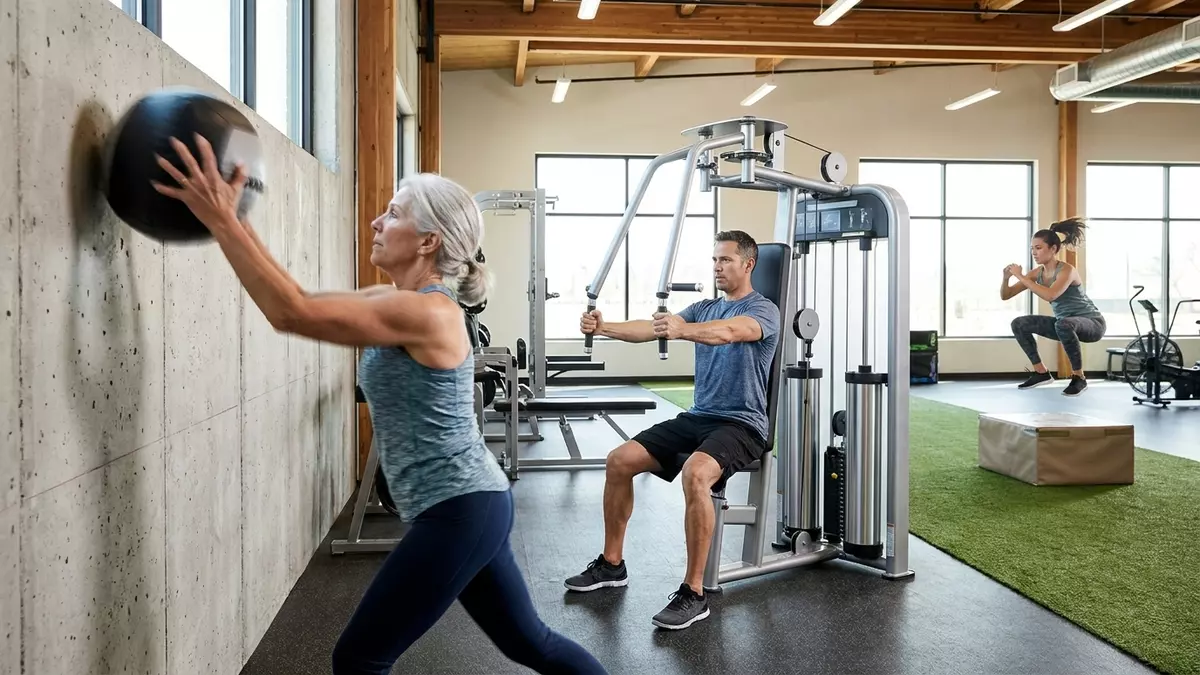
Before adding heavy external loads, master the art of accelerating your own body weight. Incorporate simple movements like low-impact jump squats, explosive step-ups onto a low box, or dynamic medicine ball chest passes against a solid wall. Focus entirely on the speed of the contraction.
2. Practice Controlled Bursts
Power training is not meant to be performed until failure or extreme cardiovascular exhaustion. To train your nervous system effectively, execute short, high-effort sets lasting between 5 to 10 seconds, followed by complete rest. This ensures your muscles have replenished their immediate energy stores, allowing your next set to be just as fast and explosive as the first.
3. Keep Your Sessions Minimal
Because power training places a high demand on your brain and central nervous system, extended workouts can cause neural fatigue. A highly focused, 20-minute power circuit performed two to three times a week is more than enough to trigger significant muscular adaptations, rev up your metabolism, and improve your daily reaction times.
| Workout Phase | Exercise Example | Rep / Time Target | Primary Focus |
| The Baseline | Bodyweight Jump Squats | 3 sets of 6 to 8 reps | Maximizing upward vertical speed upon ascent |
| Upper Body Power | Medicine Ball Wall Throws | 4 sets of 8 explosive reps | Full-body coordination and rapid core rotation |
| Machine Integration | Pneumatic Chest Press | 3 sets of 5 high-speed pushes | Joint-safe, maximum force generation via air pressure |
| Recovery Phase | Passive Rest | 90 to 120 seconds between sets | Allowing the nervous system to fully reset for top speed |
The Bottom Line
The sudden collective obsession with power training represents a smarter, more mature approach to physical longevity. It is a recognition that true physical freedom is built on how effectively, confidently, and rapidly your body can interact with the physical world around it. By choosing to train for speed alongside traditional strength, you give your body the exact tools it needs to remain resilient, agile, and independent at any age.
Frequently Asked Questions
Can power training help me build muscle size, or is it just for speed?
Yes, it is highly effective for muscle growth. Because power training specifically recruits high-threshold fast-twitch muscle fibers—which possess the greatest capacity for physical growth and hypertrophy—hyper-velocity movements can stimulate clean muscle gains, especially when paired with a protein-rich diet.
Is power training safe if I am currently managing osteoarthritis?
It can be incredibly safe, provided you utilize the right tools. Standard plyometric jumping can be jarring on arthritic joints, but using pneumatic air-resistance machines allows you to move at high speeds with smooth, uniform resistance that completely protects your joint cartilage from impact shock.
How long should I rest between sets during an explosive power workout?
Unlike traditional bodybuilding where rest periods are kept short to induce a muscle burn, power training requires longer recovery times. Aim for 90 seconds to 2 full minutes of rest between explosive sets. Your goal is to let your nervous system fully recover so you can maintain maximum velocity on the subsequent set.
Can I combine power training and traditional weightlifting in the exact same workout?
Absolutely. In sports science, this is often called “complex training.” The optimal strategy is to perform your explosive power movements (like jump squats or medicine ball throws) first thing in your workout when your nervous system is completely fresh, followed by your slower, heavier compound lifts.
How quickly will I notice improvements in my balance and reaction times?
Because power training heavily forces neurological adaptation rather than just physical muscle building, many individuals report noticing improvements in their agility, foot speed, coordination, and overall balance within just two to three weeks of consistent training.