
Table of Contents
- 1. The Powerhouse Principle: Why the Core and Hips Matter
- 2. The Breath Connection: Aligning Mind and Muscle
- 2.1. Lateral Thoracic Breathing
- 3. 4 Essential Mat Moves for Beginners
- 3.1. 1. The Pilates Hundred (Modified)
- 3.2. 2. Single-Leg Circles
- 3.3. 3. The Criss-Cross (Slow-Motion)
- 3.4. 4. Pelvic Bridges with Hip Openers
- 4. Long-Term Physical and Mental Rewards
- 5. The Bottom Line
- 6. Frequently Asked Questions
Sculpt Your Core and Unlock Your Hips: A 30-Minute Equipment-Free Pilates Guide for Beginners
When many people think about building a strong core or toning their lower bodies, they envision heavy weight racks, complex gym machinery, or high-impact jump routines. However, high-intensity workouts are not the only path to functional strength. If you are looking to build deep abdominal stability, relieve tight hip flexors, and improve your daily mobility, you can leave the dumbbells behind.
Pilates offers a low-impact, highly precise alternative that uses nothing more than your own body weight and a standard exercise mat. Originating as a specialized rehabilitation and conditioning method, Pilates focuses on strengthening the body’s “powerhouse”—the collective band of muscles spanning your deep abdominals, lower back, pelvic floor, and hips.
A targeted, 30-minute mat routine provides an accessible yet powerful way for beginners to activate neglected muscle groups, realign their posture, and build structural strength from the inside out.
Sculpt Your Core and Unlock Your Hips A 30-Minute Equipment-Free Pilates Guide for Beginners
The Powerhouse Principle: Why the Core and Hips Matter
In the foundational philosophy of Pilates, the core is much more than just the visible surface muscles of the stomach. It is the central engine of all human movement. Pilates targets the deep-layer stabilizing muscles, specifically the transversus abdominis (which acts like a natural corset around your spine) and the musculature surrounding the pelvis and hips.
                        [ THE PILATES POWERHOUSE ]
   ┌───────────────────────┼──────────────────────────┼──────────────────────┐
   ▼                       ▼                          ▼                      ▼
Transversus Abdominis   Pelvic Floor Muscles   Gluteals & Deep Hips   Multifidus (Back)
(Deep Spine Support)    (Internal Stability)   (Pelvic Alignment)     (Vertebral Control)
   │                       │                          │                      │
   └───────────────────────┴─────────────┬────────────┴──────────────────────┘
                                         ▼
                           [ Postural Alignment & Balance ]
As we spend more time sitting at desks, driving, or looking at screens, our hip flexors naturally shorten and tighten, pulling the pelvis out of alignment and placing undue stress on the lower back. By combining targeted abdominal contractions with controlled hip opening movements, Pilates systematically counteracts this modern structural strain.
Strengthening these stabilizing zones doesn’t just improve your balance; it directly enhances your performance in other physical disciplines—such as running, weightlifting, or swimming—while actively protecting your joints from everyday wear and tear.
The Breath Connection: Aligning Mind and Muscle
One of the most defining characteristics of a Pilates practice is its strict emphasis on intentional breathing patterns. In this beginner-friendly sequence—inspired by specialized mat routines like those led by popular online instructor Raminara—every single movement is explicitly paired with an inhalation or an exhalation.
Lateral Thoracic Breathing
Unlike the deep belly breathing used in restorative yoga, Pilates utilizes “lateral thoracic breathing.” This technique requires you to expand your ribcage out to the sides and back while keeping your deep abdominal muscles pulled inward and upward.
This specific breathing pattern allows you to maintain a safe, continuous core contraction throughout an entire exercise without restriction. The deep intake of oxygen fuels your muscles, while the forceful exhalation acts as a natural mechanism to deepen the contraction of your abdominal wall, keeping your spine completely stabilized.
4 Essential Mat Moves for Beginners
To experience the benefits of this 30-minute routine, find a quiet space, lay down a supportive yoga mat, and focus entirely on execution, control, and precision. Perform each movement slowly, resisting the urge to use momentum.
1. The Pilates Hundred (Modified)
Target: Deep core endurance and circulation.
How to Do It: Lie flat on your back with your legs in a “tabletop” position (knees bent at a 90-degree angle directly over your hips). Inhale to prepare, and as you exhale, lift your head, neck, and shoulders off the mat, reaching your arms long by your sides. Begin pumping your arms up and down vigorously in a small, controlled 6-inch range.
The Cadence: Inhale through your nose for five counts, and exhale completely through your mouth for five counts. Repeat this cycle ten times to reach 100 pumps.
2. Single-Leg Circles
Target: Hip joint mobility and lower abdominal control.
How to Do It: Lie on your back with your arms pressed firmly into the mat beside you. Extend your right leg straight up toward the ceiling, keeping your left leg bent with the foot flat on the floor to stabilize your pelvis. Keeping your hips perfectly still, slowly trace a basketball-sized circle on the ceiling with your right foot.
The Cadence: Inhale as you start the circle, and exhale as you complete it. Perform 5 to 8 circles clockwise, then reverse the direction before switching legs.
3. The Criss-Cross (Slow-Motion)
Target: Obliques (side abs) and rotational stability.
How to Do It: From a tabletop leg position, place your hands lightly behind your head, elbows flaring wide. Lift your chest off the mat. Extend your right leg out to a 45-degree angle while rotating your torso to bring your right shoulder toward your left knee. Hold for one second, then fluidly pass through the center to switch sides.
The Cadence: Exhale deeply as you twist, and inhale as you return to the center. Target 10 controlled repetitions per side.
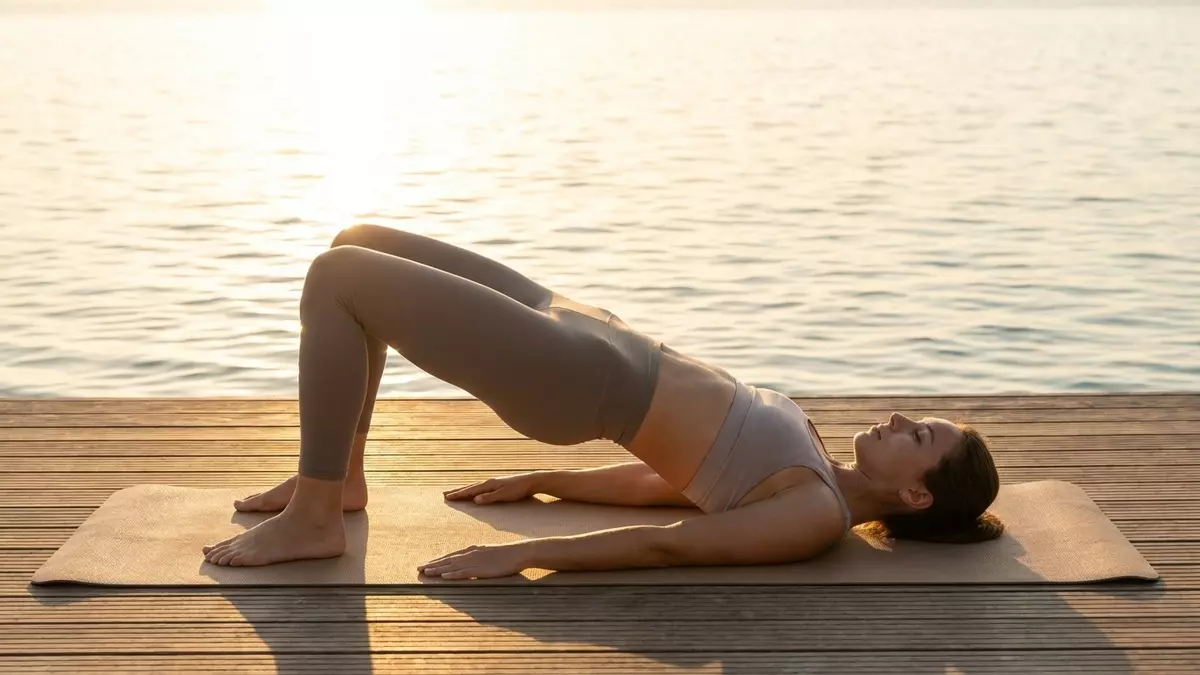
4. Pelvic Bridges with Hip Openers
Target: Glutes, hamstrings, and outer hip strength.
How to Do It: Lie on your back with your knees bent, feet hip-width apart and flat on the floor. Exhale as you press through your heels, lifting your hips toward the ceiling until your body forms a straight line from shoulders to knees. At the top of the bridge, slowly press your knees outward an inch, return them to hip-width, and lower your spine back to the mat.
The Cadence: Inhale to lower, and exhale to lift and open. Complete 12 to 15 smooth repetitions.
| Exercise | Primary Muscle Target | Key Focus Area | Modification for Ease |
| The Hundred | Rectus Abdominis & Transversus | Continuous arm pumps; neutral neck | Keep your head and shoulders flat on the mat |
| Single-Leg Circles | Hip Flexors, Deep Glutes, Lower Abs | Keeping the pelvis completely motionless | Bend the active leg slightly at the knee |
| The Criss-Cross | Internal & External Obliques | Leading with the chest, not the elbows | Touch the toes of the resting leg to the floor |
| Pelvic Bridges | Gluteus Maximus, Hamstrings | Squeezing glutes; opening knees at top | Reduce the height of your hip lift |
Long-Term Physical and Mental Rewards
Because Pilates prioritizes the quality of a movement over sheer quantity, it serves as an excellent recovery tool. It provides a highly effective training stimulus without placing jarring, high-impact stress on your knees, ankles, or lower back joints.
Clinical observations and fitness studies consistently demonstrate that a regular mat practice yields transformative long-term benefits for practitioners of all experience levels:
Postural Re-education: By strengthening the neglected muscles between your shoulder blades and throughout your lower abdomen, Pilates naturally pulls your body into an upright, confident stance, effectively neutralizing chronic neck and shoulder tension.
Enhanced Mind-Body Awareness: The intense focus required to coordinate complex breathing patterns with precise physical movements acts as a form of active meditation. This mindful concentration helps calm the nervous system, lower cortisol levels, and reduce daily stress.
Improved Body Composition: While it is not a high-calorie-burning aerobic sport, Pilates builds lean, dense muscle fibers. Increasing your lean muscle mass naturally optimizes your baseline resting metabolism, helping your body burn energy more efficiently throughout the day.
The Bottom Line
Transforming your core strength, releasing chronic hip tightness, and reclaiming your physical mobility does not require a gym membership full of heavy weights or intense, exhausting workouts. By dedicating just 30 minutes a day to a focused, mat-based Pilates routine, you can awaken your deep stabilizing muscles, correct structural imbalances, and cultivate a deeper, more mindful connection to how your body moves every day.
Frequently Asked Questions
How many times a week should a beginner practice Pilates to see results?
To build consistent muscle memory and see noticeable improvements in posture and core stability, aim to practice this 30-minute routine three times a week. Most beginners notice a distinct difference in their core control and flexibility within four to six weeks.
Will Pilates help reduce chronic lower back pain?
Yes, absolutely. Most lower back pain is caused by weak abdominal muscles and tight hip flexors forcing the spine to overcompensate. By strengthening the deep transversus abdominis and opening the hips, Pilates creates a supportive, natural muscular structure around the lower spine.
What should I do if my neck gets tired or sore during core exercises?
Neck strain usually happens when your abdominals are tired, causing you to pull on your head with your neck muscles. If your neck begins to ache during moves like The Hundred, simply lower your head and shoulders completely flat onto the mat and continue focusing on the leg and arm movements.
Is it okay to do a Pilates routine on a completely empty stomach?
Because Pilates involves deep, intense abdominal contractions and rotational twisting, performing the exercises immediately after a large meal can cause digestive discomfort. It is best to practice on an empty stomach first thing in the morning, or wait at least one to two hours after eating a light snack.
Can I practice Pilates if I am completely inflexible and can’t touch my toes?
Inflexibility is an excellent reason to start Pilates, not a reason to avoid it. Every exercise can be heavily modified with bent knees or reduced ranges of motion. Over time, the continuous focus on controlled lengthening will naturally open up your hamstrings, hips, and lower back.