
Table of Contents
- 1. The Results: Budget Champions Outperform the Industry Leader
- 2. Beyond the Taste Test: Expanding the Scored Leaderboard
- 3. Navigating the Label: The Nutritional Reality of Canned Beans
- 4. Tactical Grocery Shopping: Three Rules for Smarter Choices
- 4.1. 1. Execute the Triple Label Check
- 4.2. 2. Calculate the True Price Per Ounce
- 4.3. 3. Consider Reduced-Sugar Alternates
- 5. Re-Engineering the Plate: Elevating Simple Food Into Smart Nutrition
- 6. Summary: The Hidden Value of Everyday Staples
- 7. Frequently Asked Questions
- 7.1. 1. Why are store-brand baked beans so much cheaper than big brand names?
- 7.2. 2. Are the navy beans used in baked beans a good source of iron?
- 7.3. 3. Can I freeze leftover baked beans if I don’t finish the entire can?
- 7.4. 4. Do baked beans contain gluten?
- 7.5. 5. How can I reduce the sodium in a regular can of baked beans if I already bought it?
Supermarket Baked Beans Beat Heinz in a Blind Taste Test
For generations, reaching for a bright turquoise can of Heinz baked beans has been a automatic habit for millions of shoppers. It is one of those ultimate comfort foods, a reliable pantry staple that people drop into their grocery carts almost without thinking. The familiar brand name has long carried an assumption of superior quality, texture, and taste that budget alternatives surely couldn’t match.
However, a rigorous blind taste test conducted by the UK consumer champion group Which? has completely upended the status quo on the supermarket shelf. In a head-to-head trial evaluating 12 major brands, two budget supermarket own-label cans did the unthinkable: they officially outperformed Heinz in taste, while costing a staggering fraction of the price.
When you strip away the power of iconic logos and multi-million-pound advertising campaigns, what remains is the pure sensory experience on the spoon—and your wallet stands to benefit immensely.

Supermarket Baked Beans Beat Heinz in a Blind Taste Test
The Results: Budget Champions Outperform the Industry Leader
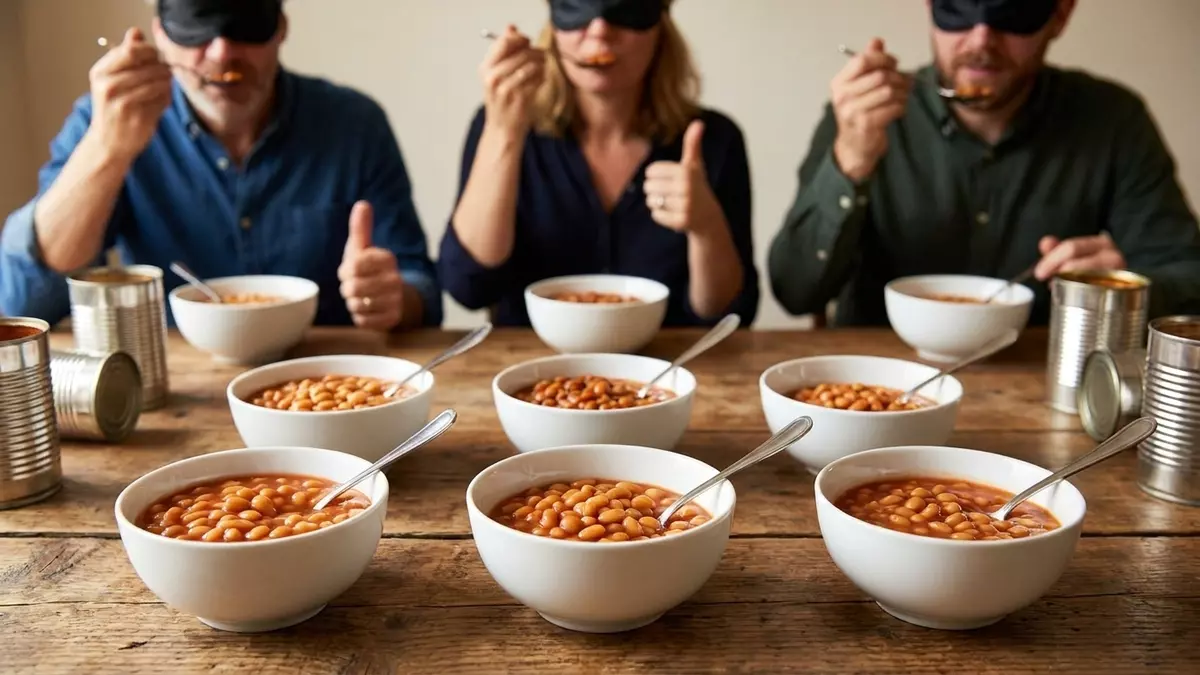
The comprehensive study utilized a dedicated panel of 60 regular baked bean consumers. To ensure total objectivity, the testing was conducted completely blind. Panelists sat in private, isolated booths and evaluated each unmarked sample purely on its individual flavor profile, visual appearance, aroma, and mouthfeel texture.
The final scores revealed a fascinating shift in the baked bean hierarchy:
Aldi Bramwells Baked Beans: Tying for the absolute top spot with a score of 77 percent, Aldi’s offering was highly praised by the panel as an “excellent all-rounder,” delivering a perfect balance of savory-sweet tomato sauce and tender beans.
Lidl Newgate Baked Beans: Sharing first place with a matching score of 77 percent, Lidl’s beans won over the tasters with their vibrant appearance, rich depth of flavor, and pleasing, firm texture.
Heinz Baked Beans: The long-standing industry benchmark landed just behind the budget newcomers, securing third place with a score of 76 percent.

[Aldi Bramwells] ──► 77% Taste Score ──► Costs 40p
[Lidl Newgate]   ──► 77% Taste Score ──► Costs 40p
[Heinz Standard] ──► 76% Taste Score ──► Costs £1.40
While a single percentage point difference in taste indicates that the top three brands are incredibly close in flavor quality, the financial reality tells a completely different story. At the time of the study, both the Aldi and Lidl cans retailed for a mere 40p (approximately 54 cents) for a 14.5-ounce can. Meanwhile, a standard 14.6-ounce can of Heinz stood at £1.40 (around $1.88).
For a household feeding a family, choosing the store brand provides a massive cost savings of £1.00 per single can, for a product that blind tasters actually preferred.
Beyond the Taste Test: Expanding the Scored Leaderboard
The Which? study looked far beyond just the top three spots, revealing a wide spectrum of quality and price across the entire supermarket aisle. Famous brand names didn’t automatically guarantee success, and some major supermarket lines fell surprisingly short.
| Baked Bean Brand | Blind Taste Score | Retail Price Per Can | Main Taster Feedback |
| Aldi Bramwells | 77% (Joint 1st) | 40p | Excellent, balanced all-rounder flavor |
| Lidl Newgate | 77% (Joint 1st) | 40p | Great appearance, rich savory depth |
| Heinz Standard | 76% (3rd Place) | £1.40 | Good texture, but carries a £1.00 premium |
| Branston | 74% | 90p | Solid sweet profile, firm bean texture |
| Asda Own-Brand | 73% | 42p | Respectable score for a low budget option |
| Sainsbury’s Hub | 73% | 43p | Good sauce consistency, value-friendly |
| Co-op Fairtrade | 57% (Last Place) | 75p | Severely criticized for a weak, watery flavor |
While secondary brands like Branston, Asda, and精Sainsbury’s held their ground with respectable seventies-range scores, Co-op plummeted to the bottom of the board. Tasters heavily penalized its recipe, noting that the sauce felt thin and the overall flavor was far too weak to stand up to a piece of hot toast.
Navigating the Label: The Nutritional Reality of Canned Beans
Baked beans are an incredible, low-cost nutritional shortcut for individuals trying to incorporate clean protein and dietary fiber into a fast-paced routine. They are virtually fat-free, completely cholesterol-free, and naturally vegan-friendly.
A standard half-can serving delivers a robust punch of nutrition:
Protein: Nearly 10 grams of plant-based muscle-building power.
Fiber: Packed with complex carbohydrates that support stable gut health.
Energy: A modest, clean 170 calories per serving.
However, the rich tomato sauce that blankets the navy beans can quietly hide significant amounts of added sugars and processed sodium. When you compare the top-rated value option against the premium brand, the nutritional fine print reveals a highly comparable blueprint, with a few subtle trade-offs.
[Aldi Bramwells (per 3.5 oz)] ──► Sugar: 4.9g │ Sodium: 212mg
[Heinz Standard (per 3.5 oz)] ──► Sugar: 4.3g │ Sodium: 236mg
While Aldi features a microscopic fraction more sugar per serving, Heinz actually contains a higher concentration of blood-pressure-boosting sodium.
According to public health guidelines provided by the U.S. Food and Drug Administration (FDA), consumers should actively use the Nutrition Facts label to maximize dietary fiber while actively restricting daily sodium and added sugars.
Based on a standard 2,000-calorie daily baseline, the official FDA reference daily values dictate a ceiling of 2,300 milligrams for sodium, a maximum of 50 grams for added sugars, and a target of at least 28 grams of dietary fiber. Reading the fine print on the back of the can ensures you don’t accidentally exceed your wellness goals during a quick lunch.
Tactical Grocery Shopping: Three Rules for Smarter Choices
True consumer value is never determined by a flashy logo on the front of a label; it requires analyzing the metrics on the back. The next time you walk down the canned goods aisle, utilize these three practical strategies to keep your health and your household budget in perfect alignment.
1. Execute the Triple Label Check
Never assume two cans are identical just because they feature similar imagery. Before placing a can into your basket, do a quick relative comparison of three key fields: Sodium content, added sugars, and the specific serving size definitions. A brand that appears lower in sugar on first glance may simply be using an artificially small serving size matrix to mask its numbers.
2. Calculate the True Price Per Ounce
Supermarkets often manipulate container sizes slightly to alter consumer perception. A brand may reduce a can from 14.6 ounces down to 14.1 ounces while keeping the price stable, creating a hidden price hike. Always ignore the large font on the tag and look at the microscopic “Price per 100g” or “Price per Ounce” print located at the very bottom of the store shelf label to find the true mathematical bargain.
3. Consider Reduced-Sugar Alternates
If baked beans are a major weekly staple in your household—especially for young children or elderly relatives watching their cardiovascular health—it may be time to transition to reduced-sodium and lower-sugar variations. Major brands like Heinz and Branston, alongside several high-quality supermarket own-labels, offer specialized low-salt lines that slash sugar and sodium counts by up to 30% while retaining the rich, comforting flavor of the original recipes.
Re-Engineering the Plate: Elevating Simple Food Into Smart Nutrition
The official Dietary Guidelines for Americans heavily place the clinical focus on prioritizing whole, minimally processed foods while strictly cutting back on refined carbohydrates and added sugars. While a convenient can of baked beans is technically processed, it can absolutely find a home within a health-focused lifestyle, provided you treat it as a component of a larger, balanced meal rather than forcing it to handle all the nutritional lifting alone.
Instead of simply dumping a can of beans over white bread, look for easy ways to structurally upgrade your plate:
The Protein Boost: Spoon your warm baked beans alongside two poached eggs, grilled mushrooms, and a handful of lightly sautéed spinach for a nourishing, vitamin-rich breakfast.
The Complex Carb Upgrade: Ladle a half-can serving over a fluffy, skin-on baked sweet potato, accompanied by a vibrant, crisp side salad tossed in olive oil to add healthy fats.
The High-Fiber Comfort: If you love classic beans on toast, swap out highly processed white bread for a dense, whole-grain sprouted sourdough slice to increase your fiber intake and prevent blood sugar spikes.
Summary: The Hidden Value of Everyday Staples
The striking results of the Which? blind taste test serve as an excellent reminder that healthy, budget-conscious everyday living doesn’t require expensive wellness supplements, exotic superfoods, or trendy specialty ingredients. True grocery store intelligence is about identifying the humble, affordable pantry items that allow you to cook satisfying meals at home more frequently without burning out your budget.
If you are fiercely loyal to the classic flavor profile of Heinz, there is absolutely no reason you must stop buying it. But if you have been grabbing that expensive blue can simply out of pure repetition, switching to a 40p store brand is an effortless, flavor-approved swap that will instantly keep more money in your pocket.
Frequently Asked Questions
1. Why are store-brand baked beans so much cheaper than big brand names?
Supermarket own-brand products are significantly less expensive because the retailer does not have to absorb massive global marketing, television advertising, and complex graphic design packaging costs. Furthermore, supermarkets produce these items in massive volumes directly with contract manufacturers, passing the structural operational savings directly down to the consumer.
2. Are the navy beans used in baked beans a good source of iron?
Yes. Navy beans (also known as haricot beans) are naturally rich in non-heme iron, which is essential for healthy red blood cell production and oxygen transport throughout the body. To maximize your body’s ability to absorb this plant-based iron, pair your beans with a source of Vitamin C, such as diced fresh tomatoes or fresh bell peppers.
3. Can I freeze leftover baked beans if I don’t finish the entire can?
Absolutely. Never store an open metal can directly in the refrigerator, as the exposed tin can oxidize and alter the flavor of the food. Instead, transfer any leftover baked beans into a clean, airtight plastic or glass container. They will keep perfectly in the refrigerator for up to 4 days, or you can freeze them for up to 3 months. Thaw completely in the fridge before reheating thoroughly on the stovetop.
4. Do baked beans contain gluten?
Standard navy beans and tomato sauce are naturally gluten-free. However, some commercial brands may incorporate wheat flour or gluten-containing starches as a thickening agent for their savory gravy. Always carefully inspect the allergen bold print on the back of the specific store brand to verify it is certified gluten-free before serving anyone with celiac disease or gluten sensitivity.
5. How can I reduce the sodium in a regular can of baked beans if I already bought it?
If you have standard high-sodium cans in your pantry, you can easily reduce the salt concentration at home. Simply empty the can into a fine-mesh strainer, drain away a portion of the commercial tomato sauce, and gently stir the remaining beans with a splash of low-sodium tomato passata, fresh garlic powder, and a dash of black pepper before heating.