
Table of Contents
- 1. The Nutritional Powerhouse of Chicken Manure
- 1.1. Outperforming Traditional Livestock Waste
- 1.2. The Danger of “Hot” Manure
- 2. How to Compost Chicken Poop Safely
- 3. 3 Practical Ways to Apply Aged Manure
- 3.1. 1. Spring or Fall Bed Amending
- 3.2. 2. Side-Dressing Established Crops
- 3.3. 3. Brewing a Nutrient-Rich Liquid “Tea”
- 4. Essential Health and Safety Boundaries
- 5. Which Plants Benefit the Most?
- 6. Conclusion
- 7. Frequently Asked Questions (FAQ)
- 7.1. Can I put raw chicken poop directly on my lawn in the winter?
- 7.2. Why does my chicken manure compost pile smell like ammonia?
- 7.3. Is store-bought bagged chicken manure safe to use immediately?
- 7.4. Can I use chicken manure on my indoor potted houseplants?
- 7.5. How can I make my compost pile heat up faster?
The Ultimate Guide to Using Chicken Manure as a Garden Fertilizer
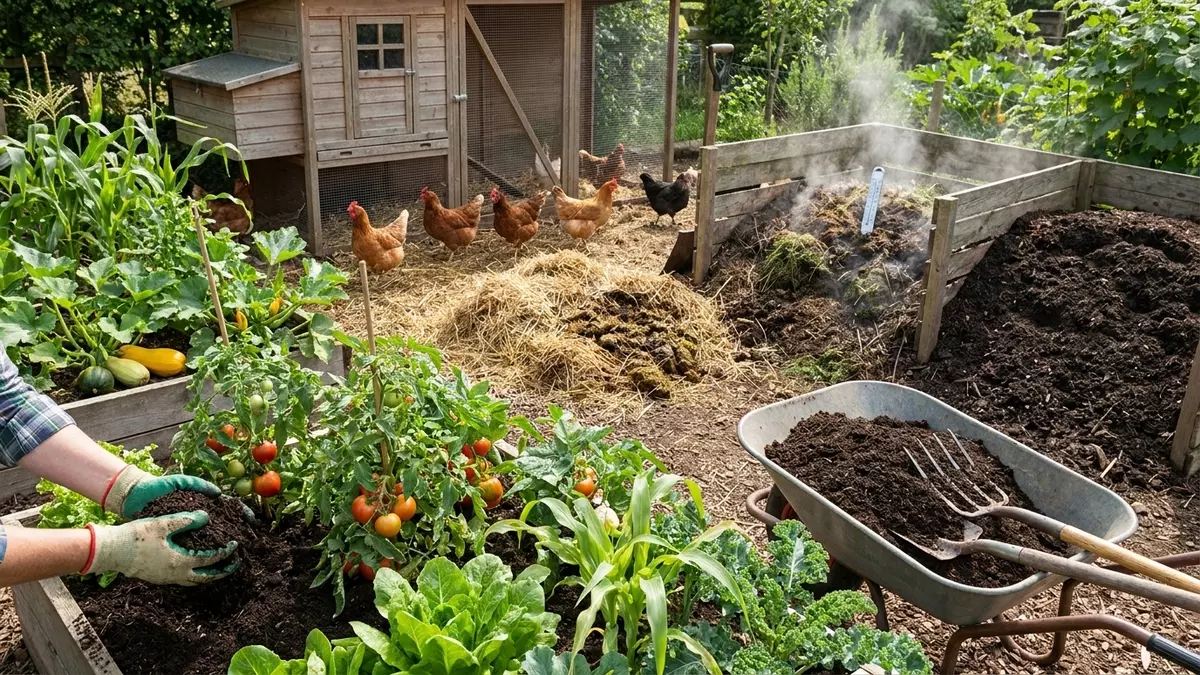
If you keep a flock of backyard chickens, you are already enjoying a daily supply of fresh, nutritious eggs. However, your hens are also leaving behind another incredibly valuable resource every single day: their droppings.
While it might not be the most glamorous part of backyard farming, chicken manure is an absolute goldmine for organic gardeners. Pound for pound, it is one of the most nutrient-dense animal wastes available. Yet, applying it incorrectly can quickly destroy your crops. Learning the science behind processing this “hot” fertilizer ensures your soil thrives while keeping your plants completely safe.
The Ultimate Guide to Using Chicken Manure as a Garden Fertilizer

The Nutritional Powerhouse of Chicken Manure
In the gardening world, fertilizers are measured by their N-P-K ratio, which stands for Nitrogen (for leafy growth), Phosphorus (for root and fruit development), and Potassium (for overall plant disease resistance).
Outperforming Traditional Livestock Waste
Chicken manure naturally boasts significantly higher concentrations of these primary nutrients than horse, cow, or sheep manure. It functions as a potent, slow-release multivitamin that feeds beneficial soil microbes, enhances soil structure, and improves moisture retention.
The Danger of “Hot” Manure
Because chicken droppings are exceptionally high in nitrogen and raw ammonia, they are classified as a “hot” manure. If you shovel raw chicken poop directly out of the coop and scatter it around your plants, the intense chemical concentration will physically burn the roots and leaves, causing the plants to wither and die.
Furthermore, fresh waste carries a high risk of transmitting dangerous pathogens like Salmonella or E. coli, making it a significant biohazard—especially if you are growing edible root vegetables or leafy greens.
How to Compost Chicken Poop Safely
To turn this hazardous waste into a rich, earthy soil amendment, you must subject it to a proper hot composting process. This breaks down the harsh ammonia into stable nutrients and generates enough heat to pasteurize harmful bacteria and weed seeds.

Chicken poop is your nitrogen-rich “green” material. Fortunately, it usually comes pre-mixed with carbon-rich “brown” bedding from the coop floor, such as straw, wood shavings, or dry leaves. Aim for a ratio that heavily favors the bedding—roughly 2 parts bedding to 1 part pure manure—to prevent the pile from becoming a slimy, anaerobic mess.
Build your compost pile in a designated bin or open heap. Spray it with water until it reaches the consistency of a wrung-out sponge. Use a pitchfork to turn the pile once a week; this injects vital oxygen into the core, keeping the beneficial aerobic bacteria working rapidly.
Use a long-stemmed compost thermometer to monitor the internal temperature. A healthy pile needs to sustain heat between $130^\circ\text{F}$ and $150^\circ\text{F}$ ($54^\circ\text{C}$ to $66^\circ\text{C}$) for at least three consecutive days to successfully kill off pathogens and destructive weed seeds.
After the intense heating phase subsides, let the pile rest and cure. The breakdown process is complete when the material turns dark, crumbly, and loses all traces of ammonia odor, smelling instead like fresh, rich forest soil.
3 Practical Ways to Apply Aged Manure
Once your chicken manure compost is thoroughly cured and aged, it is ready to be deployed across your landscape.
1. Spring or Fall Bed Amending
A few weeks before planting your spring crops, or during your autumn bed cleanup, spread a thin layer—roughly 1/4 to 1/2 inch deep—of the finished compost over your garden beds. Gently cultivate it into the top few inches of the soil. This allows the nutrients to integrate seamlessly into the soil matrix before delicate root systems expand.
2. Side-Dressing Established Crops
For fruit trees, berry shrubs, or perennial flower beds, use the aged compost as a highly nutritious top-dressing. Scatter it around the drip line of the plant, taking care to keep the compost a few inches away from the direct base of the trunk or main stem to avoid moisture buildup and collar rot.
3. Brewing a Nutrient-Rich Liquid “Tea”
If your crops need a fast-acting liquid pick-me-up during the peak of the growing season, you can brew a simple liquid fertilizer tea.
[ Finished Compost ] + [ 5 Gallons Water ] --> Steep 2-3 Days --> Strain & Pour at Soil Base
Place two shovels of completely cured chicken compost into a 5-gallon bucket of water. Stir the mixture thoroughly and let it steep in a shaded area for two to three days. Strain the liquid through burlap or cheesecloth, and pour the resulting golden-brown tea directly onto the soil at the base of your heavy-feeding plants.
Important Safety Note: Never spray manure tea directly onto the leaves or harvestable portions of edible plants.
Essential Health and Safety Boundaries
Because you are working with biological animal waste, practicing basic hygiene is essential to safeguard both your family and your garden ecosystem.
Wear Protective Gear: Always wear heavy-duty gardening gloves and close-toed shoes when handling fresh coop bedding or turning the compost pile. Wash your hands thoroughly with soap and water immediately afterward.
Observe the 90/120 Day Rule: If you must use semi-aged manure, follow strict food safety guidelines. Do not apply it to crops whose edible portions touch the soil (like lettuce, carrots, or radishes) within 120 days of harvest, or to upright crops (like corn or trellised tomatoes) within 90 days of harvest.
Flock Medication Hazards: If you have recently treated your chickens with synthetic dewormers, coccidiostats, or heavy antibiotics, do not add their waste to your garden compost pile. These chemical residues can linger in the manure, disrupting the delicate balance of your soil’s beneficial microbiome.
Which Plants Benefit the Most?
Due to its high nitrogen content, composted chicken manure acts like rocket fuel for plants that consume massive amounts of nutrients to produce foliage and fruit.
| High-Responders (Love It) | Moderate Responders (Use Aged 12+ Months) | Low-Responders (Avoid Manure) |
| Tomatoes & Peppers | Carrots | Potatoes (Promotes Scab Disease) |
| Sweet Corn | Beets | Blueberries (Prefers Acidic Ammonium) |
| Squash & Pumpkins | Turnips | Mediterranean Herbs (Lavender, Rosemary) |
| Brassicas (Kale, Broccoli) | Radishes | Legumes (Fixes Own Nitrogen) |
Conclusion
Transforming your flock’s daily droppings into high-grade organic fertilizer is the ultimate way to close the sustainability loop in your backyard. While raw chicken poop poses a definite hazard to tender plants, a patient, well-managed composting routine transforms it into a safe, incredibly effective soil amendment. By balancing your greens and browns and respecting the curing process, you can unlock a abundant, cost-free harvest year after year.
Frequently Asked Questions (FAQ)
Can I put raw chicken poop directly on my lawn in the winter?
It is not recommended. While the grass may dormant, the raw nitrogen and high salt content in fresh chicken droppings can still burn the lawn blades and wash away into local waterways during heavy winter rains, causing environmental pollution rather than helping your soil.
Why does my chicken manure compost pile smell like ammonia?
An intense ammonia smell indicates that your pile has too much nitrogen (manure) and not enough carbon (bedding), or that it is too wet. To correct this, turn the pile thoroughly and mix in several flakes of dry straw, wood shavings, or shredded cardboard to restore the structural balance.
Is store-bought bagged chicken manure safe to use immediately?
Yes. Commercially bagged chicken manure has already been professionally composted, dehydrated, and pasteurized to kill off all pathogens and weed seeds. You can mix it directly into your garden beds straight out of the bag according to the label instructions.
Can I use chicken manure on my indoor potted houseplants?
It is best to avoid using homemade chicken manure compost indoors. Even when fully cured, it retains a distinct earthy aroma that can intensify in an enclosed room, and it can introduce outdoor soil microbes or fungus gnats into your home environment. Stick to clean, indoor-formulated fertilizers instead.
How can I make my compost pile heat up faster?
If your pile is stalling, check the moisture level first—it should feel like a damp sponge. If the moisture is correct, the pile likely needs more nitrogen. Add fresh chicken droppings or green grass clippings, and ensure the heap is at least 3 feet cubed ($3\times3\times3$ feet) to effectively retain its internal thermal core.