
Table of Contents
- 1. 1. Plug the Leaks: Insulate and Seal First
- 1.1. Locate the Primary Escape Routes
- 1.2. The Bubble Wrap Strategy
- 2. 2. Leverage the Power of Thermal Mass
- 2.1. The Water Barrel Wall
- 3. 3. Harness Heat from Hot Composting
- 4. 4. Construct Traditional Manure Heating Beds
- 5. 5. Dress Your Crops in Layers with Row Covers
- 6. 6. Build a Solar-Absorbing Thermal Wall
- 7. 7. Nest Cold Frames Indoors
- 8. 8. Deflect Frost with Hay Bale Windbreaks
- 9. 9. Calibrate for Smart Solar Gain
- 10. 10. Pivot to Ultra-Cold-Hardy Crops
- 10.1. Elite Winter Varieties
- 11. Frequently Asked Questions
- 11.1. Will water barrels inside a greenhouse freeze during a severe winter?
- 11.2. Can the smell of a hot compost pile inside a greenhouse damage my plants?
- 11.3. How much warmer can I expect my greenhouse to be using only passive methods?
- 11.4. Is fresh horse manure safe to use directly under my winter vegetable beds?
- 11.5. Do I need to water my greenhouse plants as often during the winter?
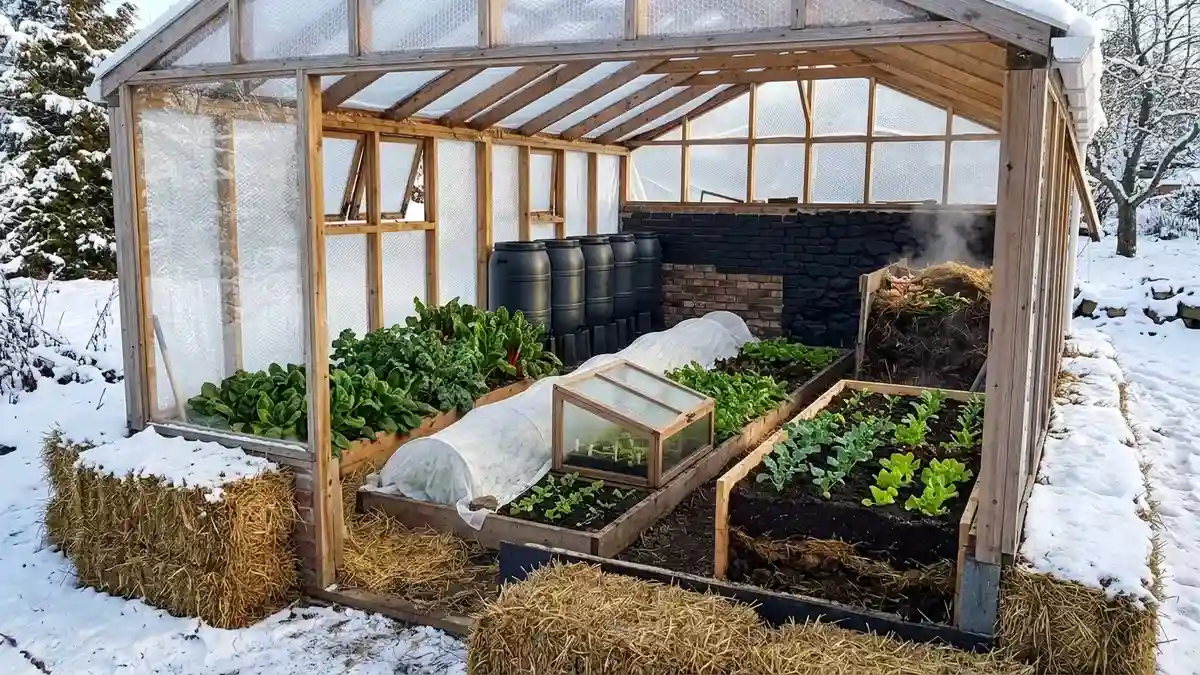
10 Ways to Heat Your Greenhouse in Winter Without Electricity
If you have ever walked into your greenhouse on a biting winter morning and felt that sharp, freezing chill, you know exactly how stressful it is to protect your vulnerable plants from frost damage. For many backyard growers and homesteaders, running expensive power lines out to the garden or racking up massive electric bills is simply not an option.
Fortunately, you do not need to flip a single mechanical switch to maintain a cozy, thriving environment for your winter crops. By understanding basic physics and deploying a few traditional agricultural techniques, you can successfully shield your plants from freezing temperatures entirely off the grid.
10 Ways to Heat Your Greenhouse in Winter Without Electricity
1. Plug the Leaks: Insulate and Seal First
Before you attempt to generate any new heat, you must prioritize trapping the energy you already have. Winter wind will aggressively steal warmth through the smallest gaps.
Locate the Primary Escape Routes
Most heat escapes dynamically through the roof and sides of a structural frame, especially around door frames, vents, and panel seams. Dedicate a weekend afternoon to patching any tears in your greenhouse film and applying heavy-duty weatherstripping to doors and windows.
The Bubble Wrap Strategy
To maximize your thermal insulation without completely blocking vital winter sunlight, line the interior walls with large-bubble clear plastic wrap. The trapped pockets of air inside the bubble wrap act as a highly effective barrier, significantly slowing down the transfer of cold air into the structure.
2. Leverage the Power of Thermal Mass
This ancient, incredibly elegant method relies on a simple rule of physics: objects with high density absorb thermal energy during sunny daylight hours and radiate that warmth back out slowly into the environment as ambient temperatures drop at night.
The Water Barrel Wall
The absolute best and most cost-effective medium for creating thermal mass is water. Line the northern interior wall of your greenhouse with dark-colored, 55-gallon steel or plastic drums filled entirely with water.
During a bright winter day, these dark barrels absorb solar radiation. When the sun sets and the interior temperature plummets, the water slowly releases its stored heat, keeping the immediate air several degrees warmer than the outdoor environment. If space is tight, stacking dense concrete blocks, bricks, or large river stones along your planting beds will achieve a similar stabilizing effect.
3. Harness Heat from Hot Composting
A properly balanced, active compost pile does far more than just break down organic kitchen waste—it operates as a highly efficient, natural biological radiator.

As beneficial microbes actively decompose nitrogen-rich and carbon-rich organic matter, the chemical process creates substantial friction and heat, frequently driving the core temperature of a healthy pile past $130^\circ\text{F}$ ($54^\circ\text{C}$). If your greenhouse layout permits, construct a high-volume compost pile consisting of straw, autumn leaves, food scraps, and fresh animal manure directly along an interior wall or inside a centralized trench. The rising, radiant heat will steadily warm the ambient air for weeks at a time.
4. Construct Traditional Manure Heating Beds
Long before the invention of electric propagation mats, historical market gardeners successfully raised early spring vegetables by building specialized “hotbeds” fueled by raw animal waste.
--------------------------------------------------
[ 8 - 10 Inches of Premium Growing Soil ]        <- Plant Roots Stay Warm
--------------------------------------------------
[ 6 - 12 Inches of Fresh Manure + Straw Mix ]    <- Decomposition Generates Heat
--------------------------------------------------
You can easily replicate this technique by digging out your greenhouse growing beds and layering 6 to 12 inches of fresh horse or cow manure mixed thoroughly with straw along the bottom. Top this organic layer with 8 to 10 inches of high-quality planting soil. As the underlying manure breaks down over the winter months, the natural decomposition process gently warms the soil from the bottom up, stimulating root activity and providing a perfect, cozy environment for starting seeds.
5. Dress Your Crops in Layers with Row Covers
Think of winter plant protection exactly like dressing yourself for a snowstorm: layering multiple covers creates a series of highly insulated, protective microclimates.
Even inside the safety of a solid greenhouse structure, draping a lightweight fabric frost blanket or a floating row cover directly over your active garden beds provides an immense safety buffer. Secure the edges of the fabric loosely with stones or soil to allow for healthy internal airflow while trapping rising ground warmth right at the soil level. This simple addition easily prevents tender greens from succumbing to sudden overnight freezes.
6. Build a Solar-Absorbing Thermal Wall
If you are fortunate enough to have a greenhouse configuration with a solid, southern-facing interior wall, you can transform that structure into a high-performance solar collector.
Paint the entire surface of the wall a matte, solid black, or line it completely with dark, unglazed bricks and heavy volcanic stones. Because dark colors absorb the full spectrum of visible light and solar wavelengths, this wall will pull in maximum energy throughout the afternoon. At night, it functions as a giant thermal battery, minimizing the drastic, rapid temperature drops that cause severe stress to delicate plant tissues.
7. Nest Cold Frames Indoors
Placing a clear-topped cold frame or a mini-hoop house directly inside your larger greenhouse structure functions exactly like a set of nesting dolls, doubling your defense against the elements.
During peak daylight hours, solar rays pass through both layers of glazing, rapidly warming the concentrated space inside the cold frame. When night falls, the dual layers of glass or plastic film trap the ambient heat inside the smaller enclosure. This specialized setup is exceptionally effective for protecting fragile winter seedlings or keeping heat-loving varieties alive well past their normal growing season.
8. Deflect Frost with Hay Bale Windbreaks
Brutal winter winds are a greenhouse’s absolute worst enemy, stripping away interior heat far faster than stagnant ambient cold.
To neutralize this issue, stack tight bales of hay or straw completely around the exterior perimeter base of your greenhouse structure. This creates a dense, natural windbreak that physically blocks freezing currents from whistling underneath your baseboards. On the inside, you can supplement this defense by hanging heavy, insulated curtains to seal off unused sections of the greenhouse at night, effectively reducing the total volume of air space you need to keep warm.
9. Calibrate for Smart Solar Gain
Sustaining an off-grid greenhouse requires active, daily management of natural solar cycles. You must learn to optimize your ventilation timing based on the position of the sun.
On clear winter days, make it a habit to crack open your vent flaps during peak daylight hours to let fresh sunlight flood the space and drive out lingering dampness. Crucially, ensure you close every vent tightly about an hour before sunset to lock that daytime warmth inside the structure before the evening freeze arrives. Additionally, keep the interior completely clutter-free so that incoming sunlight directly strikes your soil beds and thermal water masses without being blocked by empty trays or tools.
10. Pivot to Ultra-Cold-Hardy Crops
Sometimes, the most successful strategy is to work completely with nature rather than fighting against it. If your primary goal is to sustain a continuous supply of homegrown food through the winter, skip the demanding, heat-loving varieties and focus entirely on cold-tolerant vegetables.
Elite Winter Varieties
Foliage crops like spinach, kale, arugula, chard, mizuna, mache, parsley, and various heirloom winter lettuces are biologically engineered to endure freezing conditions.
* Spinach      * Kale     * Arugula
* Chard        * Mizuna   * Hardy Lettuces
These rugged greens can easily survive and even thrive in steady temperatures ranging between $30^\circ\text{F}$ and $40^\circ\text{F}$ ($-1^\circ\text{C}$ to $4^\circ\text{C}$) with minimal human intervention. By aligning your winter crop selections with the natural reality of the seasons, you take the pressure off your heating systems and ensure a reliable, stress-free harvest all winter long.
Frequently Asked Questions
Will water barrels inside a greenhouse freeze during a severe winter?
Because of the massive volume of water contained within a 55-gallon drum, it requires an extended period of sustained, deep-freezing temperatures to solidify. Even if a thin layer of ice forms on the very top of the water overnight, the barrel will continue to function as a thermal mass, releasing heat into the surrounding air as it undergoes the physical phase change.
Can the smell of a hot compost pile inside a greenhouse damage my plants?
A properly balanced compost pile—maintaining the correct ratio of carbon “browns” (straw, leaves) to nitrogen “greens” (vegetable scraps, manure)—should emit a mild, earthy scent rather than a foul odor. However, ensure your pile stays well-oxygenated by turning it regularly. Excess ammonia gases from an unbalanced, anaerobic pile can potentially stress sensitive plants in a tightly sealed enclosure.
How much warmer can I expect my greenhouse to be using only passive methods?
By combining multiple passive techniques—such as sealing air leaks with bubble wrap, adding a wall of dark water barrels, and covering crop beds with frost blankets—you can easily maintain an interior temperature that sits $10^\circ\text{F}$ to $15^\circ\text{F}$ (approx. $5^\circ\text{C}$ to $8^\circ\text{C}$) warmer than the outdoor ambient air, which is often the critical difference between plant survival and total frost loss.
Is fresh horse manure safe to use directly under my winter vegetable beds?
Yes, provided you follow the traditional hotbed layering structure correctly. The fresh horse manure must be buried under at least 8 to 10 inches of clean, high-quality topsoil. This soil layer acts as a physical barrier that prevents the raw manure from making direct contact with the tender roots of your plants, while still allowing the rising decomposition heat to warm the root zone safely.
Do I need to water my greenhouse plants as often during the winter?
No, you should significantly reduce your watering frequency during the winter months. Because daylight hours are much shorter and evaporation rates drop drastically in cool weather, plants consume far less water. Overwatering in a cool greenhouse leads to stagnant, soggy soil, which creates the perfect environment for destructive root rot and fungal diseases to take hold. Always check that the top inch of soil is completely dry before adding moisture.