
Table of Contents
- 1. The Biological Reality of Gray Hair
- 2. Deconstructing the Kitchen Dye Myth: What Cinnamon Really Does
- 2.1. The Honey and Cinnamon Hydrogen Peroxide Reaction
- 2.2. The Illusion of Coverage
- 3. Evaluating the Ingredient Matrix: A Luxury Conditioning Treatment
- 4. Step-by-Step Guide to Applying the Deep-Conditioning Mask
- 4.1. Step 1: Blend the Base
- 4.2. Step 2: Conduct a Patch Test (Mandatory)
- 4.3. Step 3: Application and Saturation
- 4.4. Step 4: Trapping the Heat
- 4.5. Step 5: The Clarifying Rinse
- 5. Real-World Expectations and Smarter Alternatives
- 6. Frequently Asked Questions (FAQ)
- 6.1. 1. Will leaving cinnamon on my hair overnight give me a faster color change?
- 6.2. 2. Can I use this cinnamon mask if I have chemically bleached or highlighted hair?
- 6.3. 3. Does this kitchen recipe help stop gray hair from growing?
- 6.4. 4. Is store-bought ground cinnamon safe to use on my hair?
- 6.5. 5. Why do some internet tutorials show dramatic before-and-after photos using this method?
The Biological Reality of Gray Hair
To understand why kitchen-based remedies often fall short, it helps to look at the cellular biology of aging hair. Hair gets its natural color from melanin, a pigment produced by specialized cells called melanocytes located at the base of each hair follicle.
As we age, these melanocytes gradually wear out and stop producing pigment. When a hair follicle loses its pigment-producing cells, the new hair strand grows out completely translucent, appearing white or gray against darker strands.
Traditional permanent hair dyes work by using alkaline chemicals (like ammonia) to physically force open the hair’s outer cuticle layer, allowing synthetic pigments to bond deeply with the inner cortex of the hair strand.
Because gray hair has a uniquely thick, coarse, and tightly closed cuticle structure, it is notoriously resistant to taking on color—even when subjected to strong, salon-grade chemical treatments.

The Biological Reality of Gray Hair
Deconstructing the Kitchen Dye Myth: What Cinnamon Really Does
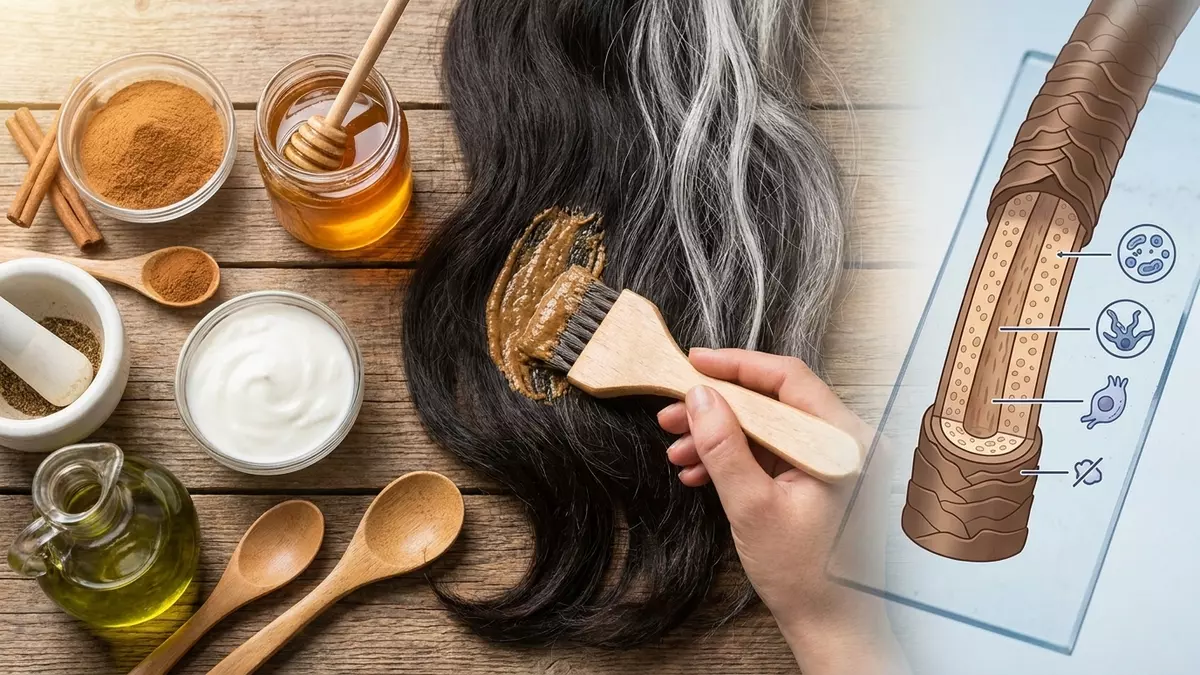
The internet is full of claims that a simple mixture of cinnamon, honey, yogurt, and olive oil can act as an all-natural substitute for hair dye. While this mixture makes an exceptional, deeply hydrating hair mask, it cannot physically dye or cover gray hair.
To understand why this recipe is continually shared, we have to look closely at the chemical behavior of its individual ingredients:

[Honey + Cinnamon] ──> Trace Hydrogen Peroxide Release ──> Mildly Strips Existing Melanin ──> Lightens Dark Hair
                                                                                                  │
                                                                                           (Does NOT Color Gray)
The Honey and Cinnamon Hydrogen Peroxide Reaction
When raw honey is mixed with water or moisture-rich ingredients like yogurt, a natural enzyme in the honey called glucose oxidase slowly breaks down, releasing microscopic, trace amounts of hydrogen peroxide.
Cinnamon contains trace iron compounds that act as a catalyst, slightly accelerating this reaction. Hydrogen peroxide is a bleaching agent; when left on the hair for several hours, it gently strips away a tiny fraction of the natural melanin inside your darker hairs.
The Illusion of Coverage
This chemical reaction explains the true outcome of the treatment:

On Dark Strands: It creates subtle, warm, copper or golden undertones by lifting away your natural dark pigment.
On Gray Strands: Because gray hair already contains zero melanin, the trace hydrogen peroxide has nothing to strip away. Cinnamon does not possess the structural pigment molecules required to bind to a coarse, pigment-free gray hair cuticle.
At best, this mask creates a visual illusion. By slightly lightening your surrounding dark hair and adding warm highlights, the harsh contrast between your dark hair and your silver roots becomes less noticeable. The gray hair isn’t covered—the rest of your hair is simply shifted to blend in with it.
Evaluating the Ingredient Matrix: A Luxury Conditioning Treatment
While you should completely abandon the expectation of hiding your grays with this recipe, you do not need to throw the ingredients away. When viewed strictly as a nourishing, texturizing hair mask, this combination delivers exceptional biological benefits for your scalp and hair health.
| Ingredient | Role in Hair Health & Scalp Care |
| Cinnamon Powder | Contains natural compounds that cause mild vasodilation (widening of blood vessels) on the scalp, temporarily boosting blood flow to feed hair follicles. |
| Raw Honey | A powerful natural humectant, meaning it actively attracts and locks environmental moisture into dry, brittle hair shafts. |
| Olive Oil | Rich in squalene and oleic acid, this heavy emollient coats the outer cuticle, smoothing down rough edges and sealing in moisture. |
| Plain Yogurt | Packed with lactic acid and milk proteins, it gently exfoliates dry flakes from the scalp while softening coarse hair textures. |
Step-by-Step Guide to Applying the Deep-Conditioning Mask
If you want to revitalize dry hair, soften coarse silver strands, and add warm highlights to your non-gray hair, here is how to safely prepare and apply this traditional kitchen treatment.
Step 1: Blend the Base
In a non-metallic bowl, thoroughly mix 3 tablespoons of cinnamon powder, 2 tablespoons of raw honey, 3 tablespoons of plain yogurt (or a silicone-free conditioner), and 1 tablespoon of extra-virgin olive oil. Stir vigorously until the mixture forms a smooth, completely uniform paste with no remaining dry cinnamon clumps.
Step 2: Conduct a Patch Test (Mandatory)
Before applying this mixture to your head, you must perform a skin patch test. Cinnamon is a potent spice containing cinnamaldehyde, a compound that is a known topical allergen and skin irritant. Apply a small dab of the paste to the inside of your elbow or the back of your neck and wait 30 minutes. If you experience any burning, severe redness, or itching, wash it off immediately and do not apply it to your scalp.
Step 3: Application and Saturation
Dampen your hair slightly with warm water to open the cuticles. Using your fingers or a hair coloring brush, section your hair and apply the mask evenly from the roots to the tips. Gently massage your scalp to distribute the oils and yogurt evenly across every strand.
Step 4: Trapping the Heat
Gather your hair and cover it completely with a plastic shower cap or a clear wrap. This step is critical: the plastic traps the natural heat radiating from your scalp and prevents the honey from drying out, keeping the glucose oxidase enzyme active. Let the mask sit for 3 to 4 hours.
Step 5: The Clarifying Rinse
Rinse your hair thoroughly with plenty of warm water to break down the honey and wash away the coarse cinnamon grains. Follow up with a gentle, sulfate-free shampoo to remove any heavy oil residues from your roots, then apply a light conditioner to seal the cuticles and lock in the shine.
Real-World Expectations and Smarter Alternatives
If your primary goal is the total management or concealment of gray hair, it is important to align your expectations with science. Relying on food items will inevitably lead to frustration. Instead, consider these proven, low-chemical alternatives:
Pure Henna and Indigo: If you want a 100% plant-based approach that genuinely colors gray hair, look to pure, body-art-quality Henna (which deposits a permanent reddish-orange ground pigment) paired with Indigo (which introduces a deep blue-black tone). When combined correctly, these plant powders can permanently dye gray hair shades of auburn, brown, or rich black without utilizing synthetic chemicals.
Demi-Permanent Glosses: If you want to avoid the harsh damage of permanent ammonia-based dyes, look for salon-grade demi-permanent glosses. These products do not lift your natural hair color; they simply deposit a sheer veil of tone over your grays, helping them look like natural, intentional highlights while keeping hair damage to an absolute minimum.
Frequently Asked Questions (FAQ)
1. Will leaving cinnamon on my hair overnight give me a faster color change?
No, and doing so is highly discouraged. Because cinnamon is an active, warming spice, leaving it in direct contact with your scalp for an extended overnight period drastically increases your risk of developing contact dermatitis, chemical burns, or severe scalp inflammation. Limit the application time to a maximum of 4 hours, and wash it away immediately if you feel a painful burning sensation.
2. Can I use this cinnamon mask if I have chemically bleached or highlighted hair?
You should exercise extreme caution. Chemically bleached hair is highly porous and structurally compromised. If you apply a heavy cinnamon and honey mixture to blonde or lightened hair, the trace peroxide reaction can interact unpredictably with your tone, often resulting in brassy, uneven orange or muddy copper discoloration that is difficult to correct.
3. Does this kitchen recipe help stop gray hair from growing?
No. Graying is a genetically predetermined, chronological process occurring deep within the hair follicle matrix under the skin. Applying external food items, vitamins, or oils to the surface of the hair shaft cannot reactivate dead or dying melanocyte cells or alter your body’s internal biological clock.
4. Is store-bought ground cinnamon safe to use on my hair?
If you choose to use this mixture as a conditioning mask, try to source organic Ceylon cinnamon (often called “true cinnamon”) rather than standard Cassia cinnamon. Cassia cinnamon contains significantly higher levels of coumarin, a natural plant compound that is far more likely to trigger allergic skin reactions and severe irritation upon direct contact with the scalp.
5. Why do some internet tutorials show dramatic before-and-after photos using this method?
Many online videos and articles utilize deceptive lighting, editing filters, or apply the mask to individuals who already possess natural, warm red or light brown hair tones that easily catch golden reflections under bright sunlight. In cases of true, coarse white or silver gray hair, no authentic, unedited structural color change occurs from this treatment.