
Table of Contents
- 1. Rebuilding the Armor: How New Discoveries Aim to Reverse Multiple Sclerosis Nerve Damage
- 2. The Myelin Dilemma: Insulation under Attack
- 3. Deconstructing the Two Regenerative Strategies
- 3.1. Strategy 1: Turning Off the Cellular Stress Alarm (C-MANF)
- 3.2. Strategy 2: Dissolving the Scar Tissue Roadblock (Protamine)
- 4. A Realistic Look at the Timeline: From Lab to Clinic
- 5. Conclusion
- 6. Frequently Asked Questions
- 6.1. What is the blood-brain barrier, and why does crossing it matter so much?
- 6.2. Can lifestyle choices or supplements like Vitamin D speed up remyelination?
- 6.3. How do current MS treatments differ from these new experimental molecules?
- 6.4. What are microglia, and why does reducing their activity matter?
- 6.5. How long does it typically take for a laboratory discovery to become an available MS drug?
Rebuilding the Armor: How New Discoveries Aim to Reverse Multiple Sclerosis Nerve Damage
Multiple sclerosis (MS) is a chronic neurological disease that impacts roughly 2.9 million people worldwide, according to the Atlas of MS. For decades, the primary goal of medical treatment has been defensive: utilizing advanced therapies to calm the immune system and slow down the frequency of subsequent attacks.
While these treatments are highly effective at preventing new injuries, they possess a major historical flaw—they cannot repair the neurological damage that has already occurred.
However, a pioneering scientific breakthrough from the University of Helsinki may fundamentally shift MS treatment from a defensive standstill to an offensive repair mission. Published in the prestigious medical journals Molecular Therapy and Neuropharmacology, new research has identified two experimental molecules that successfully push the central nervous system to regenerate its own protective nerve coatings.
This discovery opens a vital new frontier in neurology: moving past immune suppression and actively focusing on cellular repair.

Rebuilding the Armor How New Discoveries Aim to Reverse Multiple Sclerosis Nerve Damage
The Myelin Dilemma: Insulation under Attack
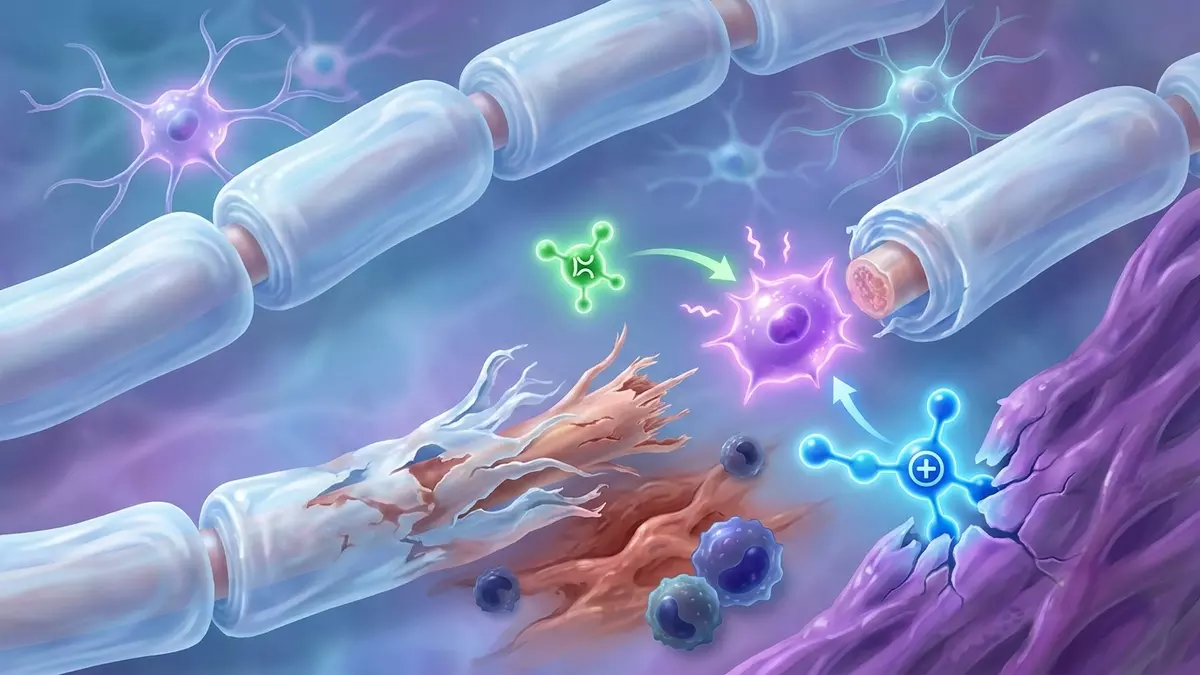
To understand how these new drug strategies operate, it helps to look at the basic anatomy of a nerve cell. In a healthy body, nerve fibers (axons) are wrapped tightly in a thick, fatty insulation layer known as myelin.
[Healthy Nerve]      ➔  =======( Thick Myelin Insulation )=======  ➔ Fast, Clear Signal
[MS Immune Attack]   ➔  ───X───( Stripped, Exposed Nerve )───X───  ➔ Short-Circuited Signal
Myelin works exactly like the plastic coating around an electrical wire, allowing high-speed electrical signals to travel cleanly between your brain and your limbs. In multiple sclerosis, the body’s own immune system mistakenly targets this coating, slowly stripping it away in a destructive process called demyelination.

When the myelin insulation is damaged or lost completely, the brain’s internal communications short-circuit. Signals slow down, break up, or fail to arrive entirely, leading to chronic symptoms such as:
Blurred or failing vision (optic neuritis).
Profound, heavy fatigue that rest cannot relieve.
Systemic numbness, tingling, or chronic nerve pain.
Loss of motor coordination and difficulty walking safely.

The central nervous system naturally possesses an innate repair mechanism called remyelination, where specialized cells try to lay down fresh coats of myelin. However, in progressive forms of MS, the localized tissue environments around the damaged areas (lesions) become deeply hostile, completely blocking these helpful repair cells from doing their job.
Deconstructing the Two Regenerative Strategies
The breakthrough research, spearheaded by researcher Tapani Koppinen under the direction of Associate Professor Merja Voutilainen, successfully mapped out two entirely distinct chemical paths to dismantle these tissue blocks and spark regeneration.
                  ┌─── Path 1: C-MANF ───➔ Deactivates Cellular Stress Alarms
[MS Nerve Lesion] ┤
                  └─── Path 2: Protamine ➔ Breaks Through Localized Scar Barriers
Strategy 1: Turning Off the Cellular Stress Alarm (C-MANF)
When brain tissue is damaged, local cells activate an emergency stress response. While this alarm system is helpful in short bursts, chronic MS lesions cause this stress signal to get stuck on high indefinitely. This permanent panic state prevents myelin-building cells from maturing.
To solve this, the research team utilized an experimental molecule called C-MANF.
The Mechanism: C-MANF directly targets the cell’s internal stress pathways, effectively switching the alarm back down to a normal level.
The Result: Once the stress path was quieted, the cells responsible for creating myelin recovered their function. In animal models, this translated to measurable structural tissue repair and significant improvements in physical motor recovery.
Strategy 2: Dissolving the Scar Tissue Roadblock (Protamine)
In long-standing MS cases, damaged tissue forms a dense, scar-like barrier consisting of molecules called chondroitin sulfate proteoglycans (CSPGs). This matrix behaves like a literal biological roadblock, preventing healthy repair cells from ever reaching the exposed nerve fibers.
The second strategy utilized a low-molecular-weight version of a small peptide called protamine.
The Mechanism: Carrying a strong positive electrical charge, this specialized peptide targets and neutralizes the blocking matrix around the lesions.
The Result: By loosening this scar barrier, the molecule allowed fresh myelin to form smoothly over the exposed axons. Tissues treated with this peptide demonstrated noticeably thicker, fully restored myelin coatings and a massive drop in microglial activity (a primary marker of chronic neuroinflammation). Crucially, the study confirmed that this molecule successfully crossed the blood-brain barrier—the highly restrictive cellular wall that typically blocks most medications from entering the brain.
A Realistic Look at the Timeline: From Lab to Clinic
While this research represents a massive leap forward for neurobiology, maintaining a grounded perspective regarding the clinical timeline is essential:
These discoveries are currently in laboratory and animal phases, not human trials. Human physiology is significantly more complex and variable than a controlled laboratory model. Years of accumulative tissue damage cannot be compared directly to an immediate animal injury.
The Next Scientific Step: Before these molecules can ever be prescribed in a clinic, they must progress into human clinical trials to explicitly prove they are safe, can travel to the correct areas of the human spinal cord, and yield functional improvements that patients can actively feel in daily life—such as steadier walking, clearer vision, and less daytime fatigue.
Conclusion
The current generation of multiple sclerosis medications has mastered the art of slowing down immune system attacks—putting out the inflammatory fires before they can spread. The exciting future of neurobiology, highlighted by the University of Helsinki’s dual-molecule discovery, is learning how to rebuild the structures that the fire originally damaged. If these regenerative strategies successfully pass through upcoming human trials, the medical community may finally have the tools to reverse disability and restore permanent nerve health.
Frequently Asked Questions
What is the blood-brain barrier, and why does crossing it matter so much?
The blood-brain barrier is a highly secure, protective wall of cells lining the blood vessels in the brain and spinal cord. Its primary job is to keep toxins, viruses, and bacteria out of your central nervous system. However, it also blocks more than 95 percent of standard medical drugs. A drug candidate that can naturally cross this barrier, like the protamine peptide in this study, is highly prized because it means the medication can actually reach the damaged nerves.
Can lifestyle choices or supplements like Vitamin D speed up remyelination?
While high-dose Vitamin D, a balanced anti-inflammatory diet, and regular exercise are excellent for supporting overall immune stability and cardiovascular health in MS patients, they do not possess the molecular power to dissolve scar barriers or reset cellular stress loops on their own. They are foundational wellness habits that complement medical care, not direct cures for nerve damage.
How do current MS treatments differ from these new experimental molecules?
Current Disease-Modifying Therapies (DMTs) are immunomodulators—they destroy, alter, or trap specific white blood cells to stop them from entering the brain and attacking myelin. They are entirely preventative. The new experimental molecules (C-MANF and protamine) do not focus on the immune system; instead, they act directly on brain tissue to encourage the growth of new myelin coatings over pre-existing injuries.
What are microglia, and why does reducing their activity matter?
Microglia are the specialized immune cells residing inside the central nervous system. When nerve damage occurs, they become hyperactive, causing chronic neuroinflammation that can worsen tissue decay over time. The fact that the experimental protamine molecule lowered microglial activity indicates that it doesn’t just encourage physical repair—it actively calms the surrounding inflammatory environment.
How long does it typically take for a laboratory discovery to become an available MS drug?
Moving an experimental molecule from initial laboratory models through all three phases of human clinical trials typically takes anywhere from 7 to 12 years. This rigorous process is legally required to verify that the drug is non-toxic, determine proper human dosages, and prove without a doubt that it delivers real-world benefits to patients without dangerous side effects.