
Table of Contents
- 1. The Broken Inheritance: How “Accidental Heat Therapy” Stalled a Destined Alzheimer’s Gene
- 2. The Engine Room Clue: Cellular Stress Responses
- 2.1. The Power of Heat Shock Proteins
- 3. From Industrial Heat to Sauna Science
- 4. The Biological Timing: Amyloid vs. Tau
- 5. A Grounded Warning: This is Not a Prescription
- 6. Conclusion
- 7. Frequently Asked Questions
- 7.1. What exactly is the Presenilin 2 (PSEN2) gene mutation?
- 7.2. Why does tau correlate more closely to dementia symptoms than amyloid?
- 7.3. Can taking hot showers or baths replicate the effects of sauna therapy?
- 7.4. Is there an easy way to naturally boost heat shock proteins without saunas?
- 7.5. Does Doug Whitney’s case mean a cure for Alzheimer’s is close?
The Broken Inheritance: How “Accidental Heat Therapy” Stalled a Destined Alzheimer’s Gene
In the field of neurogenetics, carrying an early-onset Alzheimer’s mutation is traditionally viewed as an absolute, unyielding mathematical certainty. If your parents carry the rare Presenilin 2 (PSEN2) gene mutation, symptoms of severe cognitive decline, memory erasure, and behavioral changes almost always manifest ruthlessly in your 40s or 50s. For the vast majority of families hit by this genetic anomaly, life expectancy rarely extends past the age of 60.
Yet, a man named Doug Whitney has completely broken this genetic script.
Despite carrying the exact PSEN2 mutation that devastated his relatives, Whitney has reached his late 70s with his memory, sharp mind, and cognitive faculties entirely intact.
A landmark clinical case study published in Nature Medicine, led by researcher Jorge J. Llibre-Guerra and senior author Randall J. Bateman, revealed a stunning physiological paradox inside Whitney’s brain: while he possessed the characteristically high levels of toxic amyloid plaques typical of the disease, he had an abnormally low, tightly contained accumulation of tau—the destructive protein tangle directly responsible for killing brain cells and causing dementia symptoms.

Now, a compelling scientific commentary published in the Journal of Alzheimer’s Disease suggests the secret to his lifelong cognitive resilience might lie in a highly unusual place: a lifetime of accidental, occupational heat therapy.
The Broken Inheritance How Accidental Heat Therapy Stalled a Destined Alzheimer’s Gene
The Engine Room Clue: Cellular Stress Responses
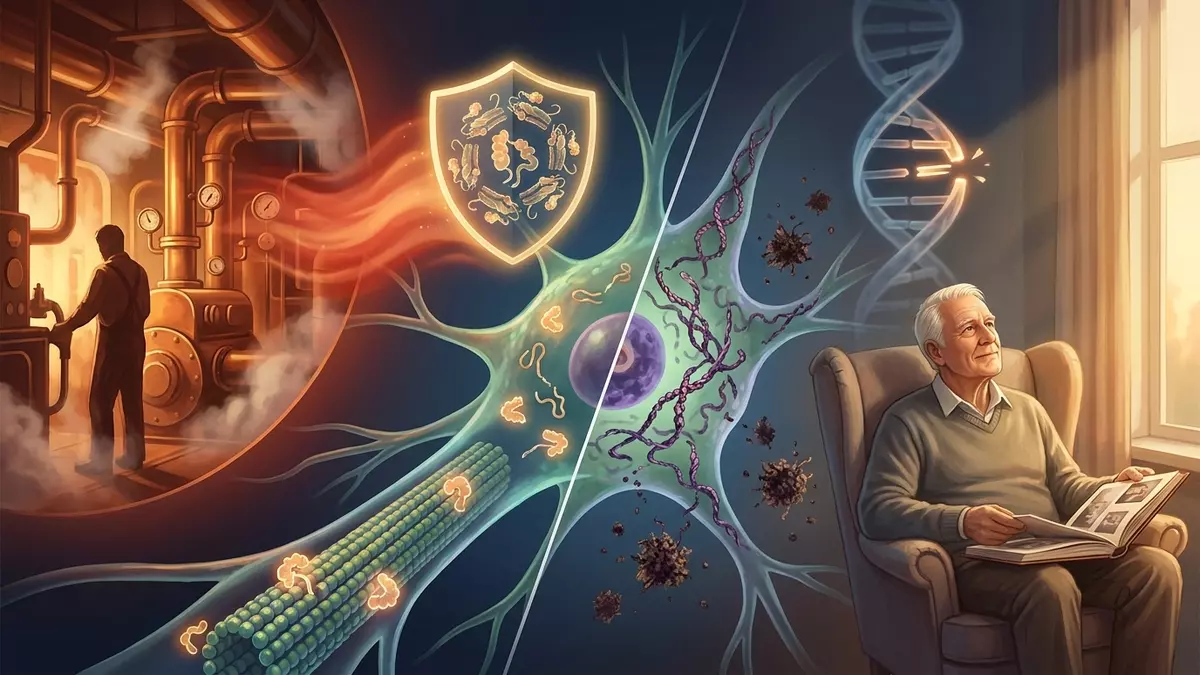
For decades, Whitney spent his working life in the sweltering, enclosed engine rooms of large ships. In these industrial environments, daily temperatures routinely hovered around a blistering 122°F (50°C).

According to a collaborative research commentary by neuroscientists Geoffrey Canet, Brendan P. Lucey, Esther M. Blessing, and Emmanuel Planel—representing institutions including the CNRS, Washington University School of Medicine in St. Louis, NYU Grossman School of Medicine, and Université Laval—this extreme, repetitive heat exposure may have inadvertently triggered a powerful, life-saving molecular shield inside his central nervous system.
[Extreme Environmental Heat] ➔ [Triggers Heat Shock Proteins (HSPs)] ➔ [Refolds/Stabilizes Misfolded Tau] ➔ [Prevents Dementia Symptoms]
The Power of Heat Shock Proteins
When the human body is exposed to elevated thermal environments, it reacts by flooding cells with specialized molecules known as heat shock proteins (HSPs). Far from being harmful, these proteins act as an elite cellular repair crew and molecular chaperones.
Alzheimer’s disease is, at its core, a disorder of misfolded proteins behaving badly. First, amyloid proteins accumulate outside cells, creating a toxic environment. This triggers tau proteins inside the neurons to warp, detach from the cell’s structural skeleton, and twist into suffocating “neurofibrillary tangles.” As these tau tangles spread from cell to cell like a slow-moving wildfire, brain tissue dies, and dementia symptoms emerge.
Upon analyzing Whitney’s cerebrospinal fluid (the fluid bathing the brain and spinal cord), researchers discovered unusually elevated concentrations of heat shock proteins.
Scientists hypothesize that these thermal-induced proteins acted like a persistent containment wall. Every time a tau protein attempted to warp and tangle inside Whitney’s brain, the heat shock proteins rushed in, physically binding to the volatile structures and forcing them back into a stable, non-toxic shape. This effectively stalled the progression of the disease for over thirty years.
From Industrial Heat to Sauna Science
While Whitney’s engine room exposure was accidental, the underlying biological mechanism aligns perfectly with a growing body of global sports science and neurological research.
| Research Source | Study Framework & Scope | Key Neurological Findings |
| Finnish Sauna Study | Tracked 2,315 middle-aged men over a 20-year observation period. | Men utilizing saunas 4 to 7 times per week demonstrated a 65% lower statistical risk of developing Alzheimer’s compared to once-a-week users. |
| Preclinical Mouse Models | Exposed mice with humanized tau mutations to sauna-like thermal environments. | Mild core body heating successfully reduced the biochemical changes that cause tau to become toxic. |
| 2025 JCI Temperature Study | Evaluated daily natural body temperature rhythms in older adults (Journal of Clinical Investigation). | Higher baseline body temperatures during natural wakefulness periods correlated with superior tau protein clearance and lower structural accumulation. |
These overlapping studies suggest that managing brain health isn’t just about targeting the physical structural plaques after they form; it involves optimizing the daily, thermal-metabolic environments in which our brain cells operate.
The Biological Timing: Amyloid vs. Tau
Doug Whitney’s brain structure provides a vital, revolutionary clue regarding the chronological timing of Alzheimer’s treatment. For decades, global pharmaceutical research has poured billions of dollars into clearing amyloid plaques. However, clinical trials frequently show that even when a drug successfully clears amyloid from a patient’s brain, their memory loss continues to worsen.
[Phase 1: Amyloid Accumulation] ➔ ( Thermal Intervention Window ) ➔ [Phase 2: Tau Tangles & Cell Death]
Whitney’s case proves that amyloid accumulation is merely the initial match—it is the subsequent replication of tau that acts as the destructive fire. Because his accidental heat therapy specifically targeted and suppressed tau stabilization before memory loss ever had a chance to begin, he remained cognitively immune to his own genetics. This indicates that future preventative therapies must focus heavily on stabilizing tau at the absolute earliest stages of the disease.
A Grounded Warning: This is Not a Prescription
While the science behind Whitney’s story is incredibly exciting, medical professionals urge readers to exercise strict caution:
Do not attempt to treat or prevent dementia by deliberately overheating yourself. Extreme thermal exposure can be incredibly hazardous. Sitting in intense saunas, hot tubs, or overheated environments poses severe risks of heatstroke, profound dehydration, dangerous blood pressure drops, and fatal cardiac strain—particularly for older adults or individuals managing underlying cardiovascular conditions.
Using saunas or thermal therapy should be treated like any major lifestyle or exercise modification. Always consult your primary physician or a neurologist to ensure your cardiovascular system can safely handle the stress of thermal conditioning.
Conclusion
Doug Whitney’s extraordinary life has provided the scientific community with a priceless gift: proof that an inherited, devastating neurological destiny can be successfully disrupted. By showing that a natural, heat-induced cellular stress response can keep toxic tau proteins at bay for decades, his case has cracked open a brand-new door for dementia research. The future of Alzheimer’s care may not simply rely on synthetic chemicals, but on learning how to safely unlock the brain’s own evolutionary resilience before the very first shadow of memory loss appears.
Frequently Asked Questions
What exactly is the Presenilin 2 (PSEN2) gene mutation?
The PSEN2 gene provides instructions for making a protein called presenilin 2, which is an essential component of an enzyme complex that cuts up other proteins in brain cells. When this gene mutates, it causes the enzyme to slice proteins incorrectly, leading to the overproduction of a sticky, toxic form of amyloid-beta peptide. This rapid accumulation causes the early-onset form of Alzheimer’s, typically striking multiple generations of a family in their 40s or 50s.
Why does tau correlate more closely to dementia symptoms than amyloid?
Think of amyloid plaques as a systemic trigger that alters the brain’s environment, while tau is the actual executioner of the cells. Amyloid builds up silently outside of neurons for up to twenty years before any symptoms appear. However, once tau begins to warp and form tangles inside the neurons, it physically cuts off the cell’s internal transport systems, causing the cell to starve and die. The localized loss of these brain cells is what directly causes memory failure, confusion, and cognitive decline.
Can taking hot showers or baths replicate the effects of sauna therapy?
Generally, no. Standard warm showers or casual baths do not raise your body’s core internal temperature high enough or long enough to stimulate the production of systemic heat shock proteins. To trigger a true molecular heat-shock response, the body typically requires sustained, controlled exposure to dry or wet heat environments that safely elevate core body temperature by a fraction of a degree under medical tolerability.
Is there an easy way to naturally boost heat shock proteins without saunas?
Yes, vigorous physical exercise is a highly effective, natural way to stimulate the production of heat shock proteins in the human body. When you perform intense cardiovascular or resistance training, your muscles generate significant internal metabolic heat, which triggers a mild, healthy cellular stress response that co-produces protective heat shock proteins throughout your systems.
Does Doug Whitney’s case mean a cure for Alzheimer’s is close?
While this case provides an invaluable roadmap for future drug development and preventative therapies, it does not represent an immediate cure. It highlights a biological pathway—proving that suppressing tau through heat shock proteins works in a living human. Scientists must now spend years figuring out how to safely mimic this protective cellular response using targeted medical therapies or controlled lifestyle interventions that can be applied to the general public.