
Table of Contents
- 1. The Hidden Imitator: Why Thyroid Disease Frequently Mimics Aging and Stress in Women
- 2. Why Women Face a Disproportionate Risk
- 3. Two Sides of the Coin: Slowing Down vs. Speeding Up
- 3.1. 1. Hypothyroidism (The Slowdown)
- 3.2. 2. Hyperthyroidism (The Speed-Up)
- 4. The Path to Clarity: Testing and Treatment
- 4.1. The Diagnostic Blood Panel
- 4.2. Medical Interventions
- 5. Conclusion
- 6. Frequently Asked Questions
- 6.1. Can dietary choices cure or reverse Hashimoto’s or Graves’ disease?
- 6.2. Why do my thyroid symptoms persist even though my blood test results are “normal”?
- 6.3. How long does it take for thyroid medication to resolve symptoms?
- 6.4. Is there a connection between thyroid disease and hair loss?
- 6.5. Can a temporary thyroid issue develop after giving birth?
The Hidden Imitator: Why Thyroid Disease Frequently Mimics Aging and Stress in Women
Waking up completely exhausted, experiencing unexpected weight fluctuations, battling a racing heartbeat, or feeling freezing cold while everyone else is perfectly comfortable can easily be dismissed as a normal byproduct of work stress, aging, or early menopause.
However, endocrinologists warn that for millions of women, these chronic everyday disruptions are not a natural part of growing older. Instead, they represent the classic warning signs of a malfunctioning thyroid gland—a subtle, widespread medical issue that frequently goes undetected for years.
The Hidden Imitator Why Thyroid Disease Frequently Mimics Aging and Stress in Women
Why Women Face a Disproportionate Risk
The thyroid is a small, butterfly-shaped gland positioned at the front of your neck. Despite its compact size, it acts as the primary speedometer for your entire body, manufacturing hormones that dictate how your cells turn oxygen and nutrients into usable energy.

[Thyroid Gland] ➔ [Produces Hormones] ➔ [Regulates Systemic Speedometer] ➔ [Dictates Heart, Energy & Weight]
When it comes to thyroid dysfunction, women are hit significantly harder than men. According to data from the American Thyroid Association:
Women are five to eight times more likely than men to experience thyroid complications.
One in eight women will develop a distinct thyroid disorder during her lifetime.
Up to 60 percent of individuals currently living with thyroid disease are completely unaware that their gland is malfunctioning.

This profound gender gap is largely tied to biology. Thyroid conditions are primarily driven by autoimmune disorders—where the immune system mistakenly attacks healthy tissue—and women are naturally more susceptible to autoimmune triggers.
Furthermore, thyroid function is deeply intertwined with major reproductive hormone shifts. Women are most vulnerable to thyroid disruptions during pregnancy, postpartum recovery, and menopause. Because these life stages already bring fatigue, unpredictable mood changes, and sleep disruptions, the underlying thyroid condition frequently goes unnoticed.

The Over-40 Screening Reality: A clinical study published in the journal Cureus evaluated 150 women over the age of 40 who were experiencing vague, everyday symptoms. While 53.3 percent of the participants possessed perfectly healthy thyroid function, the remaining 46.7 percent were diagnosed with some form of active thyroid imbalance, including underactive, overactive, or mild “subclinical” patterns that required ongoing medical management.
Two Sides of the Coin: Slowing Down vs. Speeding Up
As Dr. Hyesoo Lowe, an endocrinologist at NewYork-Presbyterian, describes it, the thyroid is “quietly doing its work underneath the surface.” Dr. Thomas Fahey at Weill Cornell Medicine adds that thyroid hormone serves as a “general regulator of metabolism.”
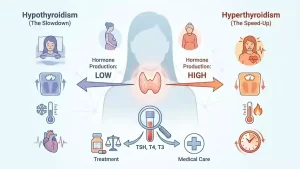
When this internal regulator slips out of balance, it typically swings in one of two opposite directions:
1. Hypothyroidism (The Slowdown)
Hypothyroidism occurs when the gland fails to produce enough thyroid hormone, causing the body’s metabolic processes to drop into slow motion. The most common root cause is Hashimoto’s disease, an autoimmune condition where the body slowly damages its own thyroid tissue.
What it feels like: Persistent, heavy fatigue that sleep cannot fix, sudden weight gain despite no changes in diet, chronic constipation, unusually dry skin, thinning hair, a slow heart rate, depression, facial puffiness, and a severe intolerance to cold temperatures.
2. Hyperthyroidism (The Speed-Up)
Hyperthyroidism is the exact opposite anomaly. The gland overproduces hormones, forcing the body to run as if its accelerator pedal is pressed to the floor. The primary driver is typically Graves’ disease, another autoimmune condition.
What it feels like: A fast or irregular heartbeat (palpitations), fine tremors in the hands, severe anxiety, irritability, chronic insomnia, rapid weight loss despite an increased appetite, frequent bowel movements, and intense heat intolerance. In advanced cases, a visible swelling may appear in the neck (a goiter), or the eyes may appear unusually prominent or bulging.
The Path to Clarity: Testing and Treatment
Because the symptoms of thyroid disease match so many other everyday lifestyle stressors, you cannot diagnose a thyroid condition based on symptoms alone. If you are experiencing a cluster of these warning signs, a physician will typically order a series of simple, highly accurate blood tests.
[Patient Symptoms] ➔ [Physician Evaluation] ➔ [Blood Panel: TSH, Free T4, Free T3] ➔ [Targeted Treatment]
The Diagnostic Blood Panel
Doctors primarily measure Thyroid-Stimulating Hormone (TSH) alongside actual thyroid hormone levels (Free T4 and Free T3). TSH is produced by your brain’s pituitary gland to tell the thyroid to get to work.
If your TSH is abnormally high, it means your brain is yelling at a sluggish thyroid to wake up (Hypothyroidism).
If your TSH is abnormally low, it means your brain has stopped signaling because the thyroid is pumping out hormones entirely on its own (Hyperthyroidism).
Medical Interventions
Once a definitive diagnosis is mapped, treatments are highly effective and tailored to your specific hormonal footprint:
| Condition | Common Medical Management Approaches |
| Hypothyroidism | Managed daily with an oral synthetic thyroid hormone replacement medication (such as levothyroxine) to restore systemic levels back to a healthy baseline. |
| Hyperthyroidism | Managed utilizing antithyroid medications to block hormone production, radioactive iodine therapy to safely shrink overactive tissue, beta-blockers to protect the heart from palpitations, or surgical removal in select cases. |
Leaving thyroid conditions untreated introduces serious long-term medical risks. Over time, an unchecked thyroid imbalance can contribute to severe bone density loss (osteoporosis), chronic heart disease, dangerous heart arrhythmias, and fertility complications.
Conclusion
If your body is sending persistent, unyielding signals of exhaustion, temperature sensitivity, or unexpected physical changes, do not automatically write them off as a consequence of aging or a busy schedule. True health tracking means advocating for your own well-being. Requesting a standard thyroid blood panel from your doctor is a quick, painless step that can eliminate months of stressful guesswork and help you get your vital energy back.
Frequently Asked Questions
Can dietary choices cure or reverse Hashimoto’s or Graves’ disease?
No. Autoimmune thyroid conditions like Hashimoto’s and Graves’ disease are genetic, structural immune system responses that cannot be cured or reversed through diet alone. While eating an anti-inflammatory diet rich in whole foods can support your overall energy and well-being, proper medical care and prescribed hormone regulations remain absolutely necessary to protect your health.
Why do my thyroid symptoms persist even though my blood test results are “normal”?
This is a frequent point of frustration for many patients. You may be experiencing “subclinical” thyroid shifts, where your hormone levels sit at the absolute margins of the standard reference range. Alternatively, your symptoms could stem from underlying vitamin deficiencies (like low vitamin B12 or iron ferritin levels) or hormonal imbalances in your adrenal system. If you still feel unwell, discuss a more comprehensive metabolic panel with your specialist.
How long does it take for thyroid medication to resolve symptoms?
If you are starting synthetic thyroid hormone replacement for an underactive thyroid, it generally takes about 4 to 6 weeks of consistent daily use for the medication to fully stabilize in your bloodstream and alter your cellular metabolism. You will likely undergo follow-up blood tests during this window so your physician can calibrate your dosage perfectly.
Is there a connection between thyroid disease and hair loss?
Yes. Severe or prolonged hypothyroidism and hyperthyroidism can both trigger widespread hair thinning across the entire scalp. This happens because thyroid hormones directly fuel the development and cycling of hair follicles. Once your systemic hormone levels are successfully balanced with appropriate medical treatment, normal hair growth cycles typically return over several months.
Can a temporary thyroid issue develop after giving birth?
Yes, this condition is known as postpartum thyroiditis. It affects roughly 5 to 10 percent of women within the first year after childbirth. It typically begins with a brief phase of mild hyperthyroidism (anxiety and weight loss) followed by a shift into temporary hypothyroidism (extreme fatigue). While it often resolves naturally within a year, it requires careful monitoring by an endocrinologist.