
Table of Contents
- 1. The Power of the Genetic “Instruction Book”
- 1.1. The Ancestry Surprise
- 2. Survival Against the Odds: The Genetic Bottleneck
- 2.1. Why They Succeeded: “Preadaptation”
- 3. The Cost of Survival: A Fragile Ecosystem
- 4. The Legacy of Frozen Samples
- 5. Frequently Asked Questions (FAQ)
- 5.1. What is island dwarfism?
- 5.2. How did these five cows survive such an extreme environment?
- 5.3. Is inbreeding always fatal for a small population?
- 5.4. Why was it necessary to remove the cattle?
- 5.5. How did the researchers know the cattle weren’t “dwarfed” by island life?
The Amsterdam Island Cattle: How DNA Rewrote a Century-Old Mystery
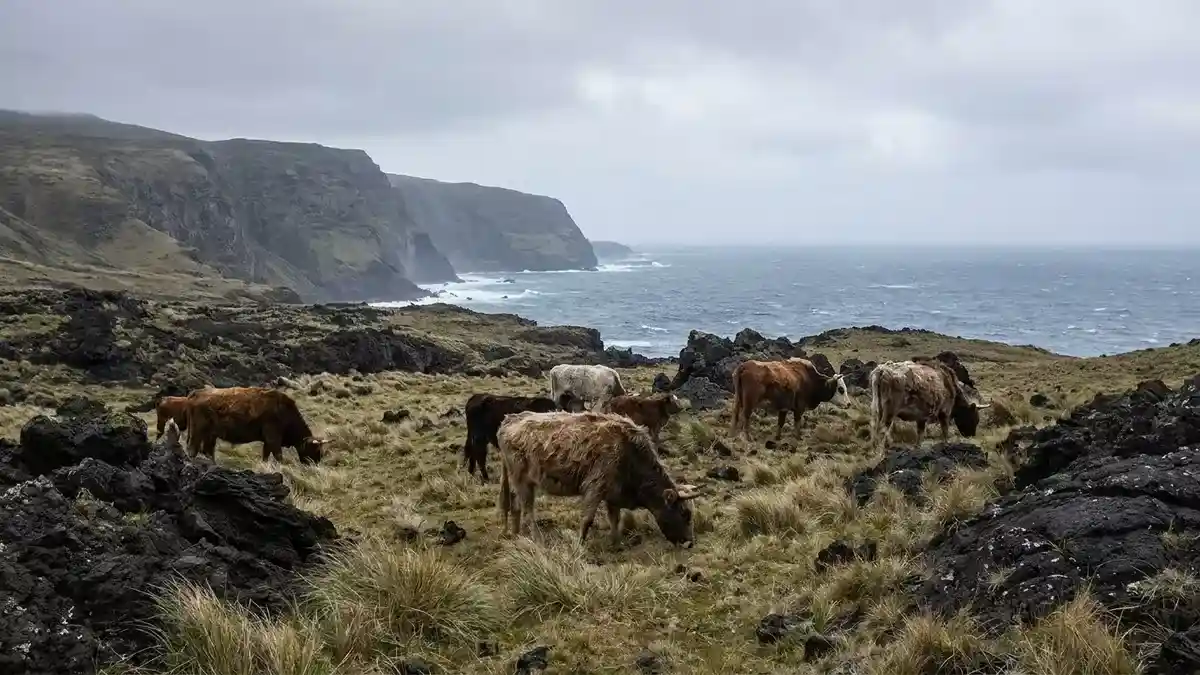
In 1871, five cattle were left behind on Amsterdam Island, a tiny, desolate speck of land deep in the southern Indian Ocean. Abandoned when a French settlement project failed, these animals faced a brutal environment: cold, wet, relentlessly windy, and devoid of the comforts of a farm. Yet, against all odds, they not only survived but thrived, growing into a feral herd that peaked at 2,000 animals and lasted until 2010.
For years, scientists theorized that this herd was a perfect example of “island dwarfism”—the rapid evolutionary process where large animals shrink in size to adapt to limited island resources. However, modern genetic analysis has turned this narrative on its head.
The Amsterdam Island Cattle How DNA Rewrote a Century-Old Mystery
The Power of the Genetic “Instruction Book”
Led by geneticist Mathieu Gautier, a team from INRAE and the University of Liège revisited the story using preserved DNA from 18 cattle sampled between 1992 and 2006. By employing whole genome sequencing—a process that reads nearly every “page” of an organism’s genetic instruction book—the researchers discovered a much more complex history than previously imagined.

The Ancestry Surprise
The DNA analysis revealed that the herd was not a monolithic group of European cattle. Instead:
75% of the ancestry traced back to European taurine cattle related to the modern Jersey breed.
25% came from Zebu cattle (humped cattle) from Madagascar and Mayotte.

This mixed heritage suggests that the cattle were likely small before they even touched the island’s shores. The “dwarfism” observed by researchers was not a rapid evolutionary reaction to island life, but rather a direct inheritance from the founders.
Survival Against the Odds: The Genetic Bottleneck
Starting a population with only five individuals usually leads to a “genetic bottleneck.” This drastically restricts the gene pool, often resulting in the expression of harmful recessive traits and a lack of resilience. While the DNA study confirmed high levels of inbreeding in the Amsterdam Island herd, it also revealed that the population managed to avoid the severe genetic collapse that typically plagues such small founder groups.
Why They Succeeded: “Preadaptation”
The study points to preadaptation as a major factor. The European ancestors (Jersey-type cattle) were already physiologically suited for environments similar to the cool, wet climate of Amsterdam Island. The cattle didn’t have to “invent” ways to survive; they arrived with a genetic toolkit that was already compatible with their new, harsh home.

Additionally, the genome scans identified signals near genes related to nervous system function. These suggest the cattle underwent rapid feralization—behavioral changes that allowed them to transition from domesticated livestock to wild, self-sufficient animals.
The Cost of Survival: A Fragile Ecosystem
While the herd’s survival was a biological triumph, it was a tragedy for the island’s unique ecosystem. By the late 20th century, the cattle had become the primary threat to endemic flora and fauna. In a difficult balancing act, conservationists began removing the cattle in the 1980s to allow native habitats to recover. The last of the herd was removed by 2010, and in 2019, the French Austral Lands and Seas were designated a UNESCO World Heritage site.
The Legacy of Frozen Samples
The story of the Amsterdam Island cattle demonstrates the quiet, transformative power of biological archives. Because tissue samples were preserved before the herd was eradicated, scientists were able to return years later with superior technology to ask better questions.
The DNA revealed that our initial assumptions—that the animals had evolved in isolation—were wrong. Instead, it was a story of hidden diversity and lucky preparation. By preserving samples today, we ensure that populations that disappear tomorrow don’t become dead ends, but rather continued opportunities for scientific discovery.
Frequently Asked Questions (FAQ)
What is island dwarfism?
Island dwarfism is an evolutionary phenomenon where large animals evolve to become smaller over many generations, typically because the limited resources and lack of predators on an island make smaller bodies more advantageous.
How did these five cows survive such an extreme environment?
The combination of their “preadapted” genetics (Jersey-type cattle already suited to cool, wet climates) and their mixed ancestry (including Zebu) gave them the necessary resilience. They essentially had the right “toolkit” to handle the island’s conditions from day one.
Is inbreeding always fatal for a small population?
Not always, but it is risky. While the Amsterdam Island cattle showed high levels of inbreeding, they avoided the “mutational meltdown” that often destroys small groups, likely because the founder animals carried a sufficiently robust range of genetic variation.
Why was it necessary to remove the cattle?
The cattle were destroying the island’s endemic (native) species, which evolved without the presence of large herbivores. Protecting the native plants and birds, which exist nowhere else on Earth, took priority over maintaining the feral herd.
How did the researchers know the cattle weren’t “dwarfed” by island life?
By comparing the genetic markers of the herd to their ancestral breeds, researchers determined that the cattle’s size was consistent with their genetic heritage rather than being a deviation from their ancestors’ standard size. The cattle were small because their parents were small, not because the island made them that way.