
Table of Contents
Breaking the Micro-Clot Barrier: A Breakthrough in Stroke Recovery
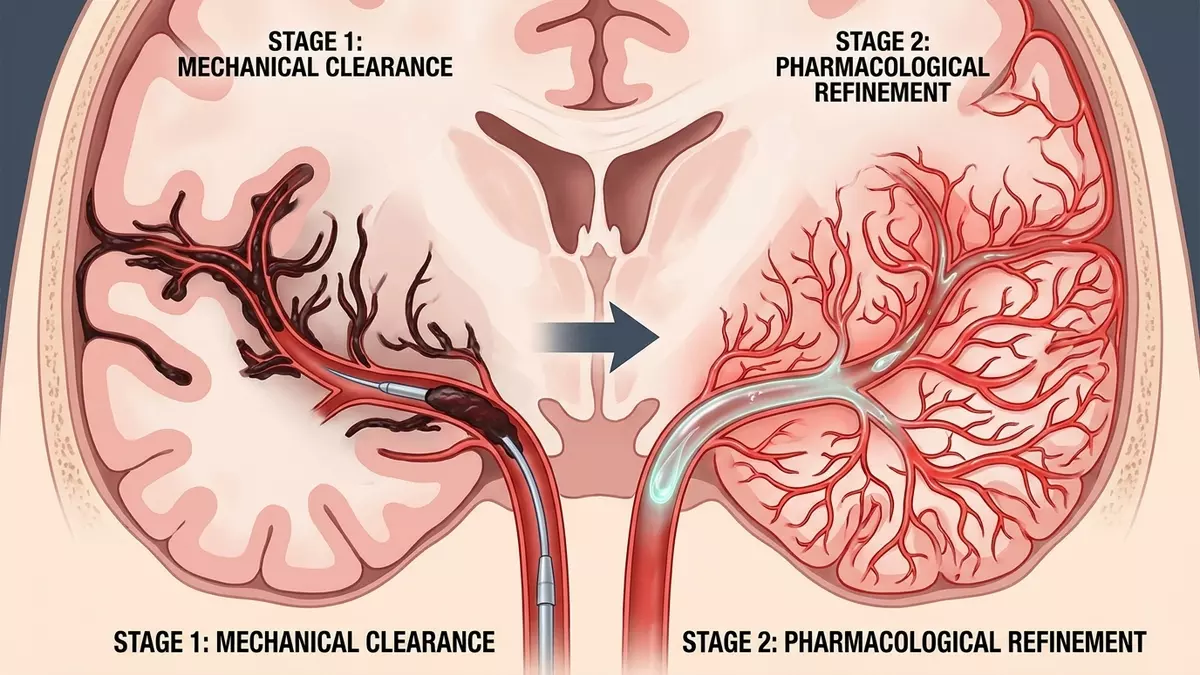
Mechanical thrombectomy—the process of using a specialized device to physically pull a blood clot out of the brain—is one of the most significant advancements in modern stroke care. However, even when a surgeon successfully clears the “main highway” of a blocked artery, many patients still struggle with long-term disability.
A new multicenter clinical trial, the CHOICE-2 study, suggests that the finish line for stroke treatment needs to be moved further. By administering a clot-dissolving drug directly into the brain’s arteries after the thrombectomy, researchers have found a way to improve recovery rates significantly, hinting that the key to independence lies in clearing the “side streets” of the brain.
Breaking the Micro-Clot Barrier A Breakthrough in Stroke Recovery
The “Side Street” Problem: Microcirculation
Why do patients experience lingering deficits after a successful surgery? According to Arturo Renú, the study’s lead author, it is like reopening a major highway only to find that all the neighborhood side streets remain blocked.

While a thrombectomy is highly effective at opening large, proximal arteries, it cannot reach the intricate network of tiny blood vessels known as the microcirculation. If these microscopic vessels remain clogged or sluggish, the brain tissue they serve continues to be starved of oxygen and nutrients, preventing full neurological recovery.
The CHOICE-2 Trial: A New Protocol
Coordinated by Hospital Clínic Barcelona and the August Pi i Sunyer Biomedical Research Institute (IDIBAPS), the trial evaluated 440 adults across 14 specialized stroke centers in Spain. All participants had experienced a severe ischemic stroke and underwent a successful mechanical thrombectomy.
Following the procedure, patients were randomly assigned to one of two groups:

Standard Care: The traditional approach after surgery.
Combined Care: Standard care plus the administration of intra-arterial alteplase—a potent clot-dissolving medication—directly into the brain artery.
The goal was to determine if this post-procedure “flush” could dissolve the micro-clots that mechanical tools are too large to touch.

Results: More Than Just Statistical Significance
The difference in outcomes was striking. After 90 days of recovery:
Excellent Functional Outcomes: 57.5% of patients in the combined treatment group achieved an excellent recovery (no disability or only mild symptoms), compared to just 42.5% in the thrombectomy-only group.
Imaging Insights: Brain scans showed that patients who received the drug had significantly fewer areas of poor blood flow, confirming that the medication successfully helped restore circulation in the smaller vessels.
A Note of Caution: Balancing Risks
While the data on functional recovery is highly promising, the researchers are careful to emphasize that this is not yet a one-size-fits-all solution.
The trial revealed a complex safety profile: while the rate of serious brain bleeding did not increase significantly, there was a higher rate of mortality at the 90-day mark in the alteplase group. This indicates that while the drug helps restore circulation, it must be used with precision. Future research will focus on identifying exactly which patients are the best candidates for this therapy to maximize benefits while minimizing these risks.
The Future of Stroke Treatment
The CHOICE-2 trial builds on preliminary findings from the original 2022 CHOICE study, turning an early “signal” into a more solid piece of evidence. As neurology moves forward, the strategy is shifting from a single-focus emergency response to a two-stage approach:
Mechanical Clearance: Removing the massive “highway” blockages.
Pharmacological Refinement: Clearing the “side streets” via targeted drug delivery.
While the medical community waits for further studies to refine the safety protocols and update clinical guidelines, this work marks a hopeful step forward. For stroke survivors, it suggests that even after the surgery ends, there are still untapped opportunities to protect the brain and restore quality of life.
Frequently Asked Questions (FAQ)
What is a mechanical thrombectomy?
It is a surgical procedure where a specialist uses a thin, catheter-like device to reach the brain’s blocked artery and physically remove the blood clot.
What is “microcirculation” in the brain?
Microcirculation refers to the smallest blood vessels (capillaries and arterioles) that deliver oxygen and nutrients directly to specific patches of brain tissue.
Is this drug treatment now standard practice?
Not yet. While the results are encouraging, the “mixed safety picture” (specifically the higher mortality observed in the drug group) means that more research is needed before this becomes routine global practice.
Why is alteplase given after surgery instead of before?
Alteplase has traditionally been used before surgery, but this study aimed to see if it could be used as a “mop-up” tool to clear smaller clots that the mechanical tool couldn’t reach.
What should I do if a family member has a stroke?
Time is brain. Always prioritize calling emergency services immediately so the patient can be transported to a hospital capable of performing mechanical thrombectomy. The faster the main clot is removed, the better the starting point for recovery.