
Table of Contents
- 1. The Flaw of the Frying Pan Method
- 2. Why the Air Fryer is the Ultimate Grilled Cheese Machine
- 2.1. Why the Toaster Oven Falls Short
- 3. Step-by-Step: How to Make an Air Fryer Grilled Cheese
- 3.1. 1. Prep the Exterior
- 3.2. 2. Load the Basket
- 3.3. 3. Set the Temperature and Timer
- 3.4. 4. The Halfway Flip
- 4. Upgrading to Gourmet, Multi-Layered Sandwiches
- 5. Conclusion: A Stress-Free Comfort Food Revolution
- 6. Frequently Asked Questions
- 6.1. Do I need to preheat my air fryer before making a grilled cheese?
- 6.2. Which melts better in an air fryer: shredded or sliced cheese?
- 6.3. How do I prevent the top piece of bread from flying off inside the air fryer?
- 6.4. Is it better to use butter or mayonnaise on the outside of the bread?
- 6.5. Can I make multiple grilled cheese sandwiches at the same time?
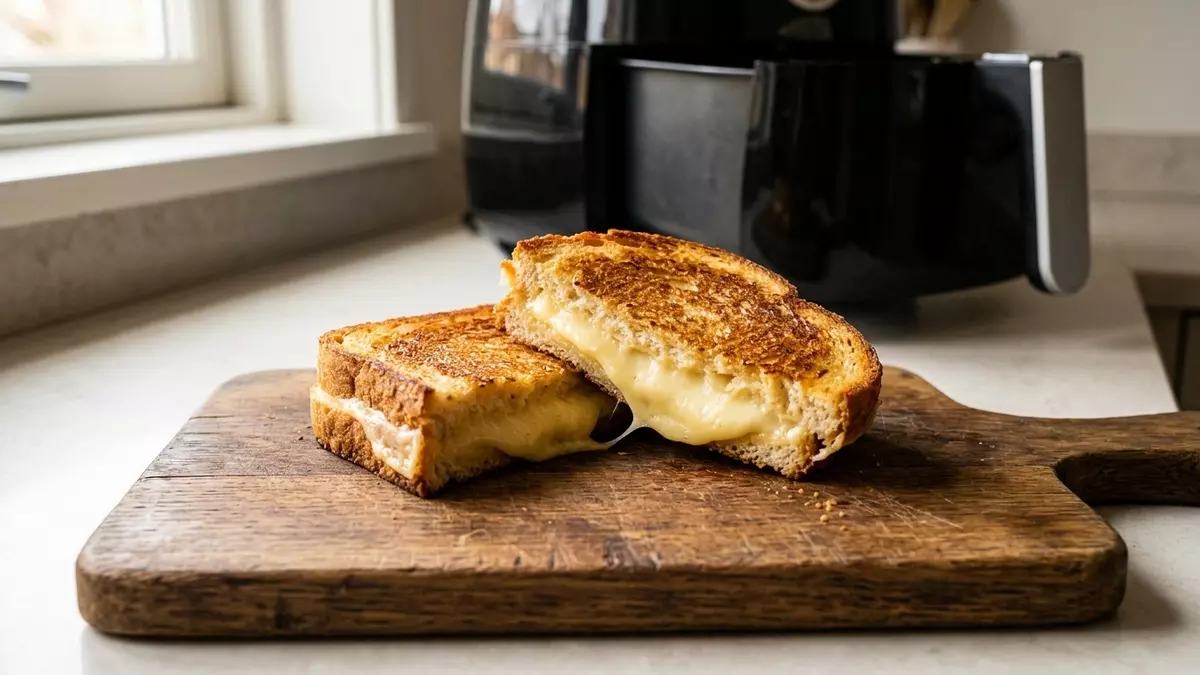
Stop Using a Frying Pan for the Perfect Grilled Cheese Sandwich
Making the perfect grilled cheese sandwich shouldn’t feel like a high-stakes gamble, yet the traditional frying pan routinely turns it into one. We have all been there: the stovetop method frequently rewards your patience with uneven browning, rushed flipping, and pockets of shredded cheese that stubbornly refuse to melt. Even when you think you have nailed the temperature, one side of the bread can rapidly scorch while the center stays completely cold.
Before you chalk up your next burnt crust to bad luck, it is time to retire the skillet. There is a cleaner, faster, and far more consistent cooking method that delivers an incredibly golden crunch, a perfectly uniform melt, and zero greasy splatters on your stovetop.
Stop Using a Frying Pan for the Perfect Grilled Cheese Sandwich
The Flaw of the Frying Pan Method
The real reason your skillet keeps betraying you comes down to basic thermodynamics: standard pan frying lacks efficient air circulation. A skillet only applies direct heat from the bottom up. Because the thermal energy is concentrated entirely on the surface making contact with the metal, the bread routinely browns and burns long before the ambient heat can penetrate the interior to melt the cheese.

Stovetop Skillet:  [Direct Heat Only From Bottom] ---> Bread Burns Before Center Melts
Air Fryer Basket:  [360° Convection Hot Air Flow] --> Simultaneous Melt and Ultimate Crunch
If you try to fix this issue by covering the pan with a lid to trap the heat, you accidentally introduce a new problem: moisture. The trapped condensation creates a steaming effect inside the pan, leaving your sandwich soggy and soft rather than crisp and crunchy.
Why the Air Fryer is the Ultimate Grilled Cheese Machine
Switching to an air fryer completely changes the dynamic by utilizing powerful, multi-directional convection currents. Intense hot air circulates rapidly around the entire sandwich at once, melting the cheese at an accelerated pace while simultaneously crisping the exterior.
Because the interior cheese melts efficiently, it acts as a structural mortar, binding the layers of bread together from the inside out. This makes flipping the sandwich halfway through the cooking process incredibly smooth and entirely mess-free.

Why the Toaster Oven Falls Short
While a toaster oven might seem like a logical alternative to a skillet, it simply cannot compete with an air fryer’s design. Toaster ovens utilize radiant heating elements that do not adequately support or seal the buttered undersides of the bread. This lack of airflow control frequently results in butter drips, smoky grease splatters, and a tedious cleanup process.
The air fryer avoids these pitfalls entirely, providing a compact, highly concentrated cooking chamber that heats up almost instantly—often requiring zero preheating.
Step-by-Step: How to Make an Air Fryer Grilled Cheese
Assembling an air fryer grilled cheese requires no exotic ingredients. You build the sandwich exactly as you traditionally would, but let the machine handle the precision execution.

1. Prep the Exterior
Generously coat the outer surfaces of your bread with softened butter or a thin layer of mayonnaise. Mayonnaise is a favorite among pro chefs because its high smoke point results in an exceptionally uniform, deep golden crust.
2. Load the Basket
For a classic, streamlined sandwich, assemble it directly inside the air fryer basket to minimize handling. Lay the first piece of bread down (buttered side touching the basket), pile on your favorite cheese blend, and top it with the second slice of bread (buttered side facing up).
3. Set the Temperature and Timer
Slide the basket into place and set your air fryer to $400^\circ\text{F}$ ($204^\circ\text{C}$).
For a light, golden crisp: Cook for 3 to 4 minutes per side.
For a bold, extra-crunchy finish: Let it ride for up to 6 minutes per side.
4. The Halfway Flip
Open the basket halfway through the estimated cooking time. Because the circulating hot air has already melted the cheese into a cohesive binding agent, you can easily slide a spatula underneath and flip the sandwich without a single ingredient sliding out of alignment.
Upgrading to Gourmet, Multi-Layered Sandwiches
Where the air fryer method truly shines is its ability to effortlessly handle complex, towering, ingredient-packed sandwiches that would completely fall apart or tear in a standard frying pan.
  [ Buttered Top Bread ]
  [ Prosciutto / Cured Meats ]
  [ Apple Slices / Tomatoes / Pickles ]
  [ Brie or Camembert Cheese ]
  [ Buttered Bottom Bread ]
When building upgraded creations, assemble the entire sandwich on a cutting board first before carefully transferring it into the fryer basket. The enclosed, uniform heat chamber makes it incredibly easy to experiment with sophisticated culinary combinations:
Textural Contrast: Layer crisp apple slices, fresh tomato wheels, roasted red peppers, or tangy pickles directly into the center.
Gourmet Cheeses: Thick-cut artisan breads and soft, luxurious cheeses like Brie or Camembert cook flawlessly even without burning the outer crust.
Bonus Crisp: If you add cured meats like prosciutto, bacon, or ham, the surrounding hot air currents will gently crisp the edges of the meat protruding from the sides, adding an extra layer of savory texture to every single bite.
Conclusion: A Stress-Free Comfort Food Revolution
Transitioning your grilled cheese routine from a stovetop skillet to an air fryer might feel like a major departure from nostalgic tradition, but the flawless results speak for themselves. By replacing uneven conduction heat with efficient, multi-directional convection airflow, you completely eliminate the frustration of burnt bread and cold centers. The reward is a perfectly calibrated, restaurant-quality sandwich featuring structural stability, an elite level of crunch, and a beautifully gooey, stringy melt every single time.
Frequently Asked Questions
Do I need to preheat my air fryer before making a grilled cheese?
For the vast majority of modern air fryers, preheating is not strictly necessary because the small cooking chamber reaches maximum temperature almost instantly. However, if your specific air fryer model tends to heat up slowly, running it at $400^\circ\text{F}$ ($204^\circ\text{C}$) for just one minute before adding the sandwich will help the exterior crust begin crisping up immediately upon contact.
Which melts better in an air fryer: shredded or sliced cheese?
Finely shredded cheese possesses a higher surface-area-to-mass ratio, meaning it will naturally melt at a faster rate than dense slices. However, traditional sliced cheese works beautifully as well and offers the added benefit of staying perfectly centered on the bread without blowing around during the initial blast of convection air.
How do I prevent the top piece of bread from flying off inside the air fryer?
Because air fryers rely on powerful, high-velocity fan currents to circulate hot air, exceptionally lightweight or thin slices of bread can occasionally shift or lift off the sandwich before the cheese has fully melted. To prevent this, you can secure the sandwich by inserting a clean wooden toothpick through the center, or place a small, air-fryer-safe metal rack or trivet gently on top of the sandwich for the first two minutes of cooking.
Is it better to use butter or mayonnaise on the outside of the bread?
Both options yield fantastic results, but they offer slightly different characteristics. Butter provides that classic, rich, nostalgic diner flavor profile. Mayonnaise, on the other hand, consists of a stable emulsion of oil and egg yolks, which features a higher smoke point than butter fat. This allows the bread to achieve a deeper, more perfectly uniform golden hue with a lower risk of accidental burning.
Can I make multiple grilled cheese sandwiches at the same time?
Yes, provided your air fryer basket is large enough to accommodate them in a single, uncrowded layer. It is critical that you never stack or overlap the sandwiches inside the basket. Overlapping blocks the vital, circulating hot air currents, which completely defeats the purpose of the convection method and results in soggy, unevenly cooked patches where the bread touches.