
Table of Contents
- 1. The Energy Crisis of Learning: How the Brain Overlaps Hunger and Memory
- 2. The Fruit Fly as a Neuroscientific Model
- 2.1. The Tiny Internal Fuel Gauge
- 3. The Experiment: Spaced Learning Triggers False Hunger
- 4. Inside the Memory Circuit: Fueling the Mushroom Body
- 5. Important Nuance: What This Means for Humans
- 6. Conclusion
- 7. Frequently Asked Questions
- 7.1. Does this study imply that I should eat sugary snacks while studying?
- 7.2. What is the difference between spaced learning and massed learning?
- 7.3. Why did coconut oil fail to save the memories in the experiment?
- 7.4. What is calcium imaging in neuroscience?
- 7.5. Do human hunger hormones affect human memory?
The Energy Crisis of Learning: How the Brain Overlaps Hunger and Memory
What makes an experience stick in your mind permanently? Traditionally, study strategies, flashcards, and emotional importance get all the credit. However, a fascinating neuroscientific discovery reveals that long-term memory formation relies on a much more primal mechanism: sugar and a simulated energy emergency.
A team of neuroscientists at the Brain Plasticity Unit of the French National Centre for Scientific Research (CNRS), ESPCI Paris, and PSL Research University has discovered that right after a intense learning session, the brain temporarily alters its internal fuel gauges. Even if an organism is completely full, the brain creates a window of “false hunger,” resetting its sugar sensors to prioritize and protect what it has just learned.
The study, published in the journal Nature, reshapes our understanding of cognitive architecture, showing that appetite and long-term memory are deeply intertwined biological processes.
The Energy Crisis of Learning How the Brain Overlaps Hunger and Memory
 A Kitchen Staple for Longevity: Why a Top Medical Professor Calls This Food His Absolute Favorite
The Fruit Fly as a Neuroscientific Model
To look directly inside a living brain during the exact moment a memory stabilizes, researchers studied Drosophila melanogaster (the common fruit fly). While a fruit fly brain is microscopic compared to a human’s, it serves as an excellent genetic map for neuroscientists.
Researchers can selectively deactivate individual cells, utilize calcium imaging (a light-based technique that causes neurons to glow when they fire), and watch behavioral changes in real time.
The Tiny Internal Fuel Gauge
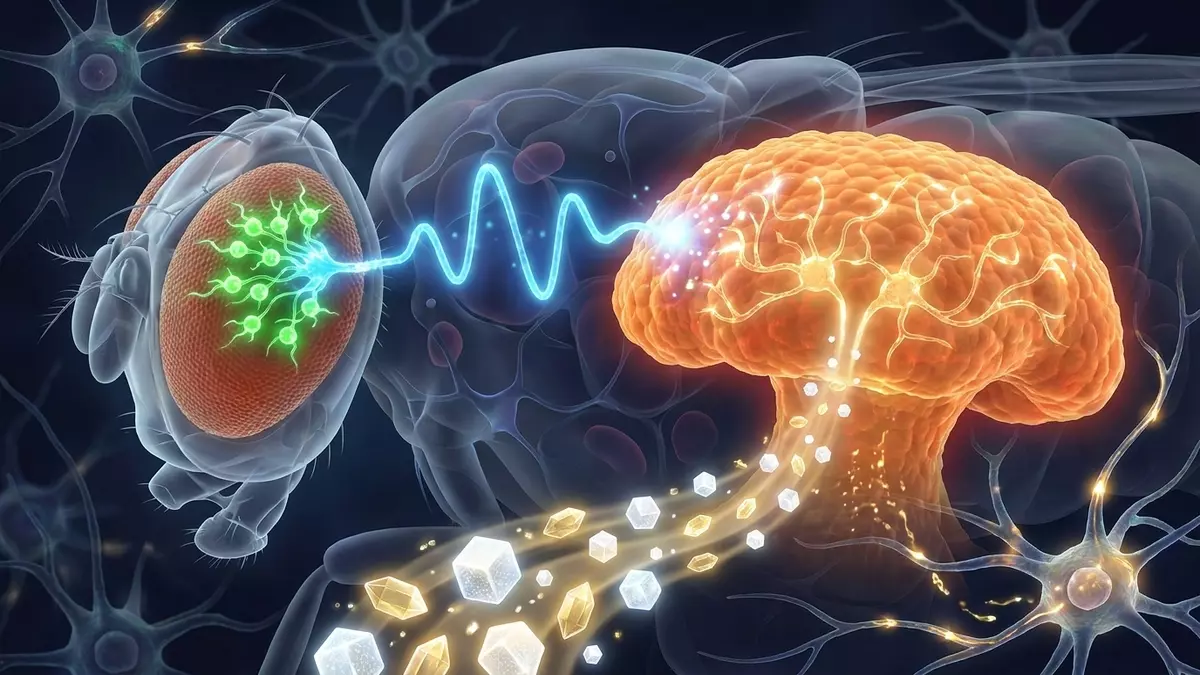
Fruit flies possess a specialized cluster of brain cells known as Gr43a neurons. These cells act as an internal fuel gauge, specifically sensing levels of fructose (a simple carbohydrate sugar) in the blood.

[Normal Satiated State] ➔ Gr43a Neurons Quiet ➔ Food Seeking Stops
[Post-Learning State]   ➔ Gr43a Neurons Reset ➔ "False Hunger" Activated
Under ordinary circumstances, these neurons flare to life when the fly is starving to encourage feeding, and they fall completely silent once the fly has eaten its fill.
The Experiment: Spaced Learning Triggers False Hunger
The researchers trained flies using an association test called aversive olfactory learning. The insects were exposed to a specific scent paired with mild, microscopic electric shocks.
Crucially, the scientists utilized spaced learning—breaking the training up into distinct sessions with rest periods in between. This mirrors human study habits; spaced repetition is the golden standard for transferring data from short-term memory into permanent, long-term storage, whereas frantic “cramming” typically fails.

What happened immediately following this spaced training surprised the research team:
The Sugar Gauge Reset: Even though the flies were completely full, their Gr43a sugar-sensing neurons suddenly switched into a highly sensitive, “fasted” state.
Active Sugar Seeking: The full flies began acting hungry, showing an intense attraction to carbohydrates and consuming extra sugar.
The Knockout Block: When scientists artificially deactivated these sugar-sensing neurons right after the training, the flies failed to form long-term memories. Deactivating the neurons later had no effect. The window of false hunger was mandatory for memory stabilization.
Inside the Memory Circuit: Fueling the Mushroom Body
The brain doesn’t just experience hunger for the sake of it; the sugar signal serves as a master key to unlock a specific physical memory bank.
Once the Gr43a neurons detect sugar during this post-learning window, they release a hormone-like chemical messenger called thyrostimulin. This hormone travels directly to a specialized center of the insect brain known as the mushroom body.
[Gr43a Sensors Triggered] ➔ [Release Thyrostimulin] ➔ [Power Up Mushroom Body] ➔ [Memory Consolidated]
Despite its name, the mushroom body is not a fungus; it is the central command room where the insect sorts, processes, and locks away vital life experiences. Previous neuroscientific research proved that building a long-term memory requires a massive surge of cellular energy inside the mushroom body. This new study fills in the missing piece: the false hunger window forces the organism to seek out carbohydrates, providing the sudden rush of sugar required to fuel the memory machinery.
Interestingly, when researchers tried to substitute the post-learning meal with coconut oil (which provides pure calories but zero carbohydrates), the memory failed to consolidate. The brain specifically required sugar, not just random energy, to lock the memory into place.
Important Nuance: What This Means for Humans
While this discovery is a major breakthrough in understanding cognitive evolution, it requires a careful, grounded interpretation:
This is a study on fruit flies, not humans. Human brains are infinitely more complex, and our memory structures (primarily the hippocampus) utilize entirely different neural pathways than an insect’s mushroom body.
Buying a box of sugary donuts or drinking soda after a intense study session will not automatically help you pass an exam. Instead, the true value of this research is conceptual: it proves that the biological systems governing metabolic energy, appetite, and memory storage overlap in ways science never previously realized.
Conclusion
The discovery that the brain interprets the consolidation of a memory as a minor energy emergency highlights the steep biological cost of learning. By temporarily bending its own hunger signals, a tiny brain can successfully force an organism to find the fuel necessary to protect crucial information. As neuroscience continues to map these pathways, we move closer to understanding how our daily diet, physical state, and cognitive habits interact to shape the way we interact with the world.
Frequently Asked Questions
Does this study imply that I should eat sugary snacks while studying?
No. This research was conducted strictly on fruit flies, which have completely different metabolic structures than humans. For humans, consuming large amounts of refined sugar causes rapid blood glucose spikes and crashes, which typically impairs concentration, causes fatigue, and harms long-term cognitive health.
What is the difference between spaced learning and massed learning?
Spaced learning involves breaking study material down into short sessions separated by timed intervals of rest. Massed learning is continuous, uninterrupted studying (commonly known as cramming). Spaced learning is mathematically proven across species to stimulate permanent neural pathways, whereas massed learning only retains information temporarily.
Why did coconut oil fail to save the memories in the experiment?
Coconut oil consists primarily of fats (lipids). While fats are incredibly high in calories, the specific memory consolidation pathway in the fly’s mushroom body requires carbohydrates (sugars like glucose and sucrose) to trigger the thyrostimulin hormone response. The brain specifically needed sugar, not raw calories.
What is calcium imaging in neuroscience?
Calcium imaging is a high-tech optical method used by researchers to watch brain activity inside a living organism. When neurons fire, calcium ions rush into the cells. By engineering organisms with fluorescent dyes or proteins that glow in the presence of calcium, scientists can visually watch exactly which brain cells turn on during a behavior.
Do human hunger hormones affect human memory?
Yes, though through different mechanisms. Human metabolic hormones like ghrelin (the “hunger hormone”) and leptin (the “fullness hormone”) have receptors in the human hippocampus—our primary memory center. Neuroscientists already know that fasting and feeding cycles alter human cognitive performance, and this new fruit fly study provides deeper insight into how old those evolutionary links might be.