
Table of Contents
The Coco de Mer: Nature’s Giant “Double Coconut”
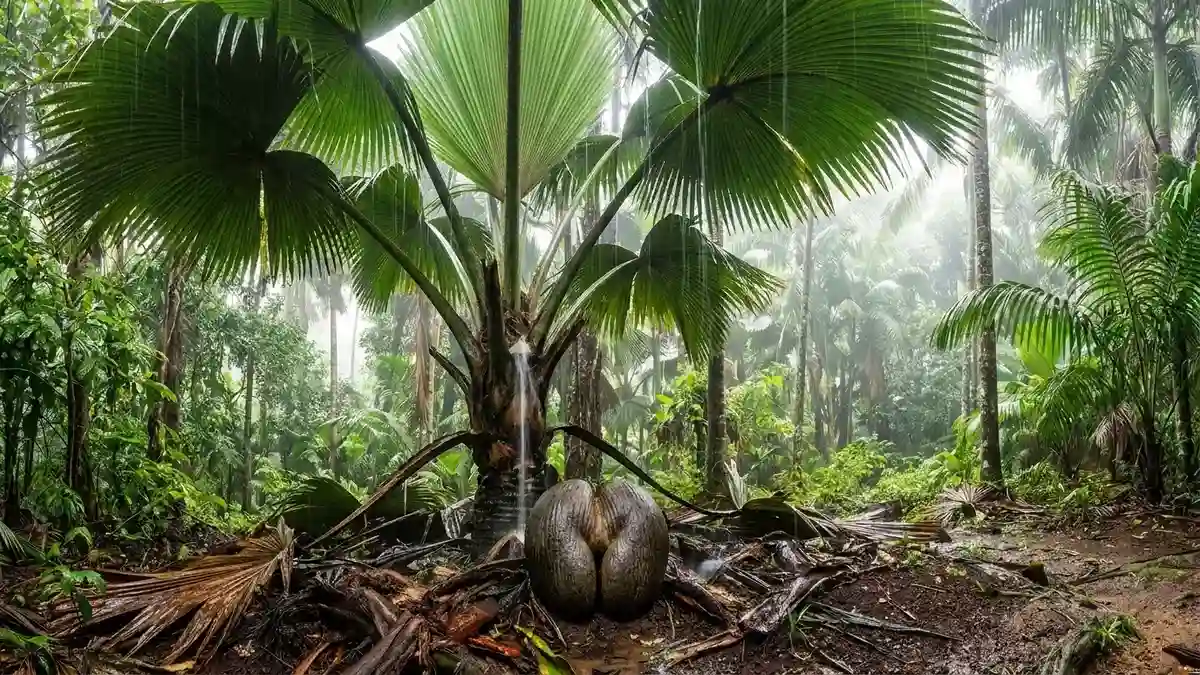
In the heart of the Seychelles, deep within the lush canopy of the Vallée de Mai Nature Reserve, grows a palm that defies botanical convention. The coco de mer (Lodoicea maldivica) is not merely a tree; it is an evolutionary marvel. Famous for producing the world’s largest seed—a massive, double-lobed structure that can weigh up to 66 pounds and stretch nearly 20 inches—this palm operates on a timeline and a survival strategy that feels almost extraterrestrial.
The Coco de Mer Nature’s Giant Double Coconut
A Botanical Heavyweight
When discussing the coco de mer, the scale is difficult to comprehend. Unlike the lightweight, wind-blown seeds of a dandelion or the animal-dispersed acorns of an oak, the coco de mer seed is a “carry-it-with-two-hands” endeavor. While estimates vary slightly depending on moisture content and whether one is measuring the seed or the protective fruit husk, the consensus remains that it is the undisputed heavyweight champion of the plant kingdom.
According to the Royal Botanic Gardens, Kew, these seeds can reach up to 55 to 66 pounds and 20 inches in length. This immense size serves a specific evolutionary purpose. Because the seeds are too heavy to be dispersed by animals or wind, they typically fall directly beneath the parent tree. In the nutrient-starved soils of the Seychelles, a massive seed provides a significant “starter pack” of energy, giving the seedling a better chance of establishing roots and surviving in the shadow of its ancestor.

Ingenious Engineering: The Rain-Harvesting System
Living on nutrient-poor ground is a challenge that would kill most plants, but the coco de mer has developed a sophisticated, self-sustaining “parental care” system. It does not just wait for rain; it actively manages it.
The palm’s foliage is spectacular, with individual leaves spanning up to 108 square feet. These massive, fan-shaped leaves function like a complex gutter system. During a storm, the architecture of the leaves channels cascading rainwater directly toward the trunk of the tree. Ecologist Christopher N. Kaiser-Bunbury, who has studied these palms extensively, notes that the redirection is so effective that one can walk through a coco de mer forest during a torrential downpour and remain remarkably dry.
The Secret to Nutrient Recycling
The tree’s “gutter” system does more than move water; it delivers vital sustenance. As the rainwater flows over the massive leaves and down the trunk, it collects organic debris, including:

Pollen
Animal droppings
Decaying plant matter

This nutrient-rich runoff is funneled into the soil immediately surrounding the base of the tree. Research conducted at the Vallée de Mai and published in the journal SONAR revealed that the soil near the trunk of a coco de mer contains nearly three times the phosphate levels of soil just a few feet away. By creating this high-nutrient “drop zone,” the tree ensures that its own offspring—which land nearby—have the chemical resources necessary to thrive, while simultaneously creating an environment that is less hospitable to competing plant species.
A Lifetime of Patience
The coco de mer is the antithesis of the “fast-growth” strategy seen in many tropical plants. Everything about its life cycle is, by human standards, agonizingly slow:
Maturation: It can take between 25 and 50 years for a palm to reach full maturity.
Fruit Ripening: Once pollinated, a single fruit may require six to ten years to fully ripen.
Germination: Once the giant seed hits the forest floor, it can take up to two years just to begin the germination process.
This deliberate pace is the species’ greatest strength and its most significant vulnerability. Because it takes decades to replace a single tree, the species cannot bounce back quickly from habitat loss or over-harvesting. Studies, including those in Forest Ecology and Management, suggest that if current pressures continue, the population could see a steady decline over the next two centuries.
Protecting a Living Legacy
The coco de mer is a testament to the power of specialized adaptation. By turning its own leaves into irrigation tools and its own waste into fertilizer, it has secured its place in a challenging ecosystem. However, its “monodominant” status—where it dominates its specific patch of forest—means that its survival is inextricably linked to the protection of the entire habitat.
For the coco de mer, survival is not a sprint; it is an endurance race that has lasted for millennia. Protecting these forests is not just about saving a rare tree; it is about preserving one of the most unique and patient engineering feats in the natural world.
Frequently Asked Questions (FAQ)
1. Why is the coco de mer seed shaped like a double coconut?
The distinct, two-lobed shape is a biological oddity that has fascinated botanists for centuries. While the exact evolutionary driver for the specific shape remains a subject of study, its primary function is to store massive amounts of energy to support the growth of the seedling in harsh, nutrient-poor environments.
2. Can I grow a coco de mer in my backyard?
Because of its massive size, slow growth rate, and very specific environmental requirements (tropical, high-humidity, and specific soil nutrients found in the Seychelles), it is not a suitable plant for home cultivation. It is also highly protected under international and local law.
3. Is the coco de mer currently endangered?
The species is considered rare and its population is vulnerable. It is found naturally in the wild only on two islands in the Seychelles, Praslin and Curieuse. Habitat protection and strict regulations against harvesting are essential for its long-term survival.
4. Does the “rain-harvesting” system benefit other plants in the forest?
The system is highly specialized for the coco de mer. By concentrating nutrients at its own base, the tree actually creates a “nursery” for its own seeds that is specifically optimized for them, often making it difficult for other species to compete for the same space.
5. How long can a coco de mer tree live?
The coco de mer is known for its extreme longevity, with some specimens capable of living for several hundred years. Its slow metabolic rate and deliberate development allow it to endure in a stable environment for centuries.