
Table of Contents
- 1. Why Our Bodies Are Running on Empty
- 2. The Chemistry of Bisglycinate: Why It’s Gentler on the Stomach
- 3. What the Clinical Evidence Says About Sleep and Stress
- 3.1. The Schuster Sleep Trial
- 3.2. The Glycine Bonus
- 4. Smart Dosing: How to Read a Supplement Label
- 4.1. Elemental Magnesium vs. Compound Weight
- 4.2. Staying Within Safe Tolerances
- 5. The Food-First Foundation
- 6. Frequently Asked Questions (FAQ)
- 6.1. 1. What is the difference between magnesium glycinate and magnesium bisglycinate?
- 6.2. 2. Can I take magnesium bisglycinate in the morning, or will it make me drowsy?
- 6.3. 3. Does the FDA approve magnesium supplements to treat high blood pressure or anxiety?
- 6.4. 4. How long does it take to see improvements in sleep or stress levels?
- 6.5. 5. Why does cheap magnesium oxide cause diarrhea while bisglycinate doesn’t?
The Magnesium Bisglycinate Shift: The Science Behind the Wellness Trend
Go down any wellness aisle or browse any health forum today, and you will find magnesium at the center of the conversation. It is being praised as a foundational fix for everything from poor sleep and daily anxiety to muscle soreness and sluggish digestion.
However, as magnesium supplements have surged into the mainstream, consumers have quickly run into a frustrating roadblock: not all magnesium is created equal. Cheap, traditional forms like magnesium oxide often come with a notorious downside—severe digestive distress, cramping, and an abrupt laxative effect.
This unpleasant reality has driven a massive shift toward a specific, premium variation: magnesium bisglycinate (also frequently labeled as magnesium glycinate). It has rapidly become the form people keep choosing, specifically for stress relief, sleep support, and gut comfort.
Here is a look at the clinical biology, recent research, and practical guidelines behind why this specific pairing is changing how we approach mineral supplementation.


The Magnesium Bisglycinate Shift: The Science Behind the Wellness Trend
Why Our Bodies Are Running on Empty
Despite its sudden popularity, magnesium is far from a trendy wellness novelty. It is a workhorse mineral that serves as a required cofactor for more than 300 enzymatic reactions in the human body. These microscopic tools are responsible for basic, non-negotiable bodily maintenance:
Energy Production: Helping your cells convert nutrients into usable cellular fuel.
Systemic Regulation: Controlling blood sugar levels, regulating blood pressure, maintaining a steady cardiac rhythm, and synthesizing proteins.
Neuromuscular Signaling: Enabling muscles to contract and relax, and allowing nerves to transmit clear signals throughout the body.

According to federal nutrition guidelines established by the National Institutes of Health (NIH), adult men generally require 400 to 420 milligrams of magnesium daily, while adult women need 310 to 320 milligrams.

Yet, despite its critical importance, national survey data reveals a stark nutritional gap: nearly half of all Americans fail to consume enough magnesium through their daily food and drink.
[Modern Processing] ──> Removes Mineral-Rich Bran & Germ ──> Low-Magnesium Diet ──> Systemic Deficiencies
This widespread deficit is largely driven by modern dietary habits. While magnesium is abundant in whole, fiber-rich foods like leafy greens, legumes, nuts, seeds, and whole grains, it is easily stripped away during industrial food production. When grains are highly refined, the nutrient-dense outer layers are discarded, leaving the final products heavily depleted of this vital mineral.
Furthermore, specific populations face a much higher risk of low magnesium status. Older adults, individuals managing type 2 diabetes, those dealing with alcohol dependence, and people with chronic digestive disorders (like Celiac or Crohn’s disease) either absorb less magnesium or lose it at an accelerated rate through their kidneys and GI tract.
The Chemistry of Bisglycinate: Why It’s Gentler on the Stomach
To understand why magnesium bisglycinate has captured the market, you have to look at its molecular structure.
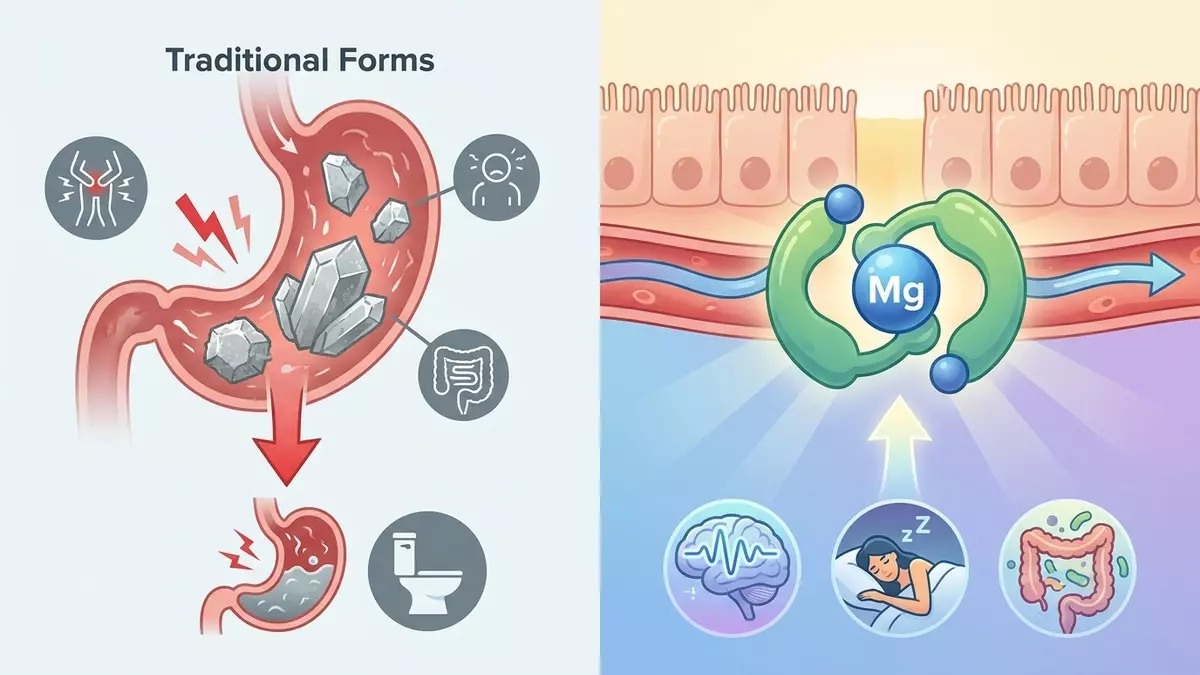
In its raw, elemental state, magnesium is highly reactive. To make it stable enough for us to swallow, manufacturers must bind it to another molecule. Traditional, lower-cost supplements rely on inorganic bonds—such as magnesium oxide or magnesium sulfate. These compounds are highly inefficient; the body struggles to break them apart in the gut. The unabsorbed magnesium remains in the intestines, drawing in water via osmosis, which triggers diarrhea, nausea, and abdominal cramping.
Magnesium bisglycinate fixes this issue through a structural technique called chelation (pronounced key-lay-shun).
       [ Glycine Amino Acid ]
                 │
[ Elemental Magnesium Atom ]
                 │
       [ Glycine Amino Acid ]
In a bisglycinate compound, a single elemental magnesium atom is chemically bound to two molecules of glycine, a naturally occurring amino acid. This organic pairing completely alters how the mineral behaves inside your digestive system.
Instead of relying on the body’s highly volatile mineral pathways for absorption, the chelated molecule is recognized by the intestines as a protein. It slips smoothly through specialized amino acid channels in the gut wall, bypassing the standard digestive bottlenecks.
A comprehensive clinical review published in the journal Nutrients confirmed that magnesium glycinate formulations demonstrate exceptionally high bioavailability and superior gastrointestinal tolerance compared to inorganic mineral salts. You absorb significantly more of the mineral, and your stomach escapes the laxative side effects.
What the Clinical Evidence Says About Sleep and Stress
While the superior absorption of magnesium bisglycinate is firmly established by chemistry, its reputation as a miracle cure for insomnia and anxiety requires a more nuanced look at the latest clinical trials.
The Schuster Sleep Trial
The link between magnesium bisglycinate and improved sleep quality was put to a rigorous test in a randomized, double-blind, placebo-controlled trial. The study, led by researcher Julius Schuster at Leibniz University Hannover along with clinical psychologist Adrian Lopresti of Murdoch University, evaluated 155 adults struggling with poor sleep quality.
Participants were given either a placebo or 250 milligrams of elemental magnesium in the form of magnesium bisglycinate daily for four weeks.
The Outcome: The group receiving the magnesium bisglycinate showed a statistically significant, modest improvement in their overall insomnia severity scores.
The Caveat: While the progress was clear, the overall effect size was modest. The researchers emphasized that while magnesium bisglycinate is a highly valuable supportive tool for sleep hygiene, it should be viewed as part of a broader lifestyle strategy rather than a standalone, instantaneous cure for chronic sleep disorders.
The Glycine Bonus
The unique benefit of the bisglycinate form during the evening hours likely stems from its compound partner: glycine. Beyond its role as a delivery vehicle for magnesium, glycine acts as an inhibitory neurotransmitter in the brain. It has been shown to naturally calm the central nervous system, lower core body temperature, and encourage the brain to ease into deeper phases of rest.
When you take magnesium bisglycinate, you aren’t just getting the muscle-relaxing benefits of magnesium; you are simultaneously getting a functional dose of a calming amino acid.
Smart Dosing: How to Read a Supplement Label
If you decide to add magnesium bisglycinate to your daily routine, avoiding marketing traps requires a basic understanding of how these products are labeled.
Elemental Magnesium vs. Compound Weight
Always turn the bottle around and look closely at the “Supplement Facts” panel. You want to look specifically for the phrase “Elemental Magnesium.”
Because magnesium bisglycinate is a large molecule, a capsule that weighs 1,000 milligrams total might only yield 100 to 120 milligrams of actual, elemental magnesium once the glycine is stripped away. Legitimate, transparent brands will clearly state the exact amount of pure mineral your body will actually receive per serving.
Warning on “Buffered” Blends: Be cautious of cheap formulations labeled as “magnesium bisglycinate buffered.” This often means the manufacturer has blended a small amount of expensive magnesium bisglycinate with a large amount of cheap magnesium oxide to artificially inflate the elemental magnesium count on the label, which can trigger the exact stomach issues you are trying to avoid.
Staying Within Safe Tolerances
While magnesium is highly safe for the general public, more is not inherently better. The established Tolerable Upper Intake Level (UL) for supplemental magnesium is 350 milligrams per day for adults. This limit applies strictly to capsules, liquids, and powders—it does not include the magnesium you naturally consume through healthy foods.
Important Medical Exception: Individuals with compromised kidney function or chronic kidney disease must exercise extreme caution before starting any magnesium routine. Because the kidneys are entirely responsible for filtering and excreting excess magnesium from the bloodstream, a reduced clearing capacity can quickly lead to a dangerous, toxic buildup known as hypermagnesemia.
The Food-First Foundation
The widespread commercial success of wellness brands highlights our collective desire for simple, capsule-based solutions to stress and fatigue. However, leading nutritional experts consistently emphasize that supplements should be used to fill specific dietary gaps, not replace a balanced plate.
Whole foods provide magnesium wrapped in a complex biological matrix of dietary fiber, essential proteins, healthy fats, and trace minerals that work synergistically. A handful of pumpkin seeds, a rich bowl of steel-cut oatmeal, or a side of sautéed spinach provides systemic nourishment that an isolated pill simply cannot replicate.
If you are looking to optimize your sleep, calm your nervous system, and protect your digestive health, switching to a highly absorbable form like magnesium bisglycinate is a scientifically sound choice—just make sure it is supporting a lifestyle built on a foundation of nutrient-dense food, consistent movement, and solid rest.
Frequently Asked Questions (FAQ)
1. What is the difference between magnesium glycinate and magnesium bisglycinate?
They are exactly the same thing. “Bisglycinate” is simply the precise chemical term indicating that the magnesium atom is bound to two (“bis”) glycine molecules. Manufacturers use the terms interchangeably on health labels, so both bottles will deliver the exact same highly absorbable, stomach-friendly benefits.
2. Can I take magnesium bisglycinate in the morning, or will it make me drowsy?
You can absolutely take it in the morning. While it helps calm the nervous system and supports healthy sleep architectures at night, magnesium does not act like a sedative or a sleeping pill. Taking it early in the day will simply support muscle relaxation, nerve function, and cellular energy production without causing daytime drowsiness.
3. Does the FDA approve magnesium supplements to treat high blood pressure or anxiety?
No. The FDA treats magnesium as a dietary supplement, meaning it cannot be marketed to prevent, treat, or cure any medical condition. While the FDA does allow a highly qualified health claim stating that adequate magnesium intake may reduce the risk of hypertension, it explicitly notes that the current scientific evidence is “inconsistent and inconclusive.”
4. How long does it take to see improvements in sleep or stress levels?
Because it is highly bioavailable, some individuals notice a gentle grounding or relaxing effect within an hour of taking a proper dose. However, for chronic deficiencies and long-term sleep improvements, clinical studies show that it typically takes three to four weeks of consistent, daily supplementation to safely restore cellular magnesium levels and see measurable systemic benefits.
5. Why does cheap magnesium oxide cause diarrhea while bisglycinate doesn’t?
Magnesium oxide has a very low absorption rate (often less than 5%). The unabsorbed mineral sits directly in your colon, where it acts as an osmotic laxative, pulling water out of your body and into your bowels. Because magnesium bisglycinate is bound to amino acids, it is rapidly absorbed through protein channels in the small intestine, leaving no mineral residue behind to cause gut distress.