
Table of Contents
- 1. Understanding the Limits of Traditional Three-Sided Sheds
- 1.1. The Problem of Shifting Weather Patterns
- 1.2. Herd Dynamics and the “Bully” Factor
- 2. How the Canadian X-Shed Reinvents Pasture Shelter
- 2.1. The Anatomy of the X-Design
- 2.2. 360-Degree Climate Protection
- 2.3. Resolving Pasture Social Conflicts
- 3. Structural Comparison: Three-Sided vs. Canadian X-Shed
- 4. Step-by-Step Guide to Constructing a Canadian X-Shed
- 4.1. Essential Tools and Materials
- 4.2. Step 1: Site Selection and Positioning
- 4.3. Step 2: Excavation and Base Preparation
- 4.4. Step 3: Setting the Structural Posts
- 4.5. Step 4: Framing the Roof System
- 4.6. Step 5: Building the Intersecting Interior Walls
- 4.7. Step 6: Flooring and Safety Touches
- 5. Long-Term Maintenance and Management Rhythms
- 6. Frequently Asked Questions
- 6.1. How many animals can safely use a Canadian X-shed at one time?
- 6.2. Does the X-design cost more to build than a standard run-in shed?
- 6.3. How does the air quality compare between the two designs?
- 6.4. Can I use the Canadian X-shed for small livestock like sheep or goats?
- 6.5. Can an X-shed handle heavy winter snow loads?
Why the Canadian X-Shed Beats Traditional Run-In Livestock Shelters
Managing livestock means playing a never-ending game of strategy against the elements. Whether you are dealing with the blistering heat of a July afternoon, a sudden torrential downpour, or a brutal sub-zero winter blizzard, ensuring your animals have reliable protection is a top priority. For generations, the go-to solution for pastures has been the classic three-sided run-in shed. It is a straightforward, budget-friendly design that offers a quick escape from the weather.
However, anyone who has managed a herd knows that traditional three-sided shelters come with distinct behavioral and environmental challenges. If the wind shifts directly into the open side, the shelter becomes useless. Even worse, social hierarchies within the herd often mean dominant animals block the single entrance, leaving more submissive individuals stranded out in the cold.
Enter the Canadian “X” run-in shed design. By rethinking the basic geometry of livestock shelter, this innovative layout solves the structural and behavioral flaws of traditional sheds. Here is a deep dive into why the X-shed is a smarter, safer, and more efficient option for your horses or cattle, along with a step-by-step guide on how to build one on your property.

Why the Canadian X-Shed Beats Traditional Run-In Livestock Shelters
Understanding the Limits of Traditional Three-Sided Sheds
To appreciate the brilliance of the Canadian X-design, it helps to look closely at where standard three-sided structures fall short. The traditional run-in shed consists of three solid walls and one completely open side, usually oriented away from prevailing local winds. While this setup is economical and easy to construct, it relies on a predictable environment.
The Problem of Shifting Weather Patterns
Weather is rarely static. A storm that begins with a northern wind can easily rotate, driving rain, sleet, or snow directly into a south-facing opening. When this happens, the interior of a three-sided shed becomes damp, muddy, and drafty, forcing animals out into the elements to find relief.

Herd Dynamics and the “Bully” Factor
Livestock species, particularly horses and beef cattle, establish strict social hierarchies. In a standard three-sided shed, a dominant alpha animal can easily station itself at the single wide opening, effectively acting as a gatekeeper. Submissive herd members are often bullied or kept entirely outside. Furthermore, if a lower-ranking animal does venture inside, they risk getting cornered against the back wall by an aggressive herdmate, which can lead to high stress levels, kicks, and costly veterinary bills.
How the Canadian X-Shed Reinvents Pasture Shelter
The core philosophy of the Canadian X-shed is total adaptability. Instead of fighting herd dynamics and shifting winds, the architecture works alongside them.
The Anatomy of the X-Design
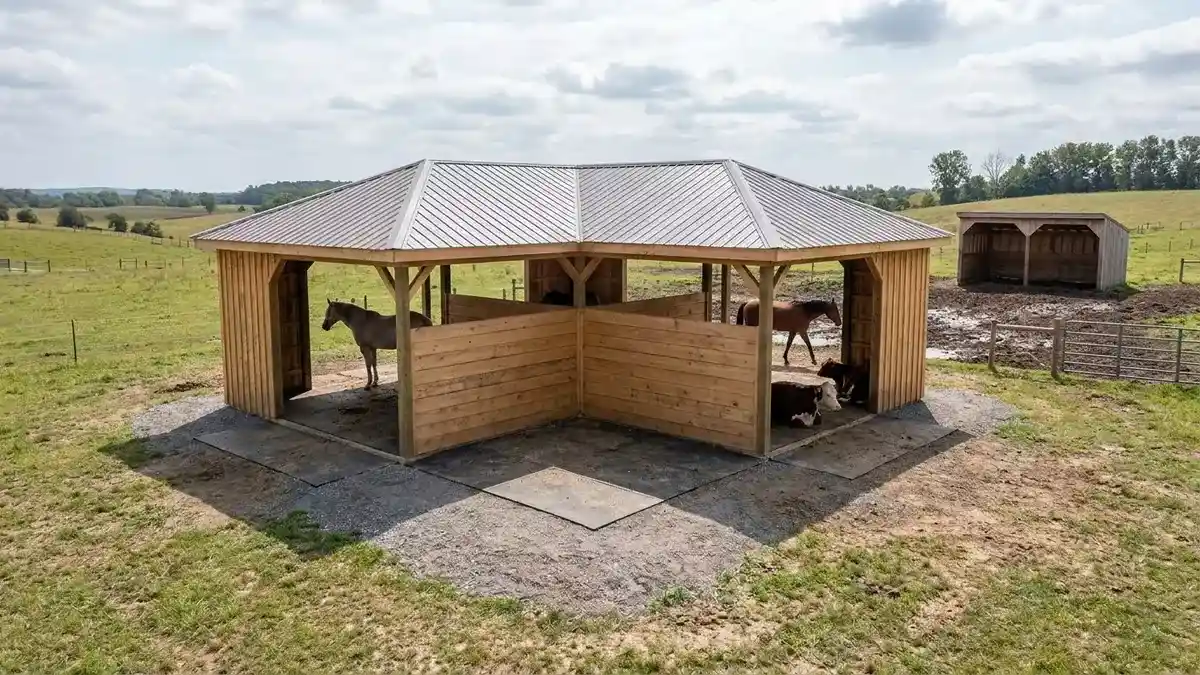
Imagine a standard square or rectangular footprint. Instead of building three outer walls, you leave all four exterior sides completely open. The magic happens on the inside: you construct two solid interior dividing walls that cross precisely in the center, forming a massive “X.”

This structural layout splits the shed into four distinct, independent quadrants, each facing a different cardinal direction: North, South, East, and West.
       [ OPEN ]
         \  /
  [OPEN]  \/  [OPEN]
          /\
         /  \
       [ OPEN ]
360-Degree Climate Protection
No matter which way the wind howls or the storm blows, the intersecting interior walls block the weather completely in at least two of the quadrants. If a freezing gale strikes from the north, your livestock instinctively move to the southern or eastern quadrants. When the summer sun is blazing directly overhead or angling from the west, the deep architectural shadows provide a cool, shaded retreat in the opposite sections.
Resolving Pasture Social Conflicts
Because the Canadian X-shed features four separate entrances and structural zones, it completely defuses herd bullying. A dominant horse or cow can only occupy one quadrant at a time. The remaining three quadrants remain wide open and accessible to the rest of the herd.
Additionally, because every single quadrant is wide open to the pasture on its outer side, an animal can never be truly trapped or cornered. If a higher-ranking animal approaches, the submissive animal can simply step out into the pasture without conflict, dramatically reducing stress and pasture injuries.
Structural Comparison: Three-Sided vs. Canadian X-Shed
When deciding which shelter to build, evaluating the structural tradeoffs can help clear up which option delivers the best long-term return on your investment.
| Feature | Traditional 3-Sided Shed | Canadian “X” Run-In Shed |
| Wind & Weather Protection | Vulnerable if wind direction shifts toward the opening. | Permanent 360-degree protection; always has a sheltered side. |
| Herd Safety & Dynamics | High risk of cornering; dominant animals can block entry. | Zero cornering risks; multiple entry zones prevent bullying. |
| Air Circulation | Can trap humidity, dust, and ammonia vapors in the back. | Excellent cross-ventilation; keeps bedding drier. |
| Material Efficiency | Low; utilizes standard framing and three outer walls. | Moderate; requires heavy-duty center support and interior walls. |
| Construction Complexity | Very simple; great for novice DIY builders. | Requires precise layout planning for the central intersection. |
Step-by-Step Guide to Constructing a Canadian X-Shed
Building an X-shed requires careful spatial planning, but the construction process uses standard, readily available agricultural building materials. Here is how to plan and execute the build successfully.
Essential Tools and Materials
Before breaking ground, gather the necessary supplies. Because this structure must withstand heavy winds from multiple angles and potential scratching or bumping from large livestock, heavy-duty materials are non-negotiable.
Support Posts: 6×6 or 8×8 pressure-treated lumber (essential for the perimeter and the central intersection).
Framing & Rafters: 2×6 or 2×8 dimensional lumber for framing, trusses, and purlins.
Interior Siding: Heavy plywood, tongue-and-groove boards, or 2×10 oak planks to handle impacts from animal hooves and bodies.
Roofing: Heavy-duty corrugated metal panels or architectural shingles.
Foundation Fill: Crushed stone, gravel, or coarse sand for base drainage.
Hardware: Heavy-duty galvanized structural screws, framing anchors, and post-hole concrete mix.
Step 1: Site Selection and Positioning
Choose a high, well-drained area in your pasture. Avoid low spots where surface water collects, as heavy livestock traffic will quickly turn wet soil into a deep mud pit. When mapping out the orientation, align the open quadrants as closely as possible with the true cardinal directions (North, South, East, West) or adjust them slightly to match the specific prevailing wind patterns of your local geography.
Step 2: Excavation and Base Preparation
Clear all topsoil and vegetation from the footprint of the structure, extending the boundary at least two feet beyond the roofline. Excavate down several inches and backfill the entire area with a thick, compacted layer of crushed stone or gravel. This creates a solid, self-draining foundation that keeps the interior dry and stands up to heavy hoof traffic.
Step 3: Setting the Structural Posts
Dig post holes at the outer corners and, most importantly, at the exact center where the interior “X” walls will meet. Holes must extend below your local frost line to prevent shifting. Secure the heavy-duty 6×6 or 8×8 pressure-treated posts into the ground using concrete. Ensure all posts are perfectly plumb and square before the concrete cures.
Step 4: Framing the Roof System
Connect the perimeter posts with heavy header beams, then construct your roof framework using rafters or engineered trusses. A hip roof or a multi-directional pitched roof works exceptionally well for this design, as it efficiently sheds rainwater and heavy snow loads away from all four open entrances. Fasten your corrugated metal roofing panels or shingles securely to the purlins.
Step 5: Building the Intersecting Interior Walls
Construct the two solid interior walls that cross in the middle of the structure. These walls must run diagonally from the center post out toward the corners, stopping short of the outer edge to leave the entryways completely clear. Use thick plywood or heavy oak planks for these dividers, ensuring they are built high enough to safely prevent animals from trying to reach or bite over the top into the neighboring quadrant.
Step 6: Flooring and Safety Touches
To optimize the health and comfort of your animals, lay down heavy-duty rubber stall mats over the compacted gravel base. Mats prevent the gravel from eroding, make mucking out the shelter incredibly easy, and offer excellent traction. Finally, thoroughly inspect the entire structure. Sand down any sharp wood splinters, countersink all screws, and verify that no bracket edges are exposed where an animal could scrape against them.
Long-Term Maintenance and Management Rhythms
An X-shed is incredibly durable, but like any piece of agricultural infrastructure, routine maintenance ensures it protects your livestock for decades.
Daily or Weekly Mucking: Because animals can enter from any angle, manure can accumulate across all four quadrants. Regular cleaning prevents ammonia buildup, keeps fly populations down, and protects hoof health.
Seasonal Foundation Refreshes: Over time, heavy rainfall or high traffic can displace gravel at the transition points where the pasture meets the stall mats. Top off these entry areas with fresh crushed stone every spring to eliminate mud holes.
Annual Hardware and Post Inspections: Large livestock love to scratch their backs and sides against solid walls. Once a year, check the structural integrity of the central intersecting walls. Tighten any loose fasteners and inspect the wood for signs of damage or wear.
Frequently Asked Questions
How many animals can safely use a Canadian X-shed at one time?
As a general rule of thumb, each individual quadrant should provide roughly the same square footage as a standard single-horse stall (typically 12’x12′ for large livestock). Therefore, a standard sized X-shed can comfortably accommodate four adult horses or head of cattle simultaneously, with each animal having its own dedicated zone.
Does the X-design cost more to build than a standard run-in shed?
The material costs are remarkably comparable. While a traditional three-sided shed uses framing and siding along its exterior perimeter, the X-shed shifts those framing and siding materials to the interior of the structure. You may spend slightly more on heavy-duty structural posts for the central intersection and roof trusses, but the added durability and safety values heavily outweigh the minor price difference.
How does the air quality compare between the two designs?
The X-shed offers far superior ventilation. Traditional three-sided sheds often suffer from dead air zones in the back corners, which can trap heat, humidity, dust, and harmful ammonia fumes from urine. Because the X-design features four open exterior sides, ambient air moves naturally through the building, keeping the environment dry and drastically reducing the risk of respiratory issues in your livestock.
Can I use the Canadian X-shed for small livestock like sheep or goats?
Absolutely. The design principles scale down beautifully for smaller livestock. In fact, sheep and goats benefit immensely from the multiple quadrants, as herd animals of all sizes utilize territorial social structures. Smaller animals will appreciate the draft-free pockets created by the interior intersecting walls during cold weather.
Can an X-shed handle heavy winter snow loads?
Yes, provided it is framed correctly. Because the structure relies on a heavy center post where the interior walls intersect, it actually features a highly robust core support system. When paired with a properly pitched roof, it handles heavy snow accumulation and high winds better than many wide-span, single-opening buildings.