
Table of Contents
- 1. Decoding Memory Consolidation: The Brain’s Energy-Intensive “Save Button”
- 2. Inside the Lab: How Fruit Flies Revealed the Sugar Secret
- 2.1. Spaced Learning vs. Cramming: Why Timing Matters
- 3. The Gr43a Sensor: The Brain’s Internal Molecular Switch
- 3.1. Timing and Nutrient Type Are Critical
- 4. Thyrostimulin: The Relay Messenger Driving Long-Term Memory
- 5. The Evolutionary Link to “Emotional Eating”
- 6. Future Implications: From Fruit Flies to Human Cognitive Health
- 7. Frequently Asked Questions (FAQs)
- 7.1. 1. Does this study mean that eating sugar will automatically make me smarter?
- 7.2. 2. Why did the researchers use fruit flies instead of testing humans directly?
- 7.3. 3. What is the difference between spaced practice and cramming for memory?
- 7.4. 4. Can healthy fats or proteins replace sugar to activate this memory switch?
- 7.5. 5. How does this research explain the human habit of “stress eating”?
New Discovery Reveals How Sugar Helps Brain Form Long-Term Memories
Have you ever noticed that after an intense, mentally exhausting study session or a highly stressful situation, your first instinct is to reach for a sugary snack? For a long time, we viewed these sudden cravings as a simple psychological desire for comfort food. However, groundbreaking neuroscience reveals that this phenomenon is actually driven by a biological imperative deeply hardwired into our biology.
A fascinating study published in Nature has uncovered a profound molecular link between metabolic intake and cognitive longevity. Researchers discovered that eating sugar triggers a biological “save button” within the brain, helping convert fleeting experiences into permanent, long-term memories. Interestingly, the key to unlocking this mystery lay within the neural architecture of hungry fruit flies.
New Discovery Reveals How Sugar Helps Brain Form Long-Term Memories

Decoding Memory Consolidation: The Brain’s Energy-Intensive “Save Button”
To understand this discovery, it helps to look at how our brains handle new information. The human brain processes thousands of short-term inputs every minute, but only a select few are transformed into permanent knowledge. This transformation process is known as memory consolidation.
Think of your brain like a gaming console. Short-term memory is the active gameplay happening in real time; if you turn off the console without saving, that progress is lost forever. Memory consolidation is the act of hitting the “save button,” ensuring the data is written onto the hard drive so you can access it later.
However, saving your progress is not free. Re-engineering neural pathways to build stable, long-term memories requires an immense amount of cellular work. Brain cells must synthesize new proteins and restructure their connections, a process that demands substantial metabolic fuel. The brain needs both a steady supply of energy and an unambiguous biological signal confirming that the information learned is worth the massive energy expenditure.

Inside the Lab: How Fruit Flies Revealed the Sugar Secret
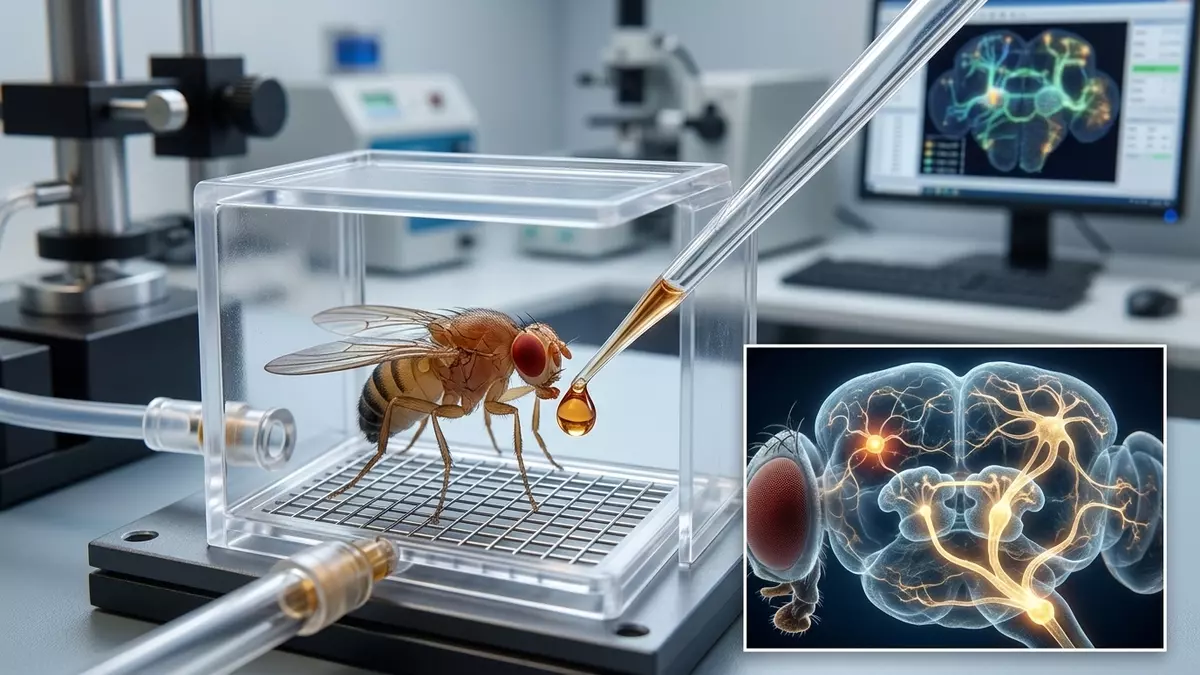
To map out this intricate relationship between metabolism and cognition, a research team at the Brain Plasticity Unit in Paris—a division of France’s National Center for Scientific Research (CNRS)—turned to a dependable staple of laboratory neurobiology: Drosophila melanogaster, the common fruit fly.
While fruit flies may seem entirely detached from human biology, their underlying neurological principles are remarkably similar to ours. Because their brains are highly compact and easier to genetically manipulate, they serve as an ideal model for tracking exactly how individual neurons talk to one another during the learning process.
The study, authored by lead researcher Raquel Francés and supervised by neuroscientists Thomas Preat and Pierre-Yves Plaçais, utilized an associative learning framework called aversive conditioning to study memory formation:

The Stimulus: Flies were exposed to a distinct environmental odor paired with a mild, harmless electric shock.
The Goal: The flies learned to associate that specific smell with danger, prompting them to actively avoid it in the future.
The Testing: Researchers evaluated how well the insects remembered this safety lesson 24 hours later, comparing groups that received different training schedules and nutritional interventions.
Spaced Learning vs. Cramming: Why Timing Matters
The research team split the flies into two primary training groups. The first group underwent a rapid, back-to-back training routine, effectively “cramming” the information. The second group participated in spaced practice, learning the association across multiple short sessions separated by distinct rest intervals.
For decades, educators and psychologists have championed the “spacing effect,” noting that human students retain information far better when study sessions are spread out over time rather than packed into a single night. This fly experiment revealed the precise biological reason why this happens.
The researchers discovered that the physical breaks during spaced training did something extraordinary: they pushed a highly specific sugar-sensing circuit in the brain into a temporary, synthetic “hunger mode.” Even though the flies were completely well-fed and satiated prior to the experiment, the spaced learning structure tricked their brains into believing they desperately needed fuel to lock in the memory.
The Gr43a Sensor: The Brain’s Internal Molecular Switch
At the absolute center of this neurological phenomenon is a specialized cluster of sugar-sensing neurons equipped with a receptor called Gr43a.
[Spaced Learning Session]
       │
       ▼
[Tricks Gr43a Neurons into "Hunger Mode"]
       │
       ▼
[Sugar Intake Consumption]
       │
       ▼
[Release of Thyrostimulin Hormone]
       │
       ▼
[Memory Consolidation "Save Button" Activated]
The Gr43a receptor is specifically tuned to detect fructose, a simple sugar abundant in fruit. When animals consume various carbohydrates—including glucose—the body processes and converts them into internal sugar signals that these receptors continuously monitor. Essentially, Gr43a acts as an internal nutrient gatekeeper, constantly measuring the chemical composition of the blood to report back to the brain.
Under normal, everyday conditions, Gr43a neurons regulate basic survival behaviors:
When an animal is starving: These neurons become highly sensitive, urging the creature to seek out carbohydrates and eat.
When an animal is full: The sensitivity of these neurons drops significantly, signaling to the body that it is time to stop eating.
However, the CNRS team observed that spaced learning completely overrides this baseline homeostatic balance. The cognitive strain of spaced practice forces the Gr43a circuit to reset its threshold, mimicking starvation. When the flies were given a sweet treat immediately after their spaced learning sessions, these newly sensitized neurons fired rapidly, signaling to the rest of the brain that the ideal metabolic window had arrived to commit the lesson to long-term memory.
Timing and Nutrient Type Are Critical
The research highlighted that this memory-saving mechanism is incredibly picky. The timing of the sugar delivery had to be precise. When flies were fed carbohydrates shortly after their spaced training, their 24-hour retention of the negative odor association skyrocketed. Conversely, if researchers withheld food immediately following the training sessions, the long-term memory failed to stabilize, leaving the flies vulnerable to forgetting the lesson entirely.
Furthermore, the quality of the fuel mattered just as much as the clock. Feeding the insects solutions of sucrose (table sugar) or glucose successfully activated the long-term memory consolidation sequence. However, when the researchers offered the flies a calorie-dense, fat-rich alternative instead, the memory consolidation process did not occur.
This critical distinction proves that the phenomenon is not merely about dumping raw calories or general energy into the body. The brain isn’t just looking for an arbitrary power source; it is awaiting a highly specific molecular message carried exclusively by carbohydrates.
Thyrostimulin: The Relay Messenger Driving Long-Term Memory
Once the Gr43a sugar-sensing neurons register the arrival of carbohydrates at the correct moment, they trigger a chemical domino effect. The activated neurons release a specialized, hormone-like signaling messenger known as thyrostimulin.
Thyrostimulin acts as the primary relay runner in this biological race. It carries the vital “sugar has arrived” notification from the metabolic sensors directly into the deeper neural circuits responsible for structural memory storage. This hormonal green light alerts the brain’s memory machinery that the body has successfully secured the premium fuel required to handle the metabolically expensive process of structural consolidation.
Note: This discovery does not suggest that eating large quantities of candy or processed junk food will magically boost your intelligence. Rather, it uncovers a highly sophisticated, evolutionary bridge showing how metabolic health and cognitive capabilities are deeply intertwined.
The Evolutionary Link to “Emotional Eating”
One of the most profound observations made during the CNRS study was how this neural reset altered the physical behavior of the flies. After completing their spaced training sessions, the insects did not just form better memories when fed sugar—they also actively sought it out with greater intensity. For a distinct window of time following their lessons, the flies demonstrated a heightened preference for sweets, consuming significantly more carbohydrates than their untrained peers.
The research team pointed out that this behavior mirrors the foundational mechanics of human “emotional eating.” When we encounter high-stress environments or demanding intellectual challenges, our brains may artificially replicate this ancient hunger loop. By tricking the body into a state of perceived starvation, the brain deliberately drives us to crave quick-acting carbohydrates to guarantee it has the necessary resources to store the vital survival data it just gathered.
Future Implications: From Fruit Flies to Human Cognitive Health
This research opens up a brand-new frontier in neurobiology, shedding light on the deeply overlooked intersections between metabolic disorders and cognitive decline. The lab’s ongoing mission focuses on utilizing advanced genetic tools, behavioral analysis, and real-time brain imaging to fully map how energy metabolism dictates cognitive performance.
The critical next milestone for neuroscientists is to determine whether an identical or highly analogous Gr43a-thyrostimulin pathway functions within the mammalian brain. If similar carbohydrate-driven memory switches are confirmed in humans, it could radically transform our approach to treating metabolic and cognitive health issues:
Optimized Learning Profiles: Designing specialized nutritional and scheduling strategies for students and professionals to naturally maximize memory retention.
Metabolic and Cognitive Therapeutics: Developing targeted therapies for cognitive decline, dementia, and Alzheimer’s disease by addressing underlying cerebral metabolic deficiencies.
Re-evaluating Eating Disorders: Providing novel neurological frameworks to treat chronic overeating and sugar addiction by viewing them through the lens of memory consolidation and stress responses.
Ultimately, this study serves as an elegant reminder that our minds and bodies are not separate entities. The complex act of remembering is deeply rooted in our physical biology, relying entirely on the food we consume and the precise moments we choose to refuel.
Frequently Asked Questions (FAQs)
1. Does this study mean that eating sugar will automatically make me smarter?
No. The study emphasizes that sugar acts as a temporal signaling mechanism to lock in specific information that has already been studied through spaced practice. Consuming excess sugar without focused learning will not enhance general intelligence or improve baseline cognitive performance.
2. Why did the researchers use fruit flies instead of testing humans directly?
Fruit flies (Drosophila melanogaster) share a substantial amount of genetic and neurological architecture with humans. Their smaller brains allow neuroscientists to map out, isolate, and observe the activity of individual neurons and receptors (like Gr43a) in real time—something that is currently impossible to do with the complex, dense structure of a living human brain.
3. What is the difference between spaced practice and cramming for memory?
Cramming consists of continuous, back-to-back learning without breaks, which provides short-term retention but fails to trigger long-term storage mechanisms. Spaced practice involves breaking up learning with rest intervals. This study proves that these intervals actively prompt sugar-sensing neurons to enter a “hunger mode,” which is necessary to trigger permanent memory storage once food is consumed.
4. Can healthy fats or proteins replace sugar to activate this memory switch?
According to the study, no. When researchers fed the fruit flies a fat-rich option instead of carbohydrates, the long-term memory switch failed to activate. The brain requires the specific molecular signature of simple carbohydrates (like fructose or glucose) to trigger the release of thyrostimulin and approve memory consolidation.
5. How does this research explain the human habit of “stress eating”?
The study revealed that intense spaced learning tricks the brain into a synthetic hunger mode, causing the flies to experience heightened sugar cravings and eat more sweets. In humans, stressful or intellectually grueling tasks may similarly trigger this deep-seated evolutionary mechanism, prompting us to crave sugary comfort foods to safeguard vital information.