
Table of Contents
- 1. Why Do Onions Bolt? Understanding the Triggers
- 1.1. 1. Wild Temperature Fluctuations
- 1.2. 2. Environmental Stress Factors
- 1.3. 3. Choosing the Wrong Variety for Your Latitude
- 2. What to Do When Your Onions Start to Bolt
- 2.1. Harvest Without Delay
- 2.2. Use Them Fresh (Skip the Root Cellar)
- 2.3. Get Creative in the Kitchen
- 2.4. Support Local Pollinators
- 2.5. Experiment with Seed Saving
- 3. Proactive Strategies to Prevent Bolting Next Season
- 3.1. Choose Resilient Varieties
- 3.2. Check the Day-Length Requirements
- 3.3. Perfect Your Planting Timeline
- 3.4. Always Harden Off Transplants
- 3.5. Provide Steady, Reliable Moisture
- 3.6. Give Them Room to Breathe
- 4. Framing Gardening Shifts as Progress
- 5. Frequently Asked Questions
- 5.1. Can you stop an onion from bolting by cutting off the flower stalk?
- 5.2. Are bolted onions safe to eat?
- 5.3. How long will a bolted onion keep after harvest?
- 5.4. Does mulch really prevent onions from flowering early?
- 5.5. Why did only a few of my onions bolt while others in the same bed are fine?
Onion Bolting: How to Save Your Harvest and Prevent Early Blooms
Few things match the pride of tending an onion patch, eagerly awaiting the day you pull plump, golden globes from the earth. But nature occasionally throws a curveball. You might walk out to your garden bed only to find a thick, rigid stalk shooting straight up from the center of your plants, quickly topped by a rounded flower bud.
Your onions have bolted. While this sudden shift can feel incredibly frustrating, it is far from a total loss. Understanding why this happens allows you to pivot your strategy, salvage a delicious harvest, and safeguard your future garden layouts.
Onion Bolting How to Save Your Harvest and Prevent Early Blooms
Why Do Onions Bolt? Understanding the Triggers
To successfully manage and prevent bolting, it helps to look at the biology of the onion plant. Onions are naturally biennials. Under normal circumstances, their life cycle spans two years: they spend the first season channeling energy into foliage and a large underground storage bulb, go dormant over winter, and then produce flowers and seeds in their second year.
Bolting occurs when environmental stressors fool a first-year onion into believing it has already completed its winter dormancy, forcing it prematurely into its reproductive phase.
1. Wild Temperature Fluctuations
The primary culprit behind early flowering is unpredictable spring weather. If young onion plants experience a prolonged cold snap followed by a sudden wave of warm weather, the internal clock of the plant resets. It senses that “winter” has passed and immediately shifts its energy away from bulb development to prioritize seed production.
2. Environmental Stress Factors
Onions crave stability. When they experience erratic conditions, their survival instincts kick in. Common stressors include:
Inconsistent watering: Alternating between bone-dry soil and muddy, waterlogged conditions.
Root shock: Rough handling during transplanting or moving seedlings outdoors too quickly.
Overcrowding: Forcing plants to compete aggressively for root space, nutrients, and sunlight.
3. Choosing the Wrong Variety for Your Latitude
Onions are highly sensitive to day length, and planting a variety poorly suited to your geographic location frequently triggers premature blooming.
Long-day onions require 14 to 16 hours of sunlight and thrive in Northern regions.
Short-day onions need only 10 to 12 hours of light and are tailored for Southern climates.
Intermediate-day onions bridge the gap, performing best in the central belt of the country.
What to Do When Your Onions Start to Bolt
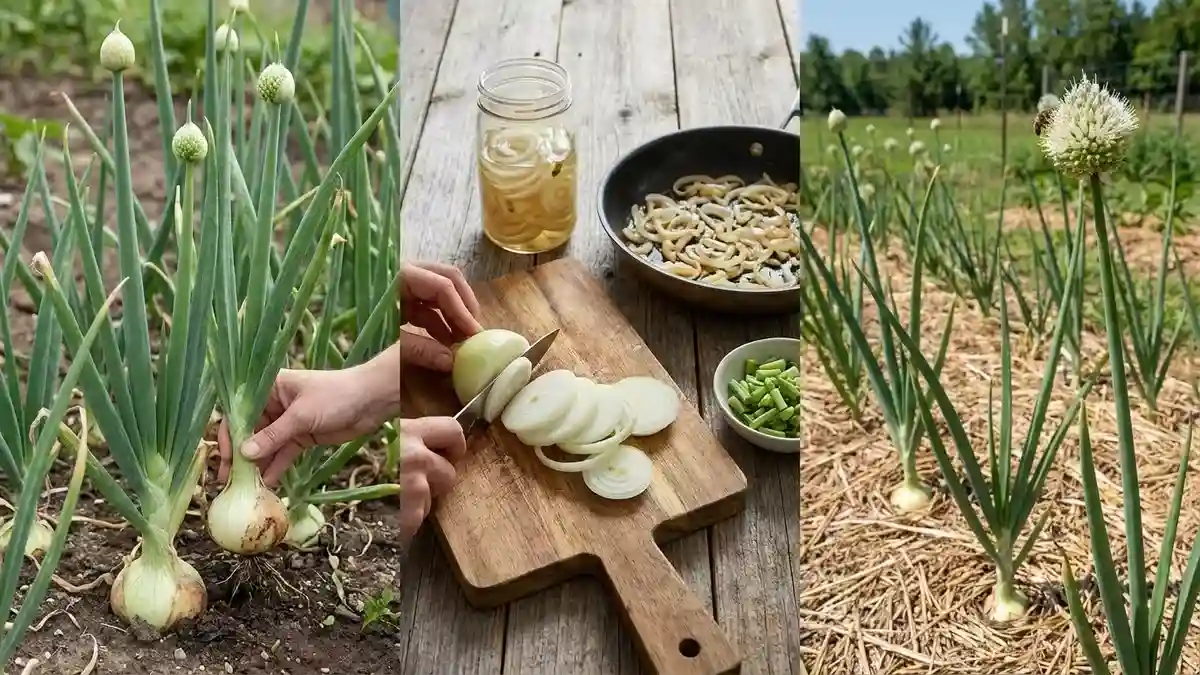
The moment you spot that thick, central flower stalk, bulb growth grinds to a halt. The plant will no longer channel sugars into swelling the onion itself. However, you do not need to toss these plants into the compost bin. Here is how to make the most of a bolted crop:
Harvest Without Delay
Don’t wait for the flower to fully open. Pull the bolted onions out of the ground immediately. If left in the soil, the central core of the bulb rapidly turns tough, woody, and fibrous, making it unpleasant to eat. Harvesting early ensures the surrounding layers remain tender and flavorful.
Use Them Fresh (Skip the Root Cellar)
Bolted onions lose their ability to cure properly. The thick central flower stalk leaves a large, open gap at the neck of the bulb when harvested, creating an easy entry point for moisture and rot-causing bacteria. Because they will not store well, bypass the drying rack and bring them straight to the kitchen for immediate use.
Get Creative in the Kitchen
Though they might be smaller than your target size, bolted onions still pack an incredible, robust flavor.
Sauté and Caramelize: Slice them up for stir-fries, soups, or slow-cook them into sweet caramelized toppings for burgers and flatbreads.
Pickling: Thinly slice the bulbs and submerge them in a quick vinegar brine for a tangy condiment.
Eat the Stalks: Do not throw away the green flower stems! While the very base can be tough, the tender upper portions of the stalk can be chopped up and used exactly like scallions or chives.
Support Local Pollinators
If you have a large patch and a few plants bolt, consider leaving a handful alone. Onion blooms develop into gorgeous, spherical white or pale pink flower heads. Bees, butterflies, and beneficial predatory insects absolutely adore them, making them excellent additions for boosting biodiversity in your backyard.
Experiment with Seed Saving
If you are growing open-pollinated or heirloom onion varieties, letting the flower head dry completely on the plant allows you to harvest homegrown seeds for future seasons. Keep in mind that onions cross-pollinate easily with other nearby varieties, so the resulting generations might yield some fun, unexpected variations.
Proactive Strategies to Prevent Bolting Next Season
While you can’t control the weather, you can dramatically lower the risk of early flowering by refining your planting techniques and garden management.
+-------------------------------------------------------------------------+
|                      ONION BOLTING PREVENTION CHECKLIST                 |
+------------------------------------+------------------------------------+
| Choose Bolt-Resistant Varieties   | Look for certified stable genetics |
+------------------------------------+------------------------------------+
| Match Your Geographic Latitude     | Long-day (North) vs Short-day (South)|
+------------------------------------+------------------------------------+
| Monitor Soil Temperatures          | Wait for a stable 50-55°F (10-13°C)|
+------------------------------------+------------------------------------+
| Practice Smooth Transitions       | Harden off indoor seedlings slowly |
+------------------------------------+------------------------------------+
| Maintain Even Soil Moisture        | Use organic mulch to retain water |
+------------------------------------+------------------------------------+
| Respect Spacing Guidelines        | Leave 4 to 6 inches between bulbs   |
+------------------------------------+------------------------------------+
Choose Resilient Varieties
When browsing seed catalogs, look explicitly for varieties praised for their bolt resistance. Certain cultivars possess genetics that make them far less sensitive to sudden temperature dips, giving you a safety net during unpredictable springs.
Check the Day-Length Requirements
Always verify that your chosen onion type aligns with your geographic zone. Planting a short-day onion in the North or a long-day onion in the South confuses the plant’s internal tracking system, almost guaranteeing poor bulb formation or premature flowering.
Perfect Your Planting Timeline
It is tempting to get onions in the ground at the very first sign of spring, but planting too early backfires. Wait until the soil temperature consistently reaches 50–55°F (10–13°C) and the threat of severe, prolonged freezes has passed.
Always Harden Off Transplants
If you start your onion seeds indoors under grow lights, moving them directly into the harsh outdoor elements causes severe transplant shock. Spend 7 to 14 days gradually acclimating the young seedlings to outdoor temperatures, wind, and direct sunlight before burying them in their permanent home.
Provide Steady, Reliable Moisture
Onions have shallow root systems, meaning they cannot dig deep for water during a drought. Aim for consistent, even moisture. A sudden cycle of drying out completely followed by heavy drenching panics the plant. Apply a thick layer of organic mulch, such as clean straw or shredded leaves, to regulate soil temperature and retain moisture.
Give Them Room to Breathe
Crowded rows induce resource anxiety. Ensure your bulbing onions are spaced roughly 4 to 6 inches apart. Proper spacing ensures every individual plant receives adequate sunlight, water, and soil nutrients to swell into a healthy bulb without feeling threatened by its neighbors.
Framing Gardening Shifts as Progress
An onion crop that bolts isn’t a failure—it’s simply an invitation to adapt. By harvesting the early bloomers immediately for fresh summer cooking, enjoying the green stalks as scallions, and leaving a few blooms for the local honeybees, you can turn a common gardening mishap into a diverse, productive harvest. Keep these preventative tips in mind for next spring, and your onion patch will be well on its way to producing the massive, storage-ready bulbs of your dreams.
Frequently Asked Questions
Can you stop an onion from bolting by cutting off the flower stalk?
Snapping or cutting off the flower stalk will not stop the bolting process. Once the plant triggers its reproductive phase, its internal chemistry changes permanently, and it will stop growing the bulb. Cutting the stalk merely diverts a tiny amount of energy back down, but the bulb must still be harvested and used quickly.
Are bolted onions safe to eat?
Yes, bolted onions are perfectly safe and delicious to eat. The only downside is that the texture of the central core can become tough and woody if the plant is left in the ground too long after flowering. Harvest them immediately and cut out any hard sections before cooking.
How long will a bolted onion keep after harvest?
Bolted onions do not store well at all and will rot quickly if placed in long-term storage. Plan to use them within a few days of harvest. If you have too many to use at once, chop them up and freeze them, or turn them into a batch of cooked, freezer-friendly caramelized onions.
Does mulch really prevent onions from flowering early?
Yes, mulch plays an important indirect role. Because temperature swings and moisture stress trigger bolting, a 2-to-3-inch layer of mulch acts as a protective blanket. It keeps the soil temperatures cooler during sudden hot spells and locks in moisture so the shallow roots don’t dry out.
Why did only a few of my onions bolt while others in the same bed are fine?
Microclimates and individual plant sizes play a role. Slightly larger, more mature transplants are actually more susceptible to cold-induced bolting than smaller, younger ones. Additionally, slight variations in soil moisture or sun exposure across a single garden bed can cause some plants to experience more stress than their neighbors.