
Table of Contents
- 1. The Primary Chemical Properties of Sodium Bicarbonate
- 2. Comprehensive Practical Applications of Baking Soda
- 2.1. 1. The Culinary Arts
- 2.2. 2. Personal Hygiene and Cosmetics
- 2.3. 3. Domestic Eco-Cleaning
- 3. 4 Crucial Health and Medicinal Benefits
- 3.1. 1. Immediate Heartburn and Indigestion Relief
- 3.2. 2. Oral Health Preservation
- 3.3. 3. Management of Lower Urinary Pathologies
- 3.4. 4. Supporting Athletic Endurance
- 4. Direct Clinical Dosage Guidelines
- 4.1. For Acute Acid Reflux (Adults)
- 4.2. For Acid Reflux (Children Over 6 Years)
- 4.3. For Urinary Alkalinization (Under Medical Supervision)
- 5. Evaluating the Matrix of Advantages and Disadvantages
- 6. Frequently Asked Questions
- 6.1. What is the exact difference between baking soda and baking powder?
- 6.2. Can baking soda be used safely on an upset stomach if I am on a low-sodium diet?
- 6.3. Why does consuming baking soda cause immediate burping?
- 6.4. Is it safe to apply pure baking soda directly to a sunburn or an open wound?
- 6.5. Does baking soda expire or lose its chemical potency over time?
The Chemical Powerhouse: Decoding the Properties, Benefits, and Multifaceted Uses of Baking Soda
Sodium bicarbonate—popularly known as baking soda—is a chemical compound consisting of an precise arrangement of sodium, carbon, hydrogen, and oxygen molecules. To the eye, it appears as a fine, white crystalline powder, completely soluble in water and carrying a faint, characteristically alkaline taste.
While it occurs naturally in mineral deposits like natron, baking soda is also produced globally on an industrial scale. This humble household staple is a chemical powerhouse, serving as a non-toxic cleaner, an essential baking ingredient, a personal care enhancer, and a potent home remedy for metabolic discomforts.
The Chemical Powerhouse Decoding the Properties, Benefits, and Multifaceted Uses of Baking Soda

The Primary Chemical Properties of Sodium Bicarbonate
Baking soda’s immense versatility stems directly from its unique chemical properties. It acts as an elite neutralizing agent across a wide spectrum of daily applications.
Slightly Alkaline pH: Baking soda carries a pH of roughly 8.3. This basic profile allows it to act as a chemical buffer, safely raising the pH of acidic environments.
Antacid Action: When it interacts with strong acids, sodium bicarbonate triggers an immediate neutralizing reaction, converting the acid into water, salt, and harmless carbon dioxide gas.
Effervescent Leavening: Under the influence of liquid and an acidic catalyst (like buttermilk, lemon juice, or vinegar), it releases rapid bubbles of carbon dioxide gas ($CO_2$), creating the structural lift required in baking.
Deodorizing Power: Unlike commercial air fresheners that merely mask bad smells with heavy artificial perfumes, baking soda chemically alters and neutralizes volatile acidic and basic odor molecules.
Mildly Abrasive Exfoliant: The physical structure of baking soda consists of micro-crystals that provide smooth, mechanical friction. This allows it to strip away dead surface cells or debris without scratching resilient finishes.


Comprehensive Practical Applications of Baking Soda
Because of its unique chemical nature, sodium bicarbonate is used across several major domestic and therapeutic fields.
                  [ SODIUM BICARBONATE ]
                             │
     ┌───────────────────────┼───────────────────────┐
     ▼                       ▼                       ▼
[ Culinary ]            [ Personal Care ]       [ Domestic Cleaning ]
Leavening agent for     Mild teeth whitener,    Odor absorber, grime
pastries & stabilizer   natural deodorant, &    cutter, & laundry
in cocoa processing     skin exfoliant          freshener
1. The Culinary Arts
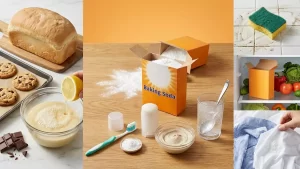
In professional pastry kitchens, baking soda functions as a primary chemical leavening agent. When mixed into batters containing acidic ingredients, it creates an airy texture in cakes, cookies, and quick breads. Food manufacturers also utilize it as a stabilizer in processed foods and as a neutralizing compound during the production of chocolate.
2. Personal Hygiene and Cosmetics
Due to its mild abrasiveness and antibacterial characteristics, baking soda is a common additive in commercial toothpastes to assist in surface stain removal and teeth whitening. It is also used as a primary ingredient in natural aluminum-free deodorants, gentle clarifying shampoos, and facial exfoliants designed to manage acne.
3. Domestic Eco-Cleaning
Baking soda cuts through tough grease, lifts soap scum from bathroom tiles, and brightens laundry without relying on harsh synthetic chemicals. Placing an open box of baking soda inside a refrigerator or a trash receptacle creates a highly effective, passive deodorizer that keeps enclosed spaces smelling clean.
4 Crucial Health and Medicinal Benefits
When used with care and moderation, baking soda provides distinct, scientifically backed therapeutic relief for several physiological conditions.
1. Immediate Heartburn and Indigestion Relief
Acute acid reflux occurs when gastric juices escape into the esophagus, causing a painful burning sensation. Consuming a diluted solution of sodium bicarbonate neutralizes stomach acid instantly, transforming it into neutral compounds and providing rapid relief from indigestion.
2. Oral Health Preservation
An overly acidic oral environment speeds up tooth decay by weakening protective enamel. Rinsing with a mild baking soda solution balances the pH inside your mouth, neutralizing harmful plaque acids and discouraging the replication of cavity-causing bacteria.
3. Management of Lower Urinary Pathologies
Clinical studies indicate that controlled doses of oral sodium bicarbonate can assist in the alkalinization of highly acidic urine. This chemical shift reduces irritation along the lining of the bladder, helping to manage symptoms associated with specific lower urinary tract issues.
4. Supporting Athletic Endurance
During high-intensity exercise, your muscles produce lactic acid and hydrogen ions, leading to muscle fatigue and a burning sensation. Some sports medicine protocols involve controlled “bicarbonate loading” prior to a race. This process temporarily increases the buffering capacity of the blood, allowing athletes to sustain peak physical output for longer periods.
Direct Clinical Dosage Guidelines
Critical Safety Warning: Sodium bicarbonate contains a high concentration of sodium and can significantly impact your internal fluid balance. Never utilize home remedies continuously for more than two consecutive weeks without consulting a qualified medical professional.
For Acute Acid Reflux (Adults)
Dissolve 1 level teaspoon of pure baking soda powder into a glass of cool water. Consume the mixture roughly one hour after a meal. Do not repeat this process more than three times within a 24-hour window, and limit use to a maximum duration of two weeks.
For Acid Reflux (Children Over 6 Years)
Administer precisely half of the standard adult dosage (1/2 teaspoon) thoroughly dissolved in water, ensuring close supervision of the child’s response.
For Urinary Alkalinization (Under Medical Supervision)
Under explicit medical direction, adults may ingest 3 grams of sodium bicarbonate every two hours to systematically elevate urine pH levels above 7.0. For children over the age of 6, physicians calculate a custom therapeutic range varying between 80 mg to 800 mg per kilogram of body weight per day.
Evaluating the Matrix of Advantages and Disadvantages
| Key Advantages | Potential Disadvantages |
| Eco-Friendly & Non-Toxic: A naturally occurring compound that degrades safely without harming water systems. | Vascular Sodium Load: High sodium content can trigger dangerous fluid retention and elevated blood pressure if over-ingested. |
| Highly Economical: Available globally at a fraction of the cost of commercial cleaners and specialized pharmaceuticals. | Risk of Enamel Erosion: Using pure baking soda as a daily toothpaste can slowly wear away protective tooth enamel due to its abrasive nature. |
| Multi-Surface Safety: Safe to use on food-preparation surfaces, steel sinks, clothing fibers, and porcelain. | Systemic Alkalosis Risk: Consuming excessive amounts can disrupt the body’s delicate acid-base balance, leading to severe metabolic complications. |
Frequently Asked Questions
What is the exact difference between baking soda and baking powder?
While they sound identical, they are chemically distinct. Baking soda is 100% pure sodium bicarbonate and requires an external acid (like lemon juice or yogurt) to activate. Baking powder is a combination of sodium bicarbonate plus a dry acidifying agent (like cream of tartar). It activates automatically as soon as it comes into contact with any neutral liquid.
Can baking soda be used safely on an upset stomach if I am on a low-sodium diet?
If you are managing chronic hypertension, congestive heart failure, or kidney disease and have been placed on a strict low-sodium restriction, avoid using baking soda as an antacid. A single teaspoon of baking soda contains roughly 1,200 milligrams of elemental sodium—nearly half of the total recommended daily allowance for adults.
Why does consuming baking soda cause immediate burping?
When sodium bicarbonate mixes with the hydrochloric acid in your stomach, a rapid neutralization reaction occurs. This chemical reaction produces a substantial volume of carbon dioxide ($CO_2$) gas. As this gas accumulates in the stomach, it naturally escapes upward, resulting in a harmless burp.
Is it safe to apply pure baking soda directly to a sunburn or an open wound?
Avoid applying dry baking soda powder directly to damaged skin or open cuts, as its high alkaline pH can cause localized chemical irritation and disrupt the skin’s natural healing barrier. For minor skin irritations or insect bites, it is safest to mix baking soda with water to create a paste, apply it for a few minutes, and rinse it off completely with cool water.
Does baking soda expire or lose its chemical potency over time?
Baking soda does not typically spoil or become toxic, but it can lose its chemical leavening power over time due to exposure to ambient moisture. To verify if an old box of baking soda is still active for cooking, drop half a teaspoon into a small bowl of vinegar. If it fizzes and bubbles aggressively, it is still perfectly potent.