
Table of Contents
- 1. BDNF: The Biochemical Catalyst for Brain Health
- 1.1. Cellular Maintenance and Repair
- 1.2. Synaptic Plasticity and Learning
- 2. The Radio Analogy: Tuning In the Neurochemical Signal
- 3. Focused Cognitive Improvements in the Executive Suite
- 4. Structural Adaptations and Memory Waves
- 5. Accessible Workouts to Trigger Your Brain Boost
- 6. Frequently Asked Questions
- 6.1. Can strength training or weightlifting trigger the same BDNF response as aerobic exercise?
- 6.2. How long does the cognitive boost from an elevated BDNF spike last after a workout?
- 6.3. Does taking oral BDNF supplements or “nootropics” provide the same brain benefits?
- 6.4. Are the brain benefits the same if I break my daily exercise into shorter blocks?
- 6.5. Does age limit my brain’s ability to sensitize itself to exercise?
The Fitness Multiplier: How Getting in Shape Upgrades Your Brain’s Biochemical Response
Most people measure the success of a fitness routine by visible physical benchmarks: a shrinking waistline, a lower resting heart rate, or the ability to run farther without losing breath. However, groundbreaking cognitive research reveals that the most profound transformation occurs entirely under the hood.
A study published in Brain Research indicates that as previously inactive adults improve their physical conditioning, their brains actually become highly sensitized to the cognitive benefits of a single workout. In essence, the fitter you become, the more neuroprotective power your brain extracts from every subsequent exercise session.
At the center of this neurological upgrade is a specialized brain protein that acts as a catalyst for mental focus, rapid learning, and cellular resilience.
 Reversing the Routine: Why National Geographic Highlights Backward Walking for Senior Stability
The Fitness Multiplier How Getting in Shape Upgrades Your Brain’s Biochemical Response
BDNF: The Biochemical Catalyst for Brain Health
The protein responsible for this mental transformation is Brain-Derived Neurotrophic Factor (BDNF). Neuroscientists frequently refer to BDNF as “miracle-grow for the brain” due to its foundational role in maintaining and optimizing the central nervous system.
Cellular Maintenance and Repair
BDNF acts as a cellular support system, keeping existing neurons healthy, vibrant, and structurally sound. It prevents premature cellular degradation and shields brain cells from metabolic stress.

Synaptic Plasticity and Learning
Your brain processes and stores information at tiny junction points called synapses, where electrical and chemical messages leap from one neuron to the next. BDNF directly stimulates synaptic plasticity—the ability of these connection points to strengthen, adapt, and rewrite themselves over time. This process forms the biological basis of learning, focus, and memory retention.
The Radio Analogy: Tuning In the Neurochemical Signal
Led by Dr. Flaminia Ronca of University College London, researchers monitored biometric and neurological markers in previously sedentary midlife adults undergoing a structured cycling program.
[ Inactive State ] ───────> Early Workout ──> Low Baseline Fitness ──> Muted BDNF Release
                                  │
                  ( Consistent Weekly Training Weeks )
                                  │
                                  ▼
[ Fitter State ] ─────────> Later Workout ──> High Cardiovascular ──> Massive BDNF Spike
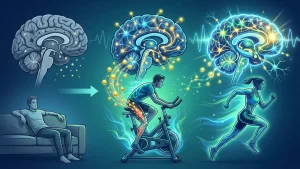
In the initial weeks of the study, when the participants were still physically unconditioned, a single session of exercise produced only modest, subdued increases in blood BDNF levels. The brain’s neurochemical response was present, but minimal.

However, as the weeks progressed and the participants’ cardiovascular fitness improved, something remarkable happened. The exact same exercise effort triggered a massive, high-intensity spike in BDNF.
Think of this phenomenon like tuning a dial on a standard radio. The broadcast station—exercise’s natural ability to stimulate the brain—was always transmitting. But by consistently showing up and improving their physical fitness, the participants effectively turned up the internal sensitivity of their radio receivers. The neurochemical signal suddenly came through with pristine, high-powered clarity.
Focused Cognitive Improvements in the Executive Suite
The research noted that these elevated BDNF spikes did not wash over the entire brain uniformly. Instead, the neurochemical changes were highly concentrated in the prefrontal cortex—the specialized biological command center located directly behind your forehead.
The prefrontal cortex acts as your brain’s executive suite, managing:
Sustained Focus: The ability to lock your attention onto a complex task for an extended period.
Sharp Decision-Making: Weighing variables and choosing efficient paths forward.
Behavioral Inhibition: The vital mental discipline required to ignore distractions, such as tuning out a buzzing smartphone or background traffic noise while working.
Intriguingly, during cognitive testing, researchers discovered that as BDNF levels rose, actual metabolic activity in certain sub-regions of the prefrontal cortex dropped. This suggests that a fitter brain can execute complex executive focus tasks with significantly less physical strain and exhaustion, maximizing cognitive efficiency.
Structural Adaptations and Memory Waves
While this specific study focused on the immediate neurochemical shifts in midlife adults, it aligns beautifully with an independent human study involving epilepsy patients. Using advanced, pre-implanted medical electrodes, scientists directly recorded internal brain activity immediately following a single cycling workout.
The data revealed a dramatic surge in high-frequency electrical bursts known as “ripples” within the hippocampus, the deep-seated brain region dedicated to memory consolidation and spatial mapping. These micro-signals act like data transfers, organizing and locking in newly acquired information after physical movement.
Over a longer timeline, this combination of consistent BDNF spikes and elevated hippocampal ripples alters physical brain biology. Long-term clinical trials show that older adults who commit to one full year of consistent aerobic exercise experience a measurable, physical increase in the total volume of their hippocampus, effectively reversing age-related brain shrinkage.
Accessible Workouts to Trigger Your Brain Boost
You do not need to train like an elite Olympic athlete to unlock this neurological compounding effect. The cognitive system responds beautifully to practical, moderate-intensity activities that can easily be woven into a standard weekly routine.
Rhythmic Cycling: Stationary or outdoor biking keeps your heart rate elevated within an optimal aerobic zone.
Brisk Power Walking: Walking at a pace that makes it slightly difficult to maintain a continuous conversation.
Stair Climbing: Utilizing vertical movement to rapidly stimulate cardiovascular output.
Low-Impact Swimming: A 30-minute swim offers smooth resistance while efficiently driving oxygenated blood straight to the cerebral arteries.
The core takeaway for anyone starting from scratch is incredibly encouraging. Your neurological system does not require a lifetime of athletic conditioning before it begins changing its behavior. Simply showing up week after week is enough to systematically upgrade your brain’s internal machinery, making every future workout exponentially more powerful than the last.
Frequently Asked Questions
Can strength training or weightlifting trigger the same BDNF response as aerobic exercise?
While heavy resistance training offers incredible musculoskeletal benefits and stimulates alternative growth factors, cardiovascular and aerobic exercises (like cycling, running, and swimming) remain the absolute most efficient triggers for massive BDNF production and release.
How long does the cognitive boost from an elevated BDNF spike last after a workout?
Following an acute bout of exercise, systemic BDNF levels typically remain elevated in the bloodstream and brain for roughly 60 to 120 minutes before returning to your baseline. However, consistent long-term training raises your ambient, resting baseline BDNF levels over time.
Does taking oral BDNF supplements or “nootropics” provide the same brain benefits?
No. BDNF is a large, complex protein molecule. If consumed orally via pills or powders, your digestive tract breaks it down completely before it can ever reach your bloodstream. Furthermore, circulating proteins cannot easily cross the tightly regulated blood-brain barrier. The absolute most effective, scientifically proven way to increase BDNF inside your brain is through self-generated physical exercise.
Are the brain benefits the same if I break my daily exercise into shorter blocks?
Yes. Emerging lifestyle data suggests that accumulating physical activity throughout the day via brief “exercise snacks”—such as three brisk 10-minute walks spread across the morning and afternoon—can stimulate multiple, rolling neurochemical mini-spikes, providing consistent cognitive protection throughout the day.
Does age limit my brain’s ability to sensitize itself to exercise?
Absolutely not. While neuroplasticity naturally slows down as humans age, clinical trials across the board confirm that neurogenesis (the creation of new brain cells) and BDNF pathways remain active well into a person’s 70s, 80s, and beyond, meaning it is never too late to begin a movement routine.