
Table of Contents
- 1. The Neuromuscular Demands of the Step-Up
- 2. What the Clinical Research Demonstrates
- 3. A Comprehensive Guide to Building a Safe At-Home Step Routine
- 4. Cognitive Fitness: Challenging the Brain
- 5. Understanding the Boundaries: Not a Universal Cure-All
- 6. Conclusion: Investing in Your Daily Mobility
- 7. Frequently Asked Questions
- 7.1. What is the ideal height for a step platform for seniors?
- 7.2. Why is muscle “power” more important than muscle “strength” for preventing falls?
- 7.3. How many times a week should I perform this step routine?
- 7.4. Is it normal to hear a clicking or popping sound in my knees during step-ups?
- 7.5. What should I do if my balance feels too shaky to try a step-up?
The Essential At-Home Exercise for Seniors to Prevent Falls and Protect Independence
When designing a fitness routine after age 65, the objective dramatically shifts away from chasing athletic records or aesthetic trends. Instead, the real goal becomes deeply practical: retaining the exact physical capability required to stand up from a deep couch with confidence, climb a flight of stairs without fear, and step off a street curb safely.
While conventional wisdom often points seniors toward gentle walks or stationary cycling, modern exercise science has identified a critical missing link in standard retirement fitness. Traditional cardio exercises do an excellent job supporting the heart, but they often fail to train muscular power—the specific ability of a muscle to contract quickly to catch yourself during a sudden slip or stumble. A lack of muscular power is the single greatest quiet predictor of catastrophic falls and a subsequent loss of personal independence.
To combat this, prominent gerontologists and physical therapists are highlighting an exceptionally simple, accessible, and high-yielding movement that can be performed right in your living room: rhythmic step exercise. By utilizing a low, stable platform or the bottom step of a staircase, seniors can systematically rebuild their lower-body power, spatial coordination, cardiovascular health, and dynamic balance all at the exact same time.

The Essential At-Home Exercise for Seniors to Prevent Falls and Protect Independence
The Neuromuscular Demands of the Step-Up
At first glance, stepping up and down from a low ledge seems almost too basic to be considered a premier medical intervention. However, from a biomechanical standpoint, this functional movement demands an immense amount of coordinated teamwork between your brain and musculoskeletal system.
The Step-Up Neuromuscular Loop:
Brain Coordinates Visual Depth -> Core Stabilizes Spine -> Glutes & Thighs Generate Upward Power -> Calves & Foot Complex Manage Deceleration & Balance
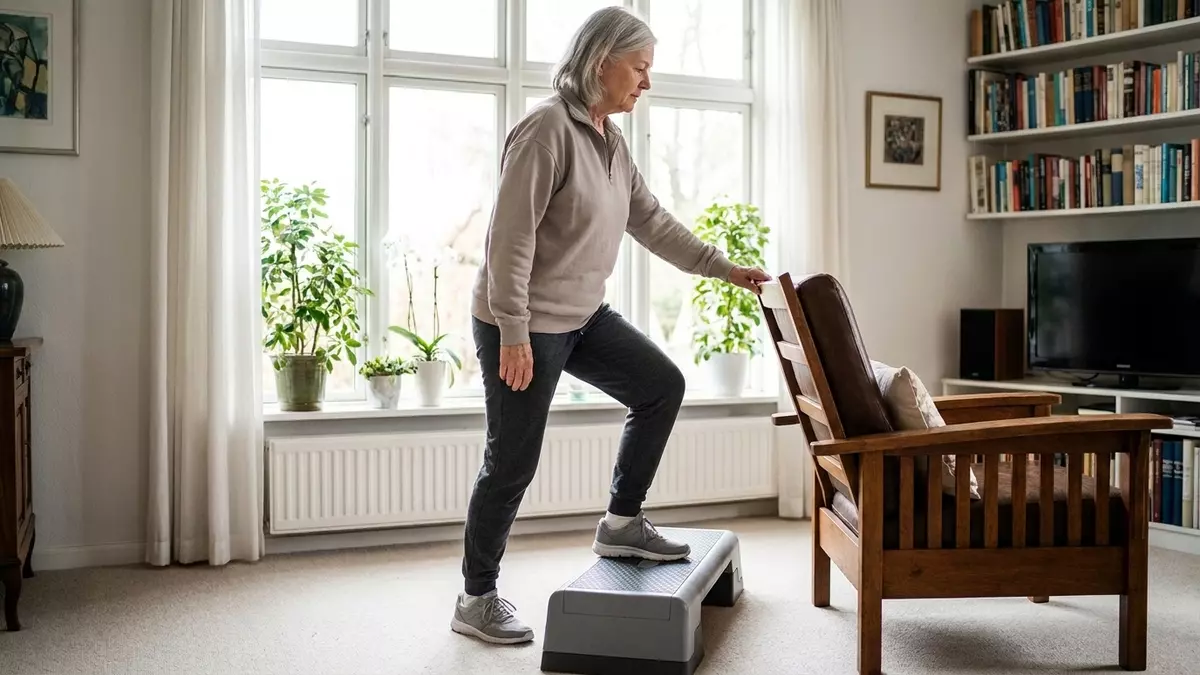
Every time you place your foot on a step and lift your body weight, your quadriceps, glutes, and hamstrings must contract aggressively to fight gravity. Simultaneously, your deep abdominal core muscles fire to keep your spine upright, while the intricate tendons around your ankles and feet micro-adjust to manage your shifting center of gravity.
Furthermore, because this exercise forces you to repeatedly transition from standing on two legs to balancing temporarily on a single leg, it actively trains your brain’s proprioception—your internal GPS that tracks where your limbs are in space. This rapid sensory feedback loop is exactly what allows your body to automatically deploy a stabilizing step if you catch your foot on an uneven sidewalk or a loose rug.
What the Clinical Research Demonstrates
The profound physical benefits of utilizing stairs and low steps as a primary training tool are heavily backed by peer-reviewed geriatric research.
A prominent clinical trial led by lead researcher Evelien Van Roie, alongside Jannique van Uffelen and Christophe Delecluse at KU Leuven and the University of Hasselt, set out to evaluate the real-world impact of step training. The researchers tracked 46 older adults living in assisted accommodation, splitting them into two groups that trained twice a week for 12 weeks. One group utilized specialized gym weight machines, while the other group focused strictly on structured stair-climbing training.

Published in the Journal of Strength and Conditioning Research, the study concluded that both training styles yielded significant, identical improvements in leg muscle power and overall functional capacity. Crucially, however, the stair-climbing group demonstrated an unmatched, superior advantage in real-world stair performance. The research proves that you do not need an expensive gym membership or complex metal machinery to build life-saving leg strength; your body can absorb the exact same high-quality structural adaptations using basic household steps.
A Comprehensive Guide to Building a Safe At-Home Step Routine
Before initiating any new physical regimen, human safety must serve as your absolute priority. The National Institute on Aging strongly advises that individuals navigating existing heart conditions, chronic dizziness, severe joint pain, or diabetes complications consult a primary healthcare provider before starting.
Once cleared, follow this structured, sequential blueprint to establish a safe and highly effective at-home step routine.
A Note on Progression: As your balance and lower-body endurance naturally improve over several weeks, you can slowly increase the challenge. Under the strict guidance of a physical therapist, you might eventually integrate very light ankle weights or small handheld dumbbells. However, speed and heavy weight should never be pursued at the expense of a smooth, perfectly balanced, and upright posture.
Cognitive Fitness: Challenging the Brain
One of the reasons rhythmic stepping is considered a “perfect” exercise for older adults is that it can easily be modified to train your brain right alongside your muscles. Because each step requires precise timing, direction, and motor control, it serves as an excellent neurological workout.
Once the basic forward step-up feels completely safe and second nature, you can carefully introduce slow, deliberate variations. Try executing lateral step-ups (stepping onto the platform sideways) to target the outer hips and gluteus medius—the primary muscles responsible for stabilizing your pelvis and preventing side-to-side swaying when you walk. You can also vary the rhythm, stepping up quickly and stepping down very slowly to intentionally challenge your eccentric muscle control.
Understanding the Boundaries: Not a Universal Cure-All
While step exercise is an elite tool for the vast majority of seniors, it is not a magical cure-all and is not appropriate for every medical profile. This specific movement may not be suitable for individuals managing:
Severe, uncompensated vertigo or neurological balance disorders
Advanced osteoarthritis resulting in severe, sharp knee or hip pain
Significant peripheral neuropathy that impairs the sensation of foot placement
The Community Preventive Services Task Force conducted a massive review of 17 separate randomized controlled trials focusing on home-based senior fitness. Their findings confirmed that the absolute smartest approach to lifelong wellness is a multicomponent routine. Step exercises should serve as an anchor, but they should be happily paired with full-body stretching for flexibility, easy walking for endurance, and gentle core work to create a comprehensive shield against aging.
Conclusion: Investing in Your Daily Mobility
At the end of the day, the true metric of fitness success after age 65 isn’t about the size of your muscles or the intensity of a workout score. It is about preserving the unflashy, vital ability to navigate your own home safely, travel to see loved ones without restriction, and walk to your mailbox with ease. By dedicating a few focused, controlled minutes to a stable step routine every week, you are making a direct deposit into your future physical freedom. Go slowly, utilize nearby support, and let consistency be your real victory.
Frequently Asked Questions
What is the ideal height for a step platform for seniors?
For most older adults, a step height of roughly 4 to 6 inches is the perfect starting baseline. This closely mimics the standard height of a municipal sidewalk curb or a shallow domestic staircase step. Avoid high, athletic aerobic steps that force your knee to bend past a 90-degree angle, as this can place excessive structural pressure on aging patellar tendons and knee joints.
Why is muscle “power” more important than muscle “strength” for preventing falls?
Muscle strength refers to the maximum amount of force a muscle can exert to move an object (like lifting a heavy grocery bag). Muscle power, however, combines strength with speed—how fast that muscle can explode into action. When you stumble over an unexpected object, your structural safety depends entirely on your power: your nervous system must instantly and forcefully fire your leg muscles to snap your foot forward and catch your weight before you hit the ground.
How many times a week should I perform this step routine?
To achieve optimal muscular adaptation without inducing systemic chronic fatigue, aim to perform your structured step exercises two to three times per week. Always leave at least 48 hours of rest between dedicated sessions to allow your muscle fibers to properly repair and grow stronger.
Is it normal to hear a clicking or popping sound in my knees during step-ups?
Occasional clicking, snapping, or popping sounds in the joints—a biological phenomenon known as crepitus—is highly common and generally harmless if it is completely painless. It is often simply caused by tiny gas bubbles shifting inside the joint fluid or a tendon sliding smoothly over a bone. However, if the clicking is accompanied by any degree of sharp pain, localized swelling, or a feeling that your knee is giving out, halt the exercise immediately and consult an orthopedic specialist.
What should I do if my balance feels too shaky to try a step-up?
If standing on a raised platform feels too intimidating or unsafe right now, you can easily modify the exercise by performing ground-level marching. Stand flat on the floor directly behind a sturdy kitchen counter, hold onto the counter edge with both hands for absolute security, and slowly march in place, lifting your knees up toward your chest one at a time. This allows you to build foundational hip flexor strength and single-leg stability before ever introducing a raised step.