
Table of Contents
- 1. The Power of the “Weak Tie”
- 2. Efficiency vs. Emotional Well-being
- 3. The Loneliness Factor
- 4. Privacy and Choice: A Necessary Balance
- 5. The “Micro-Ritual” of Daily Life
- 6. Frequently Asked Questions (FAQ)
- 6.1. 1. Does choosing a cashier make me less efficient?
- 6.2. 2. Am I “lonely” if I prefer the human lane?
- 6.3. 3. Should stores get rid of self-checkout entirely?
- 6.4. 4. Is the cashier actually connecting with me?
- 6.5. 5. Why do I feel guilty if I choose the self-checkout?
Why We Choose the Human Lane: The Hidden Psychology of Checkout
In an era defined by efficiency, the self-checkout kiosk seems like the ultimate victory. It promises speed, control, and total privacy. Yet, in aisles across the country, many shoppers consistently bypass these automated machines, choosing instead to wait in longer, staffed lines. While this behavior is sometimes dismissed as tech-aversion or stubbornness, psychological research suggests something much deeper is at play.
Choosing a cashier over a machine isn’t a rejection of progress—it’s a quiet, subconscious pursuit of human connection in an increasingly digital world.
Why We Choose the Human Lane The Hidden Psychology of Checkout
The Power of the “Weak Tie”
Sociology provides the best framework for understanding why we value these mundane interactions. In the 1970s, sociologist Mark Granovetter popularized the concept of “weak ties”—the casual, peripheral relationships we have with baristas, neighbors, delivery drivers, and grocery store cashiers.

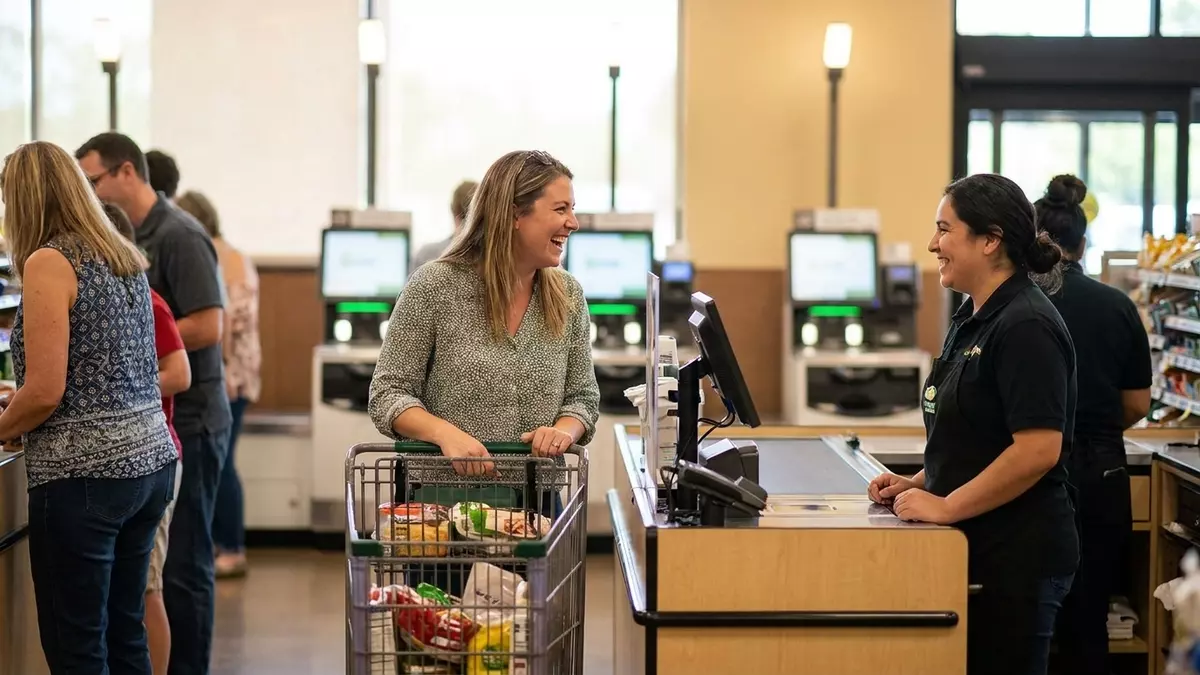
While these aren’t deep, lifelong friendships, they are far from empty. Research consistently shows that our daily sense of belonging and happiness is bolstered by these tiny, low-stakes exchanges. When you exchange a polite “How are you?” or share a laugh about the weather with a cashier, you are performing a “micro-ritual” that confirms you are a visible part of a shared, public world.
Efficiency vs. Emotional Well-being
We are often taught that efficiency is the ultimate goal of any transaction. However, behavioral science suggests we consistently underestimate how good we feel after a social interaction.
A study from the University of Chicago Booth School of Business examined social interaction in public spaces like trains and buses. Researchers found that people consistently predicted they would be happier remaining in silence, but those who actually engaged with others reported significantly more positive experiences. Similarly, a study published in the Journal of Business Research found that regular checkout lanes can foster greater customer loyalty than self-checkout, largely because the human element adds value that a cold screen cannot replicate.
 Why Building Value Beats Chasing Success
The Loneliness Factor
Loneliness is often misunderstood as simply being “alone.” In reality, it is the feeling of being unseen or disconnected, even while moving through a crowded store.
For many, especially those who have spent a quiet day at home, a quick, polite interaction at the register serves as a social “anchor.” A cashier’s nod of recognition or a friendly “have a good one” provides a moment of human validation. Given that the U.S. Department of Health and Human Services has identified social isolation as a significant health risk—comparable to major medical concerns—these small drops of social interaction are not trivial; they are essential for maintaining our emotional health.
Privacy and Choice: A Necessary Balance
Of course, the preference for human lanes is not universal, nor is it always about connection. For some, the self-checkout is a vital tool for privacy, particularly when purchasing personal items that might otherwise cause embarrassment. A 2025 University of Illinois study confirmed that many shoppers opt for automation specifically to avoid the perceived judgment or attention of others.

The takeaway is not that automation is inherently negative, but that a healthy retail environment requires a balance. Retailers that eliminate staffed lanes altogether remove an important venue for public social connection, potentially leaving their most vulnerable or socially isolated customers feeling even more disconnected.
The “Micro-Ritual” of Daily Life
When a shopper chooses the human lane, they aren’t necessarily looking for a deep conversation. They are looking for the “soft” parts of a transaction: the shared eye contact, the momentary acknowledgment of another person, and the feeling that they are participating in a communal experience.
In a world that demands we move faster, do more, and rely on screens, the checkout lane is one of the few places left where public life happens in miniature. Sometimes, we choose the longer line simply because we need to feel seen before we step back out into the noise of the day.
Frequently Asked Questions (FAQ)
1. Does choosing a cashier make me less efficient?
Yes, it might take a few extra minutes, but efficiency and well-being are two different metrics. While self-checkout wins on speed, the human lane may “win” on emotional replenishment. It is about what your day needs at that moment.
2. Am I “lonely” if I prefer the human lane?
Not necessarily. Preferring human interaction is a healthy, natural human instinct. It is a sign that you value the social fabric of your community, not a sign of deficit.
3. Should stores get rid of self-checkout entirely?
No. The goal should be choice. Having both options allows stores to serve customers who need the speed and privacy of a machine, as well as those who value the social connection of a staffed register.
4. Is the cashier actually connecting with me?
Even a very brief, transactional interaction is a form of social connection. The science suggests that even “scripted” interactions—like asking about the weather—provide a mood-lifting effect that silence does not.
5. Why do I feel guilty if I choose the self-checkout?
Some shoppers feel they are contributing to the replacement of human jobs. If this is a concern for you, it’s worth remembering that these choices are often shaped by corporate policy and store staffing. Your preference for human interaction is a valid social need, not a failure of character.