
Table of Contents
- 1. The Clinical Setup: Comparing Equal Sugars in Separate Glasses
- 2. 15 Minutes Later: The Blood Sugar Curves Diverge
- 3. The Science of the Fruit Matrix: Nature’s Traffic Control
- 4. The Hidden Variance: Lower vs. Higher Responders
- 5. Contextualizing the Data: This Is Not a Free Pass for Juice
- 6. Designing a Smarter Breakfast: Practical Takeaways
- 7. Conclusion
- 8. Frequently Asked Questions
- 8.1. Can individuals with type 2 diabetes use these findings to drink orange juice safely?
- 8.2. Is it healthier to eat a whole orange rather than drinking 100% orange juice?
- 8.3. What exactly is the difference between “free sugars” and “added sugars”?
- 8.4. Does diluting orange juice with water lower its overall glycemic impact?
- 8.5. Do orange juice cartons from the grocery store retain these beneficial plant flavonoids?
2 Sweet Drinks That Impact Blood Sugar Differently in 15 Minutes
For years, wellness advocates, nutritionists, and global public health agencies have voiced a consistent message: limit your sugar intake. In a world struggling with rising metabolic conditions, the prevailing wisdom has often been that “sugar is just sugar,” regardless of the source. On a standard back-panel nutrition label, a glass of 100% fruit juice and a sugar-sweetened soda can look remarkably similar. Both serve up a heavy dose of carbohydrates and simple sugars that might make any health-conscious individual think twice before taking a sip.
However, a clinical trial published in the Royal Society of Chemistry’s peer-reviewed journal, Food & Function, has added a major layer of nuance to this long-standing dietary debate. The study suggests that the human body doesn’t treat every sweet liquid equally. In a randomized crossover trial, researchers demonstrated that drinking 100% orange juice produces a significantly lower and slower rise in blood glucose levels compared to a volume-matched, sugar-only drink. The internal story told by the human bloodstream just 15 minutes after ingestion challenges the simplistic notion that all liquid calories behave identically.
2 Sweet Drinks That Impact Blood Sugar Differently in 15 Minutes

The Clinical Setup: Comparing Equal Sugars in Separate Glasses
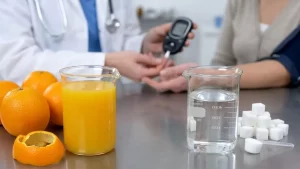
To truly test the “sugar is sugar” hypothesis, researchers in Spain designed a controlled, randomized crossover trial utilizing a cohort of healthy young men. The volunteers participated in separate testing days, consuming four distinct beverage profiles to track precisely how their endocrine systems responded over time.
The four test beverages, each measuring approximately 300 milliliters (roughly 10 fluid ounces), included:
A glass of 100% pure orange juice
A 50% orange juice blend diluted with water
A processed, sugar-only drink entirely devoid of fruit components
A standard glucose control solution


The most critical element of this experimental design was the sugar profile of the drinks. Both the 100% orange juice and the sugar-only drink were perfectly matched to contain exactly the same weight of sugar: 25 grams, which is roughly equivalent to six teaspoons. Furthermore, the molecular composition was identical, sharing the exact same ratio of glucose, fructose, and sucrose. On paper, their metabolic impact should have been completely indistinguishable.
15 Minutes Later: The Blood Sugar Curves Diverge
Despite the identical chemical sweetness on paper, the volunteers’ postprandial (post-meal) blood sugar readings revealed an entirely different reality inside the body.
Just 15 minutes after consumption, the average capillary blood glucose level among the volunteers rose to 95.9 mg/dL after drinking the 100% orange juice. In stark contrast, after drinking the fruit-free, sugar-matched beverage, their blood sugar shot up to an average of 108.7 mg/dL.
[15-Minute Blood Glucose Levels]
100% Orange Juice:  ███████████████ 95.9 mg/dL
Sugar-Only Drink:   █████████████████ 108.7 mg/dL
This divergence didn’t just manifest in the initial 15-minute window; it also dramatically altered the maximum peak values recorded during the trial. The standard glucose control solution hit the highest average peak at 134.6 mg/dL, while the fruit-free sugar drink reached a peak of 121.6 mg/dL. Meanwhile, the 100% orange juice demonstrated a heavily blunted trajectory, topping out at a modest average peak of 113.8 mg/dL.
The Science of the Fruit Matrix: Nature’s Traffic Control
How can two liquids carrying the exact same amount of sugar cause such vastly different biometric outcomes? The answer lies in a concept known in nutritional physiology as the fruit matrix.
When you consume 100% pure orange juice, you are not just drinking a pool of isolated sugar molecules. Instead, those sugars are physically enveloped in a complex, naturally occurring architectural network of bio-active compounds. Even when the heavy insoluble fiber is strained out during the juicing process, 100% orange juice retains a treasure trove of micro-nutrients, natural organic acids, vitamins, and plant-derived polyphenols—most notably a powerful citrus flavonoid known as hesperidin.
| Beverage Component | 100% Orange Juice | Processed Sugar Drink |
| Simple Sugar Mass | 25 grams (Glucose, Fructose, Sucrose) | 25 grams (Glucose, Fructose, Sucrose) |
| Flavonoids (Hesperidin) | High Concentrations | Absent (Zero) |
| Vitamin C & Organic Acids | Naturally Abundant | Absent or Trace Synthetic |
| 15-Min Glucose Spike | 95.9 mg/dL (Gradual Rise) | 108.7 mg/dL (Rapid Spike) |
In practical metabolic terms, this natural fruit matrix acts a bit like an internal traffic controller within your digestive tract. Rather than allowing simple sugars to rush across the intestinal wall and flood the portal vein all at once, the presence of these co-occurring flavonoids slows down glucose transporters in the gut. This structural synergy dampens the post-meal glucose peak, flattening the glycemic roller coaster that can otherwise leave you feeling fatigued and hungry shortly after snacking.
The Hidden Variance: Lower vs. Higher Responders
One of the most compelling insights uncovered by the Spanish research team was that human biochemistry is far from uniform. Even though the study’s test subjects were selected from a homogenous group of young, metabolically healthy men, their individual bodies processed the exact same beverages in highly diverse ways.
The data revealed two distinct physiological archetypes:
High Responders: Individuals whose blood sugar spiked dramatically after drinking the processed sugar beverage, but showed a massive, highly pronounced protective benefit (a much lower spike) when switching to 100% orange juice.
Lower Responders: Individuals who demonstrated highly resilient endocrine systems across the board, experiencing very minimal differences in their blood glucose curves regardless of which sweet drink they consumed.
This internal variation underscores an important shift currently sweeping through modern health research: away from rigid, one-size-fits-all dietary rules and toward personalized nutrition. Two people can sit at the same breakfast table, drink the exact same beverage, and experience completely different internal metabolic shifts.
Contextualizing the Data: This Is Not a Free Pass for Juice
While this study provides fascinating evidence that natural fruit complexes buffer sugar absorption, it is critical not to misinterpret these findings as a green light to consume fruit juice without boundary.
Juice remains an incredibly concentrated source of liquid energy. It takes roughly three to four whole medium oranges to yield a single 8-ounce glass of juice. In a standard setting, a person can easily drink that glass of juice in under sixty seconds, whereas sitting down to peel, chew, and digest four whole oranges would take considerable time and effort.
Furthermore, it is vital to draw a firm boundary between 100% pure fruit juice and commercial “fruit-flavored drinks” or sodas. The Centers for Disease Control and Prevention (CDC) continuously warns that sugar-sweetened beverages (SSBs) containing added high-fructose corn syrup or cane sugar are a leading contributor to chronic wellness challenges in the United States, including unwanted weight gain, type 2 diabetes, cardiovascular disease, non-alcoholic fatty liver disease, and dental cavities.
Designing a Smarter Breakfast: Practical Takeaways
Instead of using lab data to label orange juice as entirely “good” or universally “bad,” consumers should focus on lifestyle context, portion control, and meal architecture. Use these three principles to optimize your morning routine:
Audit Your Labels Intentionally: Always scan your product packaging to guarantee you are purchasing “100% Fruit Juice” with absolutely zero added sweeteners. Avoid any beverages listing “high-fructose corn syrup,” “cane sugar,” or “fructose” in the ingredients.
Practice Portion Awareness: Swap out large mugs or pint glasses for a modest 4-ounce juice glass. Keeping your serving size small naturally bounds the total glycemic load on your liver.
Build a Protein Buffer: Never drink fruit juice entirely on an empty stomach. If you enjoy a small glass of orange juice with breakfast, pair it with a handful of raw almonds, a hard-boiled egg, or a bowl of plain Greek yogurt. Layering healthy fats and clean proteins beneath the juice further slows gastric emptying, creating a flawlessly stable energy curve for the rest of your day.
Conclusion
Ultimately, the Food & Function clinical trial doesn’t overthrow global guidance regarding the wisdom of moderation. What it does beautifully achieve is reminding us that food is an intricate package, not just a collection of numbers on a spreadsheet. The natural matrix surrounding a calorie profoundly shapes how your cells process that energy. By choosing unadulterated, whole-food options and treating juice as an occasional, measured addition rather than a casual hydrator, you can enjoy the vibrant flavors of nature while respecting your body’s metabolic health.
Frequently Asked Questions
Can individuals with type 2 diabetes use these findings to drink orange juice safely?
It is important to exercise extreme caution here. Because this specific clinical trial was conducted exclusively on young, metabolically healthy male volunteers with normal insulin sensitivity, the results cannot be safely extrapolated to individuals managing pre-diabetes, insulin resistance, or type 2 diabetes. For someone with a compromised endocrine system, even the natural sugars in 100% juice can trigger a significant, dangerous glucose spike. If you have diabetes, always consult your physician or registered dietitian and monitor your specific post-meal levels using a continuous glucose monitor (CGM).
Is it healthier to eat a whole orange rather than drinking 100% orange juice?
Yes, eating a whole orange remains the absolute gold standard for metabolic wellness. When you consume the whole fruit, you are ingesting 100% of its intact, insoluble dietary fiber. This thick fibrous pulp forms a gelatinous mesh in your digestive tract, which drastically stretches out the absorption timeline of the fruit’s natural fructose. Whole fruit provides sustained satiety, zero rapid spikes, and superior long-term digestive benefits.
What exactly is the difference between “free sugars” and “added sugars”?
“Added sugars” refer specifically to any caloric sweeteners that are manually introduced to foods or beverages during industrial processing or home preparation—such as adding white table sugar to coffee or high-fructose corn syrup to soda. “Free sugars” is a broader scientific category defined by the World Health Organization that includes all added sugars plus the sugars naturally present in unsweetened fruit juices, concentrates, honey, and culinary syrups, because these liquid sugars are no longer bound inside a whole cellular plant structure.
Does diluting orange juice with water lower its overall glycemic impact?
Diluting a heavy glass of juice with plain water or unflavored sparkling water is an excellent habit, but it is important to understand the math. Dilution does not change the molecular behavior of the sugar itself, but it effectively shrinks the overall glycemic load of your drink by reducing the volume of sugar you consume per sip. Mixing a 1:1 or 1:2 ratio of juice to sparkling water allows you to enjoy the bright citrus aroma and flavor with a fraction of the total carbohydrate load.
Do orange juice cartons from the grocery store retain these beneficial plant flavonoids?
Yes, high-quality, 100% pure orange juices from the supermarket do retain a significant amount of active flavonoids like hesperidin and essential vitamin C. However, processing methods do matter. Juices that are labeled “Not From Concentrate” and varieties that contain “high pulp” generally retain a higher, more stable concentration of these natural bio-active compounds and microscopic fiber strands compared to ultra-filtered, highly pasteurized clear juices.