
Table of Contents
- 1. The First Phase: Harnessing the Power of Micro-Habits
- 2. Shifting From Cardio to Resistance: Building the Structural Cage
- 3. Decoding the Public Health Blueprint for Longevity
- 4. Navigating Physical Setbacks with Behavioral Flexibility
- 4.1. Jim Owen’s “Just Move” Intensity Calibration Matrix
- 5. The Core Philosophy: Movement is a Decentralized Choice
- 6. Conclusion: Rewriting the Trajectory of Aging
- 7. Frequently Asked Questions
- 7.1. Is strength training safe for someone with advanced arthritis?
- 7.2. How can an older adult safely begin lifting weights at home?
- 7.3. Why does human balance degrade with age, and can it be reversed?
- 7.4. Can walking alone provide all the health benefits an older adult needs?
- 7.5. How does muscle loss affect an older adult’s metabolic health?
85-Year-Old Athlete Proves It Is Never Too Late to Reclaim Your Fitness
When we hear stories about elite senior athletes winning gold medals and sprinting past competitors half their age, we naturally assume they possess a lifetime of athletic pedigree. We imagine individuals who have been running marathons, lifting weights, and eating clean since their twenties.
But every now and then, a story emerges that completely shatters that stereotype, offering a powerful, universal truth: your current age is not an expiration date for your physical potential.
Meet Jim Owen. Today, at 85 years old, he is a competitive senior athlete, a 10-time gold medal winner at the San Diego Senior Games, and the filmmaker behind the acclaimed PBS documentary Virtuous Circle, which explores the mechanics of successful aging.
Yet, if you had met Owen fifteen years ago when he was 70, you would have seen a retired Wall Street manager in severe physical distress. After decades navigating a high-stress corporate career followed by years of exhausting travel, his body was paying a heavy price. He was 35 pounds overweight, suffered from chronic, debilitating lower-back pain, and lacked the energy to get through an ordinary afternoon.

Owen’s remarkable transformation from a sedentary retiree into a global inspiration is a masterclass in behavioral change. He proved that physical regeneration doesn’t require a podium start; it simply requires the willingness to take a single step.
85-Year-Old Athlete Proves It Is Never Too Late to Reclaim Your Fitness
The First Phase: Harnessing the Power of Micro-Habits
When Owen made the conscious decision to overhaul his lifestyle at age 70, he didn’t immediately buy a gym membership or attempt a high-intensity workout. He understood that vague, overwhelming goals like “exercise more” are a primary reason fitness resolutions fail. Instead, he chose a highly specific, micro-targeted metric: walk every single day for 30 days straight.

[Age 70: Sedentary & Overweight] ➔ [30-Day Walking Habit] ➔ [Preserved Lung Stamina] ➔ [Strength Training Added] ➔ [Age 85: 10-Time Gold Medalist]
His first day on the sidewalk was a harsh wake-up call. After walking just four short blocks, Owen found himself entirely out of breath and forced to head home.
Rather than viewing this as a sign of defeat, he embraced incremental progression. He returned to the pavement the next morning, pushing just half a block further. By day 30, he was comfortably walking a full mile.
While a one-mile walk might not sound impressive to an athlete, the daily repetition fundamentally reconditioned his cardiorespiratory system. His friends and family began noticing a visible surge in his posture and daily energy levels. This positive feedback loop created a psychological momentum that made him eager to explore the next phase of physical development.

Shifting From Cardio to Resistance: Building the Structural Cage
After three months of dedicated daily walking, Owen hit a physical plateau. While his lung capacity and endurance had expanded significantly, his persistent lower-back pain remained. He quickly realized a fundamental truth of human physiology: cardio preserves your lungs, but resistance training protects your frame.
Owen’s back pain was driven by severe core weakness and age-related muscle wasting (sarcopenia). To combat this, he introduced bodyweight strength training.
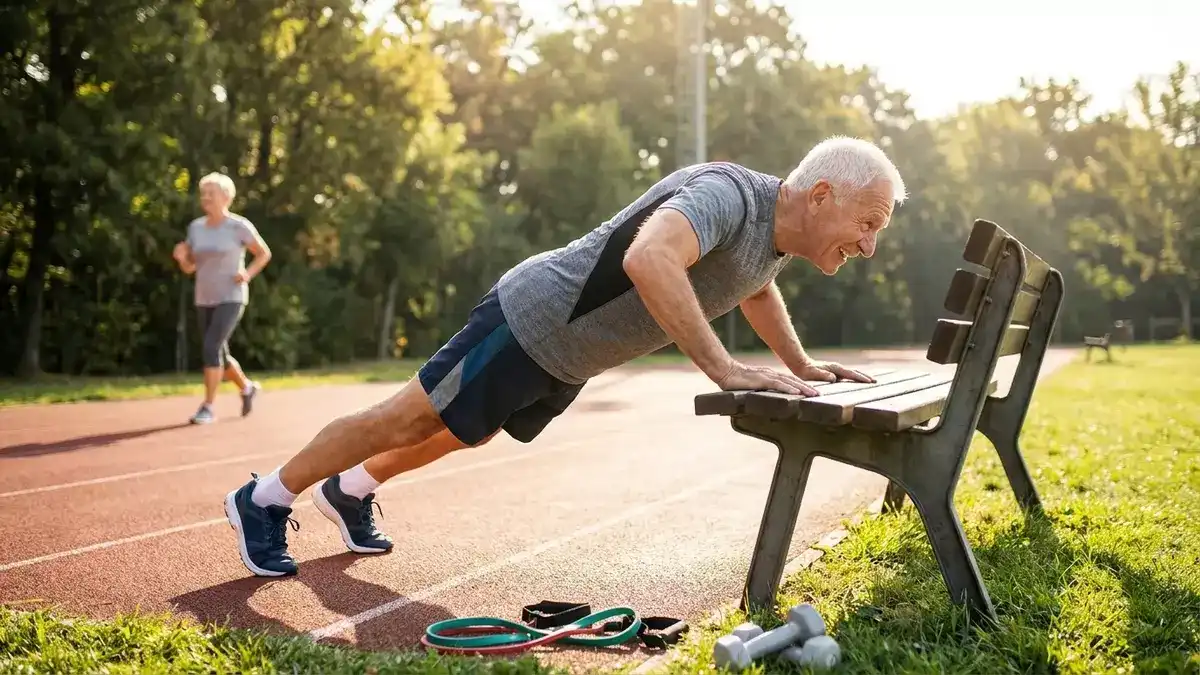
His initial attempt at a standard push-up was an absolute failure. He lacked the chest and shoulder stability to perform a single clean repetition. It took weeks of regression training—performing push-ups elevated against a wall, then moving to a sturdy bench—before he could execute one flawless floor rep.
Through relentless consistency, his strength multiplied exponentially. By the time he celebrated his 75th birthday, the man who couldn’t do a single push-up was comfortably completing sets of 50.
Decoding the Public Health Blueprint for Longevity
Jim Owen’s current competitive routine involves training six days a week, meticulously balancing targeted strength work, aerobic cardio, and deep mobility stretching. While he emphasizes that everyday seniors do not need to train like gold-medal competitors to reap the rewards of health, his multi-faceted framework directly aligns with the strict physical guidelines established by global health organizations.
The Centers for Disease Control and Prevention (CDC) asserts that adults aged 65 and older require three distinct modalities of physical movement every week to preserve independent living skills and reduce all-cause mortality:
Aerobic Activity: A minimum of 150 minutes of moderate-intensity cardio (such as brisk walking or swimming) per week to maintain endothelial function and heart health.
Muscle-Strengthening: At least two days a week targeting all major muscle groups to preserve bone mineral density and mitigate muscle loss.
Balance Exercises: Targeted movements to enhance proprioception—the body’s ability to sense its location and movements—which serves as the primary defense against catastrophic falls.
Navigating Physical Setbacks with Behavioral Flexibility
Owen’s path to the gold-medal podium was far from a flawless, linear ascent. Over the course of his fifteen-year fitness journey, he has faced severe, agonizing injuries, including a broken wrist and a fractured hip—accidents that would convince many young athletes to abandon their training permanently.
Owen’s secret to long-term compliance is absolute behavioral flexibility. He openly rejects the toxic “no pain, no gain” fitness mentality. He treats aging not as an invisible barrier, but as a dynamic landscape that requires intuitive adjustments.
Jim Owen’s “Just Move” Intensity Calibration Matrix
When faced with low-energy days, minor joint aches, or recovery periods, Owen never abandons his routine. Instead, he shifts his workout parameters seamlessly:
| Operational Variable | Peak Competitive Day | Active Recovery / Low-Energy Day |
| Resistance Strategy | Heavy progressive loading with free weights | Light bodyweight movements and resistance bands |
| Volumetric Load | High repetitions to complete failure | Low-volume, controlled structural sets |
| Core Movement | Intense athletic conditioning exercises | Gentle mobility stretching and restorative walking |
By choosing to adjust his daily intensity rather than skipping the workout entirely, Owen keeps his neural pathways active and prevents a temporary physical setback from freezing his long-term momentum.
The Core Philosophy: Movement is a Decentralized Choice
In his popular motivational book Just Move!, Owen strips away the intimidating, commercialized armor surrounding modern fitness culture. He argues passionately that true physical reinvention doesn’t require an expensive personal trainer, a high-end gym membership, or an aggressive, exhausting lifestyle makeover.
For older adults who feel alienated or embarrassed walking into a traditional weight room filled with mirrors and heavy iron, Owen reframes fitness as a series of decentralized daily micro-choices.
Choosing to park your car at the furthest edge of the grocery store parking lot, opting for two flights of stairs instead of the elevator, engaging in a 10-minute morning stretch while your coffee brews, or taking a short, brisk stroll around the block after dinner are all highly valid forms of physical medicine. Over a timeline of months, these tiny, unglamorous choices quietly aggregate, transforming a fragile physical frame into a highly resilient, energetic vessel.
Conclusion: Rewriting the Trajectory of Aging
Ultimately, Jim Owen’s historic late-life athletic career delivers a vital message to an aging global population: physical decline is not a mandatory, one-way street. While genetics certainly play a baseline role, our daily behavioral choices hold immense sway over how fluidly our tissues can adapt, heal, and regenerate as the decades pile up.
You do not need to aim for a senior games gold medal to claim your vitality. Whether you are 40, 60, or 80, the biological rules governing muscle development and cardiovascular health remain beautifully identical. The closing wisdom from Owen’s journey is a brilliant, urgent call to action that sticks with you: “The sooner you start, the easier it is—but it’s never too late.”
Frequently Asked Questions
Is strength training safe for someone with advanced arthritis?
Yes, when executed with proper form and controlled pacing, resistance training is highly therapeutic for individuals managing osteoarthritis. Lifting weights strengthens the skeletal muscles surrounding your arthritic joints, effectively transforming those muscles into structural shock absorbers. This added support reduces the daily friction and physical strain placed on the thinning joint cartilage, resulting in a marked reduction in daily pain and an expansion of your pain-free range of motion.
How can an older adult safely begin lifting weights at home?
The safest way to introduce resistance training at home is by mastering fundamental bodyweight movements before introducing external loads. Start with variations of daily functional patterns: practice slow, controlled sit-to-stands from a sturdy kitchen chair to build quadriceps strength, perform elevated push-ups against a wall to engage the upper body, and practice standing on one foot near a countertop to enhance stability. Once these movements are perfected, you can gradually introduce light dumbbells or flexible resistance bands.
Why does human balance degrade with age, and can it be reversed?
Age-related balance decline is typically driven by a combination of visual changes, a slowing of the vestibular system inside the inner ear, and a natural loss of fast-twitch muscle fibers in the legs and core. Fortunately, balance is a highly trainable neurological skill. Consistently practicing simple stability drills—such as heel-to-toe walking, lateral leg lifts, or practicing introductory Tai Chi patterns—forces the brain to rewrite its balance pathways, drastically improving stability and reducing the risk of accidental falls.
Can walking alone provide all the health benefits an older adult needs?
While walking is an absolute gold standard for cardiorespiratory endurance, blood pressure management, and mental health, it cannot serve as a comprehensive, standalone fitness routine. Walking does not provide sufficient mechanical loading to halt age-related bone mineral density loss, nor does it adequately challenge upper-body or core musculature. To unlock optimal functional health, a walking routine must be balanced with at least two dedicated days of targeted resistance and core stability work.
How does muscle loss affect an older adult’s metabolic health?
Skeletal muscle tissue is the primary engine driving your resting metabolic rate and functions as the body’s largest reservoir for storing blood glucose. When an individual experiences severe age-related muscle wasting (sarcopenia) due to an inactive lifestyle, their body’s capacity to efficiently clear sugar from the bloodstream drops sharply. This structural loss significantly elevates their long-term risk for developing insulin resistance, metabolic syndrome, and type 2 diabetes, making muscle preservation essential for systemic metabolic wellness.