
Table of Contents
- 1. Deconstructing Osteoarthritis: Beyond Simple Wear and Tear
- 2. How Electrical Stimulation Bypasses Joint Pain
- 3. What the Clinical Research Reveals
- 3.1. Reversing Muscle Wasting (Atrophy)
- 3.2. Pre-Surgery Conditioning (“Prehab”)
- 4. Changing the Environment: The Cellular Twist
- 5. Navigating the Treatment: Not a Cure, but a Vital Bridge
- 5.1. Comprehensive Safety Screening Matrix
- 6. Conclusion
- 7. Frequently Asked Questions
- 7.1. What does an NMES session actually feel like on the skin?
- 7.2. How does an NMES device differ from a standard TENS unit?
- 7.3. How many times a week should I use electrical stimulation for osteoarthritis?
- 7.4. Can I buy an NMES device for personal use at home?
- 7.5. Will using an NMES device help me lose weight around the arthritic joint?
A New Osteoarthritis Approach: Electrically Stimulating Muscles to Alter the Joint Environment
For the estimated 595 million people worldwide suffering from osteoarthritis, daily life can feel like a frustrating paradox. Medical consensus and organizations like the Centers for Disease Control and Prevention (CDC) continuously emphasize that low-impact exercise is one of the single most effective strategies for managing symptoms. Stronger muscles act as structural shock absorbers, stabilizing vulnerable joints, easing chronic pain, and slowing down tissue degradation.
Yet, when every step induces a sharp ache, your body’s survival instinct screams at you to sit down and rest. This creates a destructive downward spiral: pain leads to inactivity, inactivity breeds muscle wasting, and weaker muscles subject the already vulnerable joint to even harsher crushing forces.
To break this cycle, an innovative medical approach is shifting the spotlight away from simply masking localized pain and toward neuromuscular electrical stimulation (NMES). By sending targeted electrical signals directly into the surrounding muscle groups, this emerging therapy allows muscles to contract without forcing the compromised joint to endure painful weight-bearing movement. Crucially, cutting-edge biomechanical research suggests that these electrical pulses do more than just maintain muscle mass—they may actively alter the biochemical environment inside the joint capsule itself.
A New Osteoarthritis Approach Electrically Stimulating Muscles to Alter the Joint Environment
Deconstructing Osteoarthritis: Beyond Simple Wear and Tear
To appreciate how electrical stimulation helps, it is vital to correct a common misconception. Osteoarthritis is not merely passive “wear and tear” like an old car tire losing its tread. It is an active, complex disease that compromises the entire structural ecosystem of the joint.
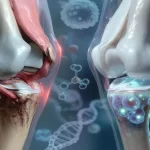
As illustrated in comparative anatomical models, a progressive arthritic environment involves:
The fragmentation and thinning of shock-absorbing hyaline cartilage.
Micro-fractures and the development of painful bony overgrowths (bone spurs) on the underlying bone.
Chronic low-grade inflammation of the synovial membrane (the inner lining that secretes lubricating fluid).
The progressive weakening and loss of elasticity in surrounding ligaments and stabilizing skeletal muscles.

When these tissues degrade, routine activities like climbing stairs, carrying grocery bags, or simply getting out of a car turn into grueling daily endurance tests. Because there is currently no definitive cure to reverse cartilage loss entirely, clinical care focuses heavily on joint protection and maximizing muscle function.
How Electrical Stimulation Bypasses Joint Pain
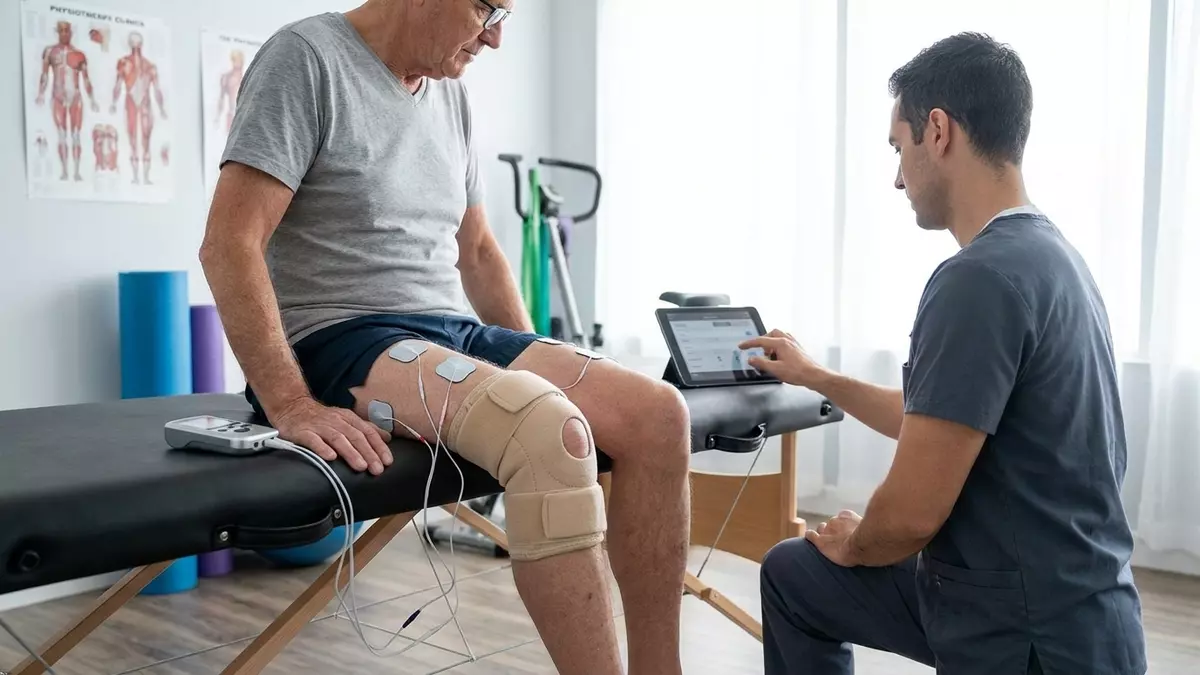
Neuromuscular electrical stimulation functions by placing highly conductive adhesive pads called electrodes directly onto the skin overlying key muscle groups, such as the quadriceps above a arthritic knee.
The compact NMES device delivers precise, low-frequency electrical currents that travel through the skin to depolarize the motor nerves. This causes the muscle fibers to rhythmically contract and relax, perfectly mimicking the internal electrical signals your central nervous system sends when you actively choose to lift a weight.
[NMES Device Sends Pulse] ➔ [Depolarizes Motor Nerves] ➔ [Muscle Dynamically Contracts] ➔ Joint Remains Stationary & Pain-Free
The profound mechanical twist of NMES is that it achieves isometric muscle contraction. The targeted muscle is forced to exert force and perform metabolic work, yet the actual skeletal joint can remain completely stationary and unweighted. For a patient whose hip or knee joint throbs under the stress of a standard squat or walk, NMES offers an elegant backdoor pathway to condition muscle tissue while bypassing joint friction entirely.
What the Clinical Research Reveals
This therapeutic approach is backed by a mounting body of peer-reviewed clinical data. Dr. Louise Burgess, an expert lecturer in sport and exercise science at Bournemouth University, has highlighted NMES as a vital lifeline for arthritic patients who face severe physical barriers to conventional athletic rehabilitation.
Reversing Muscle Wasting (Atrophy)
A comprehensive 2021 systematic review evaluated the impact of NMES on adults battling advanced hip and knee osteoarthritis. The analysis concluded that electrical stimulation is a highly effective, feasible intervention for reversing severe muscle loss. Intriguingly, the review also documented that patient adherence to home-based NMES protocols was identical to voluntary exercise groups, proving that the physical sensation of the electrical current is highly tolerable for the vast majority of users.
Pre-Surgery Conditioning (“Prehab”)
The utility of NMES extends heavily into the surgical realm. A localized pilot study tracking patients scheduled for total knee replacement surgery implemented a short, home-based quadriceps stimulation program prior to their operation.
Even though the patients were in too much pain to perform standard leg extensions, the passive electrical stimulation successfully preserved their quadriceps strength going into the operating room. This foundational strength acted as a biological buffer, drastically accelerating their post-operative mobility and early rehabilitation timelines.
Changing the Environment: The Cellular Twist
The most exciting frontier of NMES research goes beyond simple muscle building. Growing laboratory evidence suggests that the mechanical squeezing of muscles via electrical stimulation actively alters the local biochemical environment of the joint itself.
When an arthritic joint is inactive, the synovial fluid turns stagnant, allowing a pool of inflammatory signaling proteins (cytokines) to accumulate and accelerate cartilage breakdown. However, when surrounding muscles are forced to contract via NMES, they act as mechanical pumps, stimulating localized blood flow and encouraging the healthy circulation of synovial fluid.
Furthermore, contracting muscle fibers release specialized, anti-inflammatory proteins called myokines. These myokines travel locally to help neutralize destructive inflammatory enzymes within the joint capsule, effectively shifting the internal environment away from rapid degradation and toward stabilization.
Navigating the Treatment: Not a Cure, but a Vital Bridge
Despite its immense promise, medical experts urge a balanced perspective: electricity does not replace the holistic benefits of voluntary movement. NMES should never be viewed as a permanent, standalone cure or a reason to abandon traditional physical therapy.
Instead, the ideal clinical application of NMES is as a rehabilitative bridge. It serves as an emergency intervention to keep muscles active during an acute arthritic flare-up, a protective tool during pre-operative waiting periods, or a confidence-builder for individuals paralyzed by the fear of movement (kinesiophobia). It keeps the muscular shock absorbers online so that patients can eventually transition safely back into active walking, swimming, and functional living.
Comprehensive Safety Screening Matrix
While NMES is exceptionally safe for the general population, it utilizes electrical currents and is strictly contraindicated for certain individuals. Always review these medical boundaries with a clinician prior to initiating treatment:
| Unsuitable Categories (Contraindicated) | Safe Profiles (Excellent Candidates) |
| Individuals with implanted pacemakers or defibrillators (current can disrupt device signaling) | Patients experiencing severe, acute arthritic pain flare-ups |
| Individuals with active deep vein thrombosis (DVT) or localized skin infections | Pre-operative patients preparing for joint replacement surgery |
| Individuals suffering from severe peripheral nerve conditions or altered skin sensation | Individuals dealing with advanced muscle wasting due to severe inactivity |
Conclusion
The evolution of neuromuscular electrical stimulation represents a refreshing shift in modern orthopedic medicine—moving away from merely masking osteoarthritic pain with systemic anti-inflammatory drugs or opioids, and moving toward restoring localized tissue vitality from within. By elegantly bypassing joint friction to preserve raw muscular strength, NMES protects the body’s natural shock absorbers, offering an accessible, pain-free path back toward independent, lifelong mobility.
Frequently Asked Questions
What does an NMES session actually feel like on the skin?
When the NMES device is turned on, you will initially feel a light, pins-and-needles tingling sensation beneath the adhesive pads. As the intensity is gradually adjusted upward, this tingle transitions into a deep, firm, and completely involuntary squeezing sensation as the muscle fibers engage in a full contraction. While the sensation can feel unusual or surprising at first, it should never feel sharp, stinging, or painful. You remain in complete control of the intensity dial at all times.
How does an NMES device differ from a standard TENS unit?
While both devices utilize adhesive skin pads and electrical currents, they target entirely different neurological pathways. A TENS (Transcutaneous Electrical Nerve Stimulation) unit uses a high-frequency, low-intensity current to stimulate sensory nerves, temporarily blocking pain signals from reaching the brain—it acts as a digital band-aid for temporary pain relief. An NMES unit uses lower frequencies and higher intensities specifically calibrated to target motor nerves, physically forcing the muscle tissue to contract to build strength and mass.
How many times a week should I use electrical stimulation for osteoarthritis?
For noticeable, long-term improvements in muscle density and joint stability, consistency is paramount. Most successful clinical protocols recommend utilizing the NMES device for 20 to 30 minutes per day, roughly 3 to 5 times per week, over a continuous block of 6 to 8 weeks. Always follow the specific parameters and placement guidelines provided by your physical therapist or orthopedic physician to align with your personal joint health goals.
Can I buy an NMES device for personal use at home?
Yes, there are numerous high-quality, consumer-grade NMES devices available for home use. Many models can be purchased over-the-counter, while higher-intensity clinical units may require a formal prescription from a healthcare professional. It is highly recommended to have your initial session supervised by a physical therapist, who can precisely map out the correct electrode placement zones for your specific anatomy and teach you how to safely scale the electrical intensity.
Will using an NMES device help me lose weight around the arthritic joint?
No, NMES is not a weight-loss tool. While the forced muscular contractions do consume a minor amount of cellular energy, the localized calorie burn is far too low to stimulate systemic fat reduction. The true metabolic value of NMES for weight management is indirect: by safely restoring your leg strength and reducing localized joint pain, it empowers you to comfortably return to active, calorie-burning voluntary exercises like swimming, cycling, and walking.