
Table of Contents
- 1. The Ultimate Aerobic Engine Builder
- 1.1. What the Clinical Data Shows
- 2. True Full-Body Engagement: More Muscles, Same Clock
- 3. High Intensity Without the Joint Impact
- 3.1. Overcoming Weight and Joint Limitations
- 4. Head-to-Head: How Rowing Compares to Other Cardio
- 4.1. Deciphering the Data on Energy Expenditure
- 5. A Beginner’s Guide to Perfect Rowing Form
- 5.1. The Golden Rule of Timing
- 5.2. The 2,000-Meter Baseline Test
- 6. Try this Balanced Full-Body MetCon Workout
- 7. Conclusion
- 8. Frequently Asked Questions
- 8.1. What damper setting should I use on a rowing machine?
- 8.2. Can rowing help correct poor posture from office work?
- 8.3. How often should I use the rowing machine each week?
- 8.4. Why do my lower back and knees hurt after rowing?
- 8.5. Is rowing safe for older adults with joint conditions?
Why the Rowing Machine Is the Ultimate Tool for Cardio, Strength, and Posture
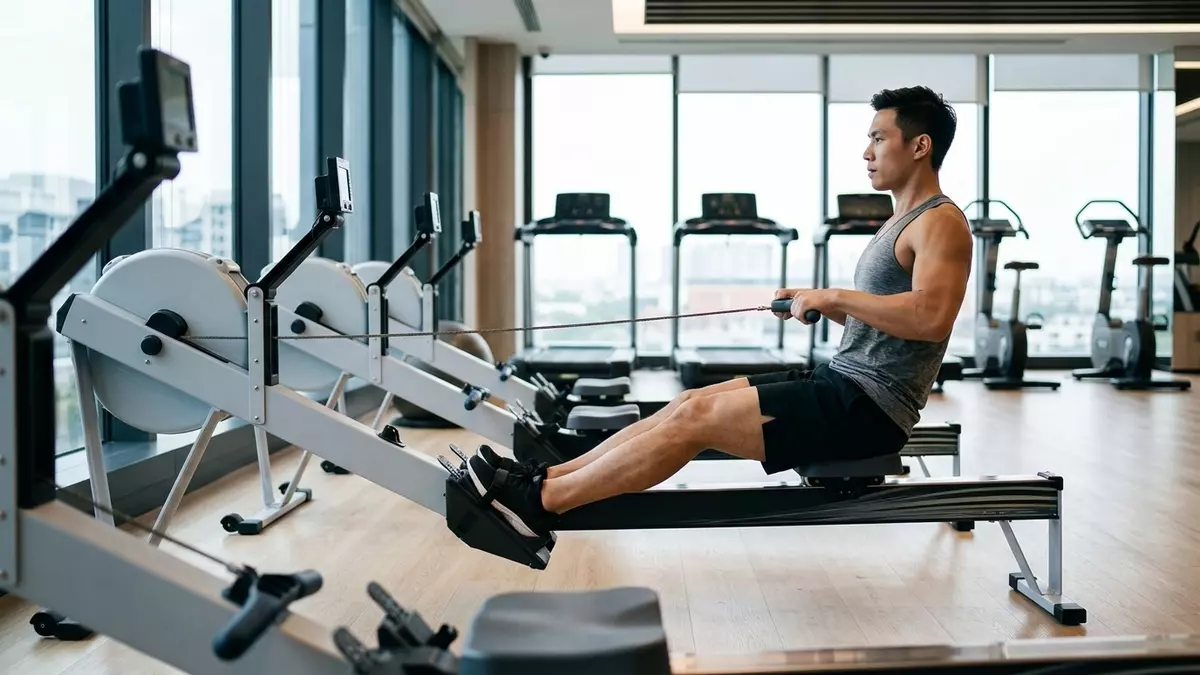
Walk into almost any gym, and you will notice a familiar pattern. The treadmills are packed, the stationary bikes are entirely filled, and the rowing machine often sits quietly in the corner, waiting for someone brave enough to strap in, pull, push, and breathe hard.
For years, the indoor rower was viewed as a niche tool reserved strictly for competitive crew athletes. However, that perception is shifting rapidly. With the rise of global fitness racing events like HYROX—where athletes must complete a grueling 0.62-mile (1,000-meter) row as a core racing station—the rowing machine is finally getting the mainstream spotlight it deserves.
For everyday gym-goers, the real appeal of the rower is beautifully simple: it delivers intense cardiovascular conditioning, full-body muscular recruitment, and low-impact joint protection within a single, fluid movement. It is a highly efficient package deal that challenges your heart and muscles simultaneously.

Why the Rowing Machine Is the Ultimate Tool for Cardio, Strength, and Posture
The Ultimate Aerobic Engine Builder
If you have ever spent ten minutes on a rowing machine, you know exactly how exhausting it feels. That rapid onset of fatigue isn’t just in your head; it is a direct reflection of how hard the machine forces your cardiorespiratory system to work.
The underlying driver of this intensity is oxygen demand. In exercise science, $VO_2$ max measures the maximum amount of oxygen your body can successfully utilize during intense physical exertion. It serves as the definitive gold-standard metric for your overall cardiovascular fitness—essentially measuring the literal size of your internal aerobic engine.

Because rowing recruits multiple large muscle groups simultaneously, your heart and lungs must work in overdrive to pump massive volumes of oxygen-rich blood with every single stroke.
What the Clinical Data Shows
A 2021 sports medicine study led by Timo Kirchenberger investigated the impact of structured rowing training on young, well-trained athletes. After an eight-week regimen that integrated high-intensity interval training (HIIT) on indoor rowers, the participants demonstrated significant improvements in their overall oxygen-utilization metrics and drastically shaved time off their 1.24-mile (2,000-meter) rowing time trials.
Rowing doesn’t just burn calories in the moment; it systematically expands your body’s long-term capacity to generate and distribute cellular energy.

True Full-Body Engagement: More Muscles, Same Clock
Traditional cardio machines are highly specialized, lower-body dominant tools. Running relies heavily on your legs to carry your body weight across a distance, while cycling leans almost exclusively on the quads, hamstrings, and glutes to turn the pedals. This leaves the upper body completely out of the fitness equation.
Rowing, conversely, distributes the physical workload across your entire anatomy. A single proper rowing stroke requires a beautifully coordinated sequence of power:
The Drive Sequence: Legs (60%) ---> Hips & Torso (20%) ---> Arms & Upper Back (20%)
Because of this comprehensive movement pattern, a dedicated rowing session acts as both a cardio workout and a resistance training session. It actively engages your quads, glutes, hamstrings, core, latissimus dorsi (lats), shoulders, rhomboids, and forearm grip strength all at once.
This full-body muscular recruitment is heavily backed by contemporary electromyography (EMG) studies. A 2023 muscle activity study utilized advanced sensors to map exactly how muscles fire during the distinct phases of a rowing stroke, confirming that the machine activates almost every major skeletal muscle group. You aren’t just burning calories; you are building functional, coordinated muscular endurance.
High Intensity Without the Joint Impact
For many fitness enthusiasts, the greatest advantage of the rowing machine is what it doesn’t do to the human body. It completely eliminates the repetitive, jarring impact forces that travel up through the ankles, knees, and hips every time a runner’s foot strikes the asphalt.
This low-impact nature makes it an invaluable tool for individuals navigating post-injury rehabilitation, office workers who spend hours sitting at a desk, or anyone carrying extra body weight.
As Cameron Harris, managing director at Truth Fitness, points out:
“The rower allows you to work at very high intensities, one of the main reasons being that you aren’t restricted by your physical body weight like with running.”
Overcoming Weight and Joint Limitations
Consider an individual who is 22 pounds above their ideal weight. If they attempt a high-intensity run, their knee joints may begin to ache or throb well before their heart and lungs are truly challenged. On a rowing machine, the sliding seat supports the user’s physical body weight, allowing them to push their cardiovascular system to its absolute limits without damaging their joints.
This joint-friendly profile is supported by a 2022 randomized clinical trial published by Pei-Ling Lin and colleagues. The study tracked older adults suffering from mild knee osteoarthritis—the chronic wear-and-tear condition often referred to as “bad knees.” After completing a 12-week computer-aided rowing program, the participants experienced substantial improvements in overall knee health, localized muscular strength, and daily physical functioning, easily outperforming the control group that engaged in standard resistance exercises.
Head-to-Head: How Rowing Compares to Other Cardio
To maximize your time in the gym, it helps to understand how the rowing machine stacks up against traditional fitness equipment based on different athletic goals.
| Fitness Metric | Indoor Rowing Machine | Traditional Treadmill | Stationary Exercise Bike |
| Muscular Recruitment | Full-Body (85% of total muscle mass) | Lower-Body Dominant | Lower-Body Isolated |
| Joint Impact Level | Extremely Low (Seated, fluid motion) | High (Repetitive ground impact) | Low (Smooth pedaling motion) |
| Postural Correction | High (Strengthens upper back & core) | Neutral | Low (Encourages slouching) |
| Peak Fat Oxidation | Moderate to High | High | Moderate |
Deciphering the Data on Energy Expenditure
A 2021 study published in the Journal of Sports Science and Medicine found that treadmill running produced a slightly higher rate of fat oxidation than both rowing and elliptical exercise in healthy men, though peak oxygen utilization remained identical across all three modalities. Furthermore, a 2024 study featured in Frontiers in Sports and Active Living monitored recreationally active, middle-aged men and concluded that the treadmill yielded the highest absolute oxygen consumption, heart rate, and overall energy expenditure during maximum efforts.
If your single, exclusive goal is pure running-specific conditioning or maximizing instant caloric burn per minute, the treadmill remains a powerful tool. However, if your goal is long-term conditioning, core stability, and full-body structural balance, the rowing machine stands in a class of its own.
A Beginner’s Guide to Perfect Rowing Form
To unlock the full health benefits of the rower and protect your lower back from strain, you must prioritize technique over raw speed. Avoid the temptation to chase exhaustion on day one; instead, focus on mastering the cadence of the stroke.
The Golden Rule of Timing
Keep this simple sequence in mind every time you sit on the ergometer:
The Drive (The Power Phase): Drive hard with your legs, hinge backward slightly with your body, and pull the handle to your chest with your arms.
The Recovery (The Return Phase): Extend your arms forward, hinge your body forward at the hips, and bend your legs to slide the seat back to the starting position.
Drive Phase:    Legs ===> Body ===> Arms
Recovery Phase: Arms ===> Body ===> Legs
The 2,000-Meter Baseline Test
To establish a clear benchmark for your cardiorespiratory fitness, complete a simple 1.24-mile (2,000-meter) time trial after a thorough 10-minute warmup. Maintain a steady, controllable pace, note your average “split time” (the time it takes to row 500 meters), and repeat this exact test every six weeks to cleanly track your cardiovascular progress over time.
Try this Balanced Full-Body MetCon Workout
If you want to integrate the rowing machine into a dynamic metabolic conditioning (MetCon) routine that keeps your heart rate elevated while building strength, try this structured five-round circuit:
Rowing: 400 meters (Focus on a powerful, explosive leg drive)
Kettlebell Deadlifts: 10 repetitions (Engages the hamstrings, glutes, and lower back)
Strict Pushups: 8 repetitions (Balances the pulling motion of rowing with a chest and tricep push)
Rest precisely 60 seconds between rounds, and repeat for 5 total sets.
This balanced layout spreads the physical load evenly across your legs, hips, back, chest, and core, providing a comprehensive workout that leaves no muscle group left behind.
Conclusion
The rowing machine is an exceptional piece of fitness engineering because it solves a persistent workout dilemma: how to challenge the cardiovascular system without overloading the joints. By combining endurance training, core stabilization, and muscular strength into a single, elegant movement, rowing delivers an incredibly efficient workout. Stop passing by the quiet machine in the corner—strap into the rower, focus on your form, and experience the physical benefits of a true full-body workout.
Frequently Asked Questions
What damper setting should I use on a rowing machine?
Many beginners mistakenly assume that setting the flywheel damper to 10 makes the workout better. In reality, a high damper setting mimics a heavy, sluggish boat, which can quickly strain your lower back if your form slips. For an optimal balance of smooth resistance and aerobic conditioning, keep the damper set between 3 and 5, which closely replicates the natural feel of clean water.
Can rowing help correct poor posture from office work?
Yes! Spending long hours slouched over a desk weakens the muscles in your upper back and shoulders. The pulling phase of a rowing stroke actively targets and strengthens your rhomboids, lats, and posterior deltoids, while forcing your core to stabilize. This helps pull your shoulders back into alignment and strengthens your natural posture.
How often should I use the rowing machine each week?
For great results, try incorporating a rowing session into your routine two to three times a week. Because it is a demanding full-body exercise, your muscles need time to recover. Spacing out your sessions or alternating rowing days with low-intensity walking or targeted mobility work ensures your body stays fresh and injury-free.
Why do my lower back and knees hurt after rowing?
If you experience pain in your lower back or knees, it is almost always a sign of improper technique. Back pain typically occurs when you slouch your shoulders or bend forward at the waist during the drive phase. Knee pain often happens if you slide too far forward on the recovery, causing your knees to bend past a safe 90-degree angle. Focus on keeping a flat, neutral spine and pushing strictly through your heels.
Is rowing safe for older adults with joint conditions?
Absolutely. As demonstrated in recent clinical trials, the smooth, impact-free nature of indoor rowing makes it incredibly safe and therapeutic for older adults managing conditions like knee osteoarthritis. It strengthens the supporting muscles around fragile joints without subjecting them to harsh impact forces, provided the individual begins at a gentle pace and prioritizes proper form.