
Table of Contents
1 Procedure Relieves Severe Knee Arthritis Pain For A Full Year
Knee osteoarthritis has a way of shrinking your world. Suddenly, a quick walk to the mailbox requires mental preparation, taking the stairs feels like a massive physical challenge, and standing in a grocery checkout line becomes an endurance test.
For decades, patients suffering from chronic joint pain have faced a deeply frustrating medical dilemma. When basic treatments like ibuprofen and physical therapy stop working, the only remaining option is often a highly invasive, total knee replacement surgery.
Now, a major breakthrough published in the medical journal Radiology is offering immediate hope to those stuck in this painful middle ground. Researchers from Charité – Universitätsmedizin Berlin have successfully demonstrated that a minimally invasive procedure known as genicular artery embolization (GAE) can dramatically reduce knee pain and restore daily joint function for at least an entire year—all without a single surgical incision.
1 Procedure Relieves Severe Knee Arthritis Pain For A Full Year

The Global Burden of Knee Osteoarthritis
Before understanding the solution, it helps to understand the scale of the problem. Osteoarthritis is a degenerative joint disease characterized by the mechanical breakdown of cartilage—the slick, protective tissue that cushions the ends of your bones. As this cartilage wears away over time, the resulting bone-on-bone friction causes severe pain, chronic swelling, debilitating stiffness, and a significant loss of mobility.
The World Health Organization (WHO) reported that in 2019, approximately 528 million people worldwide were living with osteoarthritis. The knee is by far the most commonly affected joint, accounting for roughly 365 million of those cases globally.
This isn’t just a sterile clinical statistic. It is a daily reality that severely limits a person’s ability to work, exercise, sleep soundly, and perform the tiny, everyday movements that healthy individuals take completely for granted.

Falling Into the “Treatment Gap”
The standard medical playbook for treating knee arthritis follows a highly predictable path. Doctors typically begin with conservative care: targeted physical therapy regimens, weight management, non-steroidal anti-inflammatory drugs (NSAIDs), and localized corticosteroid or hyaluronic acid injections directly into the joint.
Because osteoarthritis is a progressive disease, these conservative measures eventually begin to lose their effectiveness. This dynamic creates what Dr. Florian Nima Fleckenstein, the lead researcher of the Berlin study, describes as a massive “treatment gap.”
Patients trapped in this gap are in far too much pain to live their lives normally, but they may be too young, too medically compromised, or simply unwilling to undergo a major joint replacement surgery and endure its grueling months of physical rehabilitation.

Genicular Artery Embolization: How It Works
This is exactly where genicular artery embolization steps in to rewrite the rules of joint care.
When a knee joint is constantly damaged by advancing arthritis, the body tries to heal the area by creating a dense network of abnormal, microscopic new blood vessels around the joint—a biological process known as neovascularization. Instead of helping, however, these tangled vessels fuel a vicious cycle. They deliver inflammatory cells to the knee and generate abnormal nerve growth, which keeps the body’s pain signals constantly switched “on.”
GAE directly targets and shuts down this pathological vascular network.
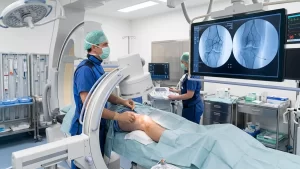
During the outpatient procedure, an interventional radiologist uses fluoroscopic guidance (real-time, continuous X-ray imaging) to navigate a microscopic catheter through the vascular system, starting from a tiny pinhole in the upper leg all the way down to the affected arteries in the knee. Once the catheter reaches the abnormal blood vessels, the doctor injects rapidly resorbable gelatin-based microspheres.
The Highway Analogy: Think of your leg’s main artery as a major highway, and the abnormal, inflammation-causing vessels as troublesome dirt side roads. The microscopic beads selectively dam up those side roads, starving the inflammation of its blood supply, without interrupting the critical blood flow traveling down the main highway to the rest of your leg.
What makes this new iteration of GAE incredibly unique is the temporary nature of the embolic beads. Older methods used permanent synthetic particles to block the vessels. These newer, gelatin-based spheres do their job and then safely dissolve within hours, greatly minimizing the risk of long-term tissue damage while still providing sustained symptom relief.
Groundbreaking Results from the Berlin Study
The research out of Germany provides some of the most robust, real-world data to date on this procedure. The study followed 194 patients (114 women and 80 men, with a median age of 69) whose severe knee pain had completely resisted standard conservative treatments for at least three months. In total, 239 procedures were performed, as 45 patients received the treatment on both of their knees within a four-week window.
The clinical results were closely tracked over a 12-month period using the standard 0-to-10 Numeric Rating Scale (NRS) for pain, as well as the Knee Injury and Osteoarthritis Outcome Score (KOOS), which measures exactly how the knee impacts daily life on a 0-to-100 scale.
The 12-Month Transformation
The data revealed rapid, substantial, and incredibly sustained improvements across every single metric.
| Measurement Category | Before Treatment (Baseline) | 12 Months After Procedure |
| Pain Score (0-10 Scale) | 7 (Severe Pain) | 3 (Mild Pain) |
| Daily Activities (0-100) | 53 | 71.5 |
| Sports & Recreation (0-100) | 15 | 36 |
| Overall Quality of Life (0-100) | 19 | 40 |
By the one-year mark, a staggering 80% of participants had achieved a pain reduction considered “clinically meaningful”—meaning the relief was substantial enough to significantly alter their daily lived experience. Patients reported being able to stand up without wincing, walk significantly further distances, and reclaim outdoor hobbies they assumed were lost forever.
An Excellent Safety Profile
Whenever a new medical procedure enters the spotlight, patient safety is the primary concern. In the Berlin cohort, the image-guided procedure achieved a flawless 100% technical success rate.
Remarkably, there were zero moderate or severe adverse events reported over the entire year. Mild, self-limiting reactions occurred in only 6.7% of the procedures. These minor side effects were limited to temporary skin discoloration around the knee and one isolated case of a superficial bruise near the groin insertion site. All of these minor issues resolved entirely on their own without requiring any further medical intervention.
The Future of Joint Care
It is vital to manage expectations: GAE is not a magical cure for osteoarthritis. It does not regenerate lost cartilage, nor does it replace the fundamental need for regular exercise, weight management, or eventually, a total joint replacement for end-stage, “bone-on-bone” arthritis.
However, for carefully selected patients who are trapped in the treatment gap, genicular artery embolization using temporary microspheres represents a massive leap forward. It offers a powerful, low-risk bridge between simple steroid injections and invasive orthopedic surgery.
The scientific community is already mobilizing to conduct larger, multi-center randomized trials to compare GAE directly against sham procedures and standard care. But for the millions of people whose daily routines have been dictated by a throbbing, swollen knee, this procedure offers genuine, scientifically backed hope for a vastly more active, pain-free future.
Frequently Asked Questions (FAQs)
1. What exactly is a genicular artery?
The genicular arteries are a highly specific network of blood vessels that supply vital oxygen and nutrients to the knee joint, including the surrounding ligaments, cartilage, and synovial tissue.
2. Does this procedure require general anesthesia or an overnight hospital stay?
No. Genicular artery embolization is a minimally invasive, outpatient procedure. It is typically performed using local anesthesia at the catheter insertion site (usually the upper thigh or groin) along with mild twilight sedation. This allows patients to remain comfortable and go home the very same day.
3. Will this procedure regrow the cartilage in my knee?
No. Currently, there is no proven medical procedure that can organically regrow eroded cartilage. GAE works strictly by cutting off the blood supply to the hyperactive, inflammatory vessels that generate pain signals. It gives you substantial pain relief and improved mobility, even though the structural cartilage loss remains unchanged.
4. How do I know if I am a good candidate for GAE?
Ideal candidates are typically middle-aged to older adults who have mild to moderate knee osteoarthritis and have not found relief from at least three months of conservative treatments (such as NSAIDs, physical therapy, or cortisone injections), but who are not yet medically ready or eligible for a total knee replacement.
5. How long does the pain relief actually last?
The latest clinical data from the Berlin study shows that a vast majority of patients experience significant, clinically meaningful pain relief for at least 12 months following a single procedure. Because the technique uses newly developed rapidly resorbable microspheres, long-term multi-year studies are currently ongoing to determine the absolute maximum duration of relief.