
Table of Contents
- 1. The Science Behind Sideways Planting
- 1.1. Why More Roots Mean More Fruit
- 2. Step-by-Step Guide: How to Plant Tomatoes Sideways
- 2.1. Step 1: Prep the Seedling
- 2.2. Step 2: Dig a Shallow Trench
- 2.3. Step 3: Position the Plant
- 2.4. Step 4: Bury and Water Thoroughly
- 3. Essential Care Tips for a High-Yielding Season
- 3.1. 1. Enrich the Planting Trench
- 3.2. 2. Implement Deep, Targeted Irrigation
- 3.3. 3. Maintain Strategic Spacing and Support
- 4. Conclusion
- 5. Frequently Asked Questions
- 5.1. Can you use the sideways planting method for determinate (bush) tomatoes?
- 5.2. Will burying the stem cause the tomato plant to rot?
- 5.3. How long does it take for the sideways plant to stand up straight?
- 5.4. Should I fertilize my tomatoes right after planting them sideways?
- 5.5. Can I use the horizontal trench method in raised beds or fabric containers?
The Secret Trick to Planting Tomatoes Sideways for a Massive Harvest
Any seasoned gardener knows that tomato plants can be notoriously finicky during their initial establishment phase. Issues like weak, floppy stems and leggy seedlings frequently plague home growers, often culminating in a disappointing, sparse harvest.
Fortunately, an unconventional yet highly effective gardening hack can completely transform your tomato crop: trench planting, or planting your tomatoes sideways.
While laying a perfectly good seedling flat in the dirt might feel counterintuitive at first, this method capitalizes on a unique biological trait of the tomato plant. By burying the stem horizontally in a shallow trench rather than dropping the root ball deep into a traditional vertical hole, you trigger an explosion of root growth that sets the stage for an incredibly high-yielding season.

The Secret Trick to Planting Tomatoes Sideways for a Massive Harvest
The Science Behind Sideways Planting
Tomatoes possess a remarkable evolutionary advantage: they are adventitious root growers. This means that the microscopic, fuzzy hairs lining a tomato stem are capable of transforming into fully functional roots whenever they come into direct, sustained contact with moist soil.
Standard Planting: Short root system ---> Limited nutrient intake
Sideways Planting: Elongated root system along the stem ---> Maximum nutrient intake
When you plant a tall, leggy seedling upright, the buried root system remains small, forcing a weak stem to support a top-heavy plant. Conversely, when you bury a long section of the stem horizontally, the plant initiates root production along the entire length of that subterranean vine.

Why More Roots Mean More Fruit
An expanded root system acts as a supercharged engine for your plant. With triple or quadruple the root mass of a traditionally planted tomato, your vine can absorb water and vital soil nutrients with unparalleled efficiency. This results in:
Rapid vegetative growth and thicker, sturdier main stalks.
Significantly increased resistance to drought, as the expansive root net can find moisture deeper in the soil bed.
Superior structural stability against harsh winds and heavy summer downpours.

This technique is an absolute game-changer if your indoor seed-starting setup lacked sufficient light, leaving you with tall, spindly, “leggy” seedlings that would otherwise struggle to survive the transition to the outdoor garden.
Step-by-Step Guide: How to Plant Tomatoes Sideways
Executing this technique successfully requires a gentle hand and the proper preparation. Follow these steps to maximize your root-growing potential.
Step 1: Prep the Seedling
Select your tomato seedling. If it looks overly tall or stretched out, it is the perfect candidate for this method. Carefully snip off the lower sets of leaves, leaving only the top cluster of foliage intact. Removing these lower branches prevents them from rotting underground and tells the plant to focus its energy on root production at those exact nodes.
Step 2: Dig a Shallow Trench
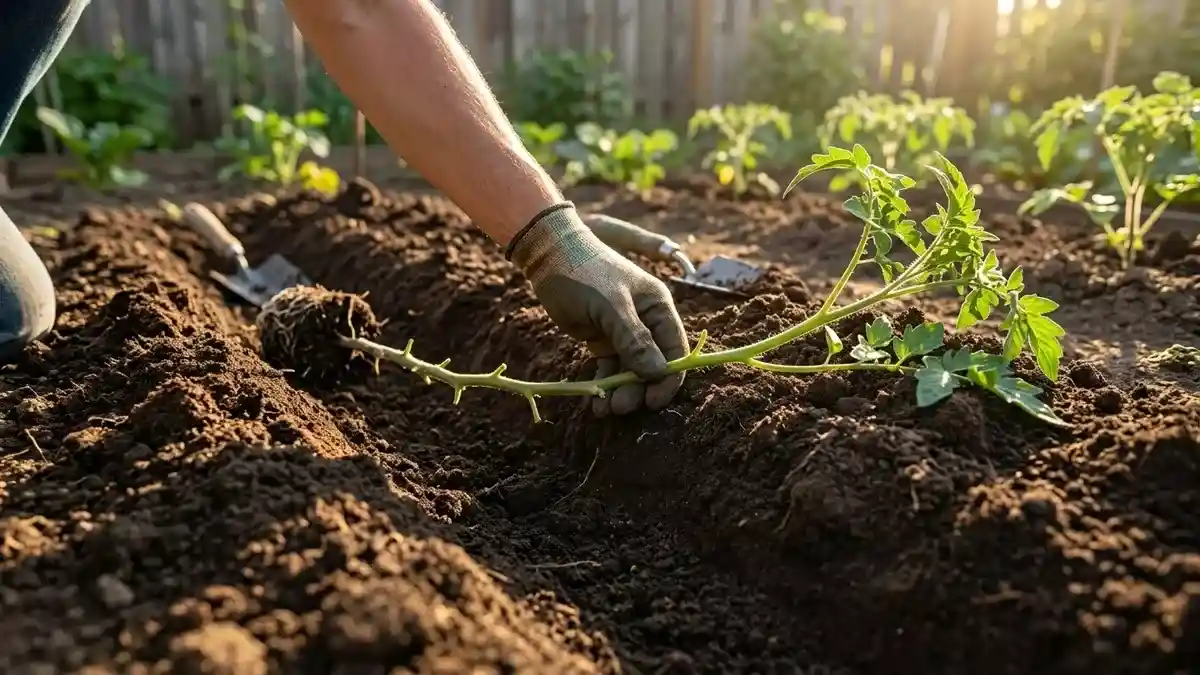
Instead of digging a deep, vertical hole, use a garden trowel to scoop out a long, shallow trench roughly 5 to 6 inches deep. The length of the trench should mirror the length of the trimmed, bare stem of your seedling.
   [Top Leaves] (Above ground)
     \
______\______________________  <-- Soil Line
       \_[Bury Stem Horizontally]_ (5-6" Deep)
                                  \__[Root Ball]
Step 3: Position the Plant
Place the original root ball at one end of your trench. Lay the bare stem flat along the bottom of the trench. Next, gently guide the leafy top of the plant so it arches slightly upward, pointing out of the soil.
Do not force a sharp 90-degree bend, as you risk snapping the succulent stem. A soft, gradual curve is all it takes. Tomatoes are highly phototropic, meaning they automatically grow toward light; within 24 to 48 hours, the exposed top will naturally straighten itself up toward the sun.
Step 4: Bury and Water Thoroughly
Carefully backfill the trench with loose soil, completely covering the horizontal stem while keeping the top leafy tuft exposed. Press down very gently on the soil to eliminate large air pockets without compacting the dirt. Water the entire length of the trench deeply to settle the soil around the newly buried stem.
Essential Care Tips for a High-Yielding Season
While sideways planting gives your tomatoes a massive head start, maintaining excellent care habits throughout the season ensures you maximize your harvest potential.
1. Enrich the Planting Trench
Tomatoes are incredibly heavy organic feeders. When digging your shallow trench, blend a generous handful of rich compost, worm castings, or well-aged manure into the soil. This provides an immediate, easily accessible reservoir of nutrition for the newly forming roots.
2. Implement Deep, Targeted Irrigation
To discourage soil-borne fungal diseases, always water your tomato plants directly at the base rather than overhead. Aim for deep, infrequent watering sessions that saturate the entire root zone, encouraging the roots to push deeper into the earth. Applying a 2-inch layer of clean straw or shredded leaf mulch over the trench will help lock in vital soil moisture and suppress competitive weeds.
| Watering Method | Disease Risk | Root Health Impact |
| Overhead Sprinkling | High (Fosters blight and fungus) | Shallow, weak root development |
| Ground-Level Soaking | Extremely Low | Deep, resilient, expansive root network |
3. Maintain Strategic Spacing and Support
Because sideways-planted tomatoes grow into robust, heavily laden bushes, proper spacing is crucial. Space your trenches 2 to 3 feet apart to guarantee excellent air circulation around the mature foliage, which drastically reduces the risk of powdery mildew and blight.
Once the plant straightens itself out and begins its rapid upward climb, secure it with a heavy-duty tomato cage or a sturdy stake to keep the heavy clusters of developing fruit off the ground.
Conclusion
Switching from traditional vertical holes to horizontal trench planting is a simple, no-cost adjustment that pays massive dividends at harvest time. By working with the tomato’s natural urge to sprout roots from its stem, you build a fortress of a root system capable of supporting heavy, fruit-laden vines all summer long.
Frequently Asked Questions
Can you use the sideways planting method for determinate (bush) tomatoes?
Yes! While indeterminate (vining) varieties benefit the most due to their natural tendency to get tall and leggy, determinate varieties will also develop a stronger, more efficient root system using this method.
Will burying the stem cause the tomato plant to rot?
No, as long as your soil drains well and you have removed the lower leaves before burying the stem. Tomato stems are specifically adapted to transition into root tissue when underground, unlike many other vegetable plants whose stems will rot if buried.
How long does it take for the sideways plant to stand up straight?
Tomatoes respond incredibly fast to sunlight. Within 24 to 48 hours after being buried sideways, the leafy tip of the plant will naturally curve upward and face the sky completely on its own.
Should I fertilize my tomatoes right after planting them sideways?
It is best to mix slow-release nutrients like compost or a balanced organic fertilizer into the trench soil at planting time. Avoid heavy applications of synthetic high-nitrogen chemical fertilizers immediately after planting, as this can burn the sensitive, emerging new root hairs.
Can I use the horizontal trench method in raised beds or fabric containers?
Absolutely. Trench planting is excellent for raised beds. If you are using containers, just ensure the pot is wide enough across (at least 15 to 20 inches in diameter) to accommodate the length of the horizontal stem.