
Table of Contents
The 5-Move Wall Workout for Joint-Friendly Knee & Core Strength
If you find that traditional squats and lunges cause discomfort in your knees, you don’t have to abandon lower-body strength training. Fitness expert Maddy Biddulph has developed a brilliant solution: a five-move “wall workout” designed to build muscle and stability while keeping your joints protected.
By utilizing a wall for support, you can focus on muscle activation and core engagement without the high-impact stress often associated with floor-based exercises. This routine is low-impact, highly effective, and requires minimal equipment—just a wall, a resistance band, and a cushion or yoga block.
The 5-Move Wall Workout for Joint-Friendly Knee & Core Strength
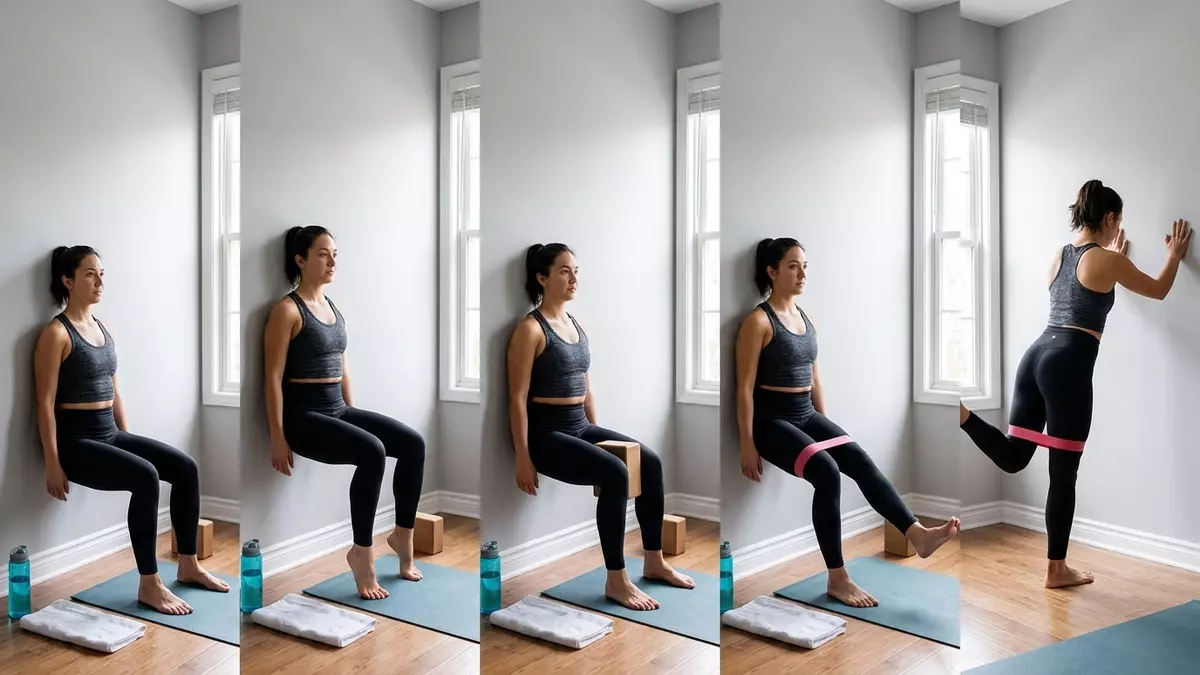
The 5-Move Wall Routine
For the best results, perform these moves in 30-second rounds, eventually working your way up to one minute per move as your stamina increases.

1. The Classic Wall Sit
This is the foundation of the routine.
How-to: Lean your back against a wall and slide down until your knees are bent at a 90-degree angle. Ensure your hips, shoulders, and lower back remain pressed firmly against the wall.
Why it works: It builds isometric endurance in your quadriceps and glutes. Strong quads act as a “shock absorber” for your knees, significantly reducing daily strain.

2. Wall Sit with Calf Raise
This variation introduces dynamic movement to the static wall sit.
How-to: While holding your wall sit, lift both heels off the floor, balancing on your toes. Hold for a second, then lower your heels back to the ground with control.
Why it works: It builds calf and ankle strength. When your lower legs are strong, your ankles provide a stable foundation, which prevents your knees from compensating during walking or stair-climbing.

3. Wall Sit with Ball Pulse
Adding a small object between your knees changes everything.
How-to: Place a Pilates ball, cushion, or yoga block between your knees while in the wall sit position. Use your inner thighs to squeeze the object in a rhythmic, pulsing motion.
Why it works: This activates the adductors (inner thighs) and the medial muscles of the knee. Proper alignment through the inner thigh is essential for keeping the knee tracking correctly, preventing pain during movement.
4. Wall Sit with Step-Out
Time to add resistance for the hips.
How-to: Place a looped resistance band just above your knees. While maintaining your wall sit, alternate stepping one foot out to the side and then returning to the center.
Why it works: The band adds tension that forces your hip abductors (the outer hips) to work. Strong, stable hips are critical for knee health; if your hips are weak, your knees are often forced to take on extra stress.
5. Standing Donkey Kick
We finish by moving away from the wall to target the posterior chain.
How-to: Keep the resistance band above your knees. Face the wall and lean your hands against it for balance. With your knee bent at 90 degrees, kick one leg back, focusing on squeezing your glute at the top of the movement.
Why it works: This isolates the gluteus maximus—the largest muscle in your body—which provides the stability and power required to take the pressure off your knee joints during every step you take.
Why This Routine Works for Every Age
This routine is perfect for those who are managing joint sensitivity or anyone looking to build a “bulletproof” foundation for their knees. The support of the wall allows you to maintain perfect alignment, ensuring the work is being done by your muscles rather than your ligaments.
Pro-Tips for Success:
Alignment is Everything: Always keep your feet hip-width apart and ensure your knees are pointed in the same direction as your toes.
Breathe: It is easy to hold your breath during wall sits. Keep your breathing steady and rhythmic to keep your blood pressure stable.
Consistency over Intensity: You don’t need to train to failure to see results. These movements are designed to be integrated into your week frequently, providing steady, cumulative benefits for your joint health.
Frequently Asked Questions (FAQ)
Can I do this routine if I have existing knee pain?
If you have sharp pain, consult a physician or physical therapist first. However, if your knee pain is related to general weakness or lack of stability, these exercises are often exactly what physical therapists recommend to help.
What if I don’t have a resistance band?
You can perform the moves without the band to start. As you get stronger, the band adds the necessary resistance to keep your muscles challenged.
How often should I perform this routine?
Because these are low-impact, you can perform this routine 3–4 times per week. Consistent, smaller sessions are far better than one long, exhausting workout.
Is it normal for my legs to shake during wall sits?
Yes! That “shaking” is your muscles fatiguing. It is a sign that you are challenging your endurance. Just keep your form strict, and if the shaking becomes uncontrollable, stand up and rest.
Can I use a rolled-up towel instead of a Pilates ball?
Absolutely. A firm pillow, a thick book, or a rolled-up towel all work perfectly for the inner-thigh squeeze in move #3.