
Table of Contents
- 1. The Molecular Mystery: High Amyloid, But Missing Tau
- 2. The Biological Defense: How Heat Shock Proteins Rescue Neurons
- 3. From saunas to Laboratory Mice: Validating Thermal Therapy
- 3.1. The Finnish Sauna Longitudinal Study
- 3.2. Insights from Animal Models
- 4. The Brain’s Natural Daily Temperature Rhythm
- 5. A Word of Caution: Not a Simple DIY Prescription
- 6. Summary: A New Paradigm for Cognitive Resilience
- 7. Frequently Asked Questions
- 7.1. 1. Does this research mean that amyloid-beta is not the true cause of Alzheimer’s?
- 7.2. 2. Can I get the same heat shock protein benefits from taking a hot bath?
- 7.3. 3. What exactly is a Presenilin 2 (PSEN2) genetic mutation?
- 7.4. 4. How long do heat shock proteins stay active in the body after a heat session?
- 7.5. 5. Is thermal therapy safe for someone who has already been diagnosed with advanced Alzheimer’s?
Can Exposure to Intense Heat Help Stall the Onset of Alzheimer’s Disease?
For families carrying rare, aggressive genetic mutations for early-onset Alzheimer’s disease, family history can feel like a pre-determined medical sentence. In these families, symptoms like severe memory loss, confusion, and cognitive decline routinely manifest in a person’s 40s or 50s, with many individuals succumbing to the disease before reaching the age of 60.
But a remarkable scientific anomaly has completely disrupted this genetic script. A man named Doug Whitney inherited the rare Presenilin 2 (PSEN2) mutation—the exact genetic marker responsible for devastating generations of his family. Yet, despite carrying this genetic risk, Whitney has defied the odds, reaching his late 70s with his memory, sharp mind, and cognitive faculties completely intact.
Seeking to understand this extraordinary resistance, a team of international researchers uncovered a fascinating clue in Whitney’s occupational history. For decades, he spent his working life inside sweltering ship engine rooms, routinely enduring ambient temperatures climbing as high as 122°F (50°C).

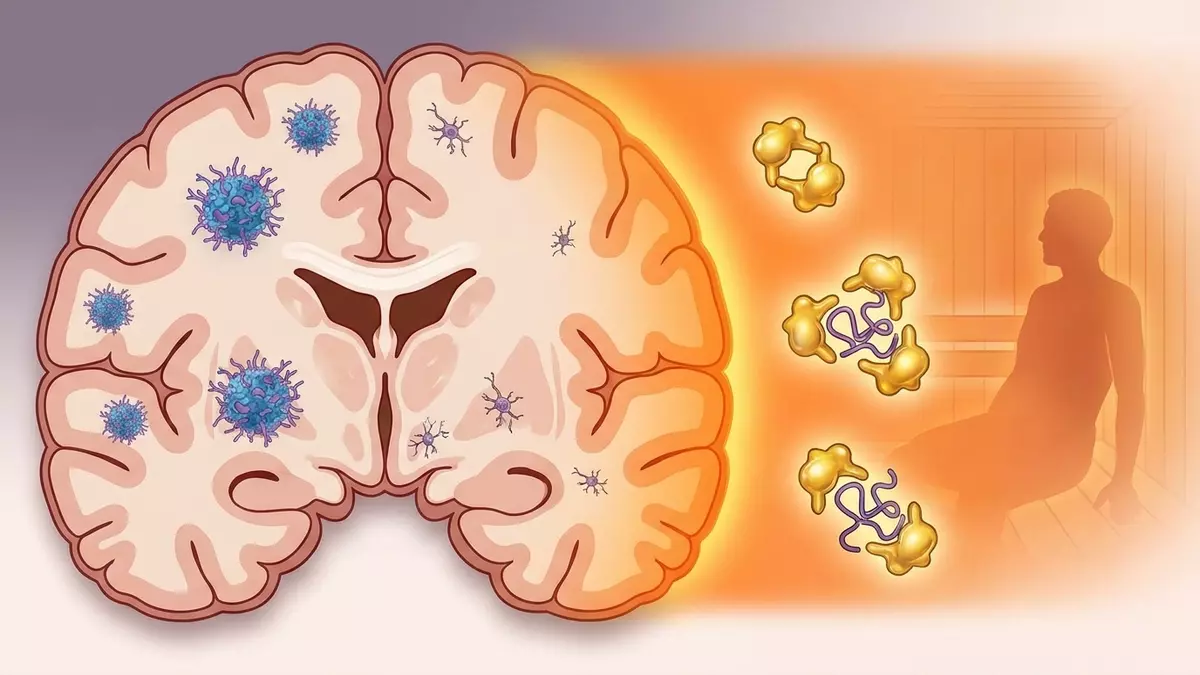
Today, neuroscientists suspect that this intense, chronic occupational heat exposure functioned as an accidental form of whole-body thermal therapy, offering a powerful, real-world case study into how the brain handles cellular stress.
Can Exposure to Intense Heat Help Stall the Onset of Alzheimer’s Disease
The Molecular Mystery: High Amyloid, But Missing Tau
To understand why Doug Whitney’s brain resisted degeneration, scientists evaluated his neural biomarkers. A groundbreaking study published in Nature Medicine, led by Dr. Jorge J. Llibre-Guerra and senior author Dr. Randall J. Bateman, revealed a fascinating biological paradox.

[PSEN2 Genetic Mutation] ──► Builds Up Amyloid Plaques (Present in Whitney's Brain)
                                         │
                                         ▼ (But Heat Therapy Blocks This Step!)
                              Abnormal Tau Protein Tangles ──► Cognitive Decline
Whitney’s brain scans demonstrated an exceptionally high accumulation of amyloid-beta plaques—the classic sticky protein clumps long considered the primary hallmark of Alzheimer’s pathology. Under normal circumstances, heavy amyloid buildup triggers a toxic domino effect, causing a secondary protein called tau to misfold, stabilize into dense tangles, and spread throughout the brain, killing neurons and destroying memory.
In Whitney’s case, however, the destructive cascade stalled. Despite the high amyloid levels, his brain showed remarkably limited, localized tau accumulation. Because tau tangles track much more accurately with the physical symptoms of dementia than amyloid plaques do, keeping tau from spreading effectively shielded his mind from cognitive decline.
The Biological Defense: How Heat Shock Proteins Rescue Neurons
In a follow-up scientific commentary published in the Journal of Alzheimer’s Disease, an international research consortium—including experts from the CNRS, Washington University School of Medicine in St. Louis, NYU Grossman School of Medicine, and Université Laval—explored the underlying biological mechanisms at play. Authors Geoffrey Canet, Brendan P. Lucey, Esther M. Blessing, and Emmanuel Planel argued that Whitney’s elevated internal body temperatures systematically activated a fundamental cellular defense mechanism.

When the human body is exposed to thermal stress, it rapidly increases the production of a specialized class of molecules called heat shock proteins (HSPs). Far from being harmful, these microscopic molecules act as a cellular repair crew. Their primary biological job is to assist other proteins in folding into their correct configurations and to actively prevent damaged, unstable proteins from clumping together.
       [Intense Ambient Heat Exposure]
                     │
                     ▼
  [Rapid Production of Heat Shock Proteins]
                     │
                     ▼
[HSPs Bind to Misfolded Tau] ──► [Prevents Tangles & Protects Memory]
Remarkably, clinical testing revealed that Whitney possesses exceptionally high concentrations of these protective heat shock proteins within his cerebrospinal fluid—the vital liquid surrounding the brain and spinal cord. Neuroscientists hypothesize that these elevated HSP levels continuously bound to early, misfolded tau proteins inside his brain cells, neutralizing them before they could aggregate into destructive neural tangles.
From saunas to Laboratory Mice: Validating Thermal Therapy
While the concept of using heat to protect the brain may sound unconventional, a growing body of epidemiological and clinical research strongly supports the link between thermal exposure and neurological health.
The Finnish Sauna Longitudinal Study
The scientific interest in heat therapy is heavily supported by a landmark longitudinal study out of Finland, which monitored 2,315 middle-aged men over the course of more than 20 years.
| Weekly Sauna Frequency | Statistical Alzheimer’s Risk Reduction | Primary Neurobiological Hypothesis |
| 1 Time Per Week | Baseline Risk Reference | Standard age-related neuro-degeneration |
| 2 to 3 Times Per Week | Moderate Risk Reduction | Mild cardiovascular and vascular benefits |
| 4 to 7 Times Per Week | 65% Lower Risk of Alzheimer’s | Sustained systemic activation of Heat Shock Proteins |
This striking 65% reduction in dementia risk among frequent sauna users provided scientists with compelling epidemiological data, demonstrating that routine whole-body heating correlates with significant long-term brain resilience.
Insights from Animal Models
To find the precise biological pathways driving this statistical trend, researchers transitioned to controlled laboratory mouse models. When mice engineered to develop human-like tau pathology were subjected to mild, sauna-like ambient heating, the thermal exposure directly reduced the accumulation of hyperphosphorylated, toxic tau. The heat stress stimulated the animals’ brains to clear away damaged proteins more efficiently, confirming that thermal therapy alters protein clearance pathways in mammals.
The Brain’s Natural Daily Temperature Rhythm
The connection between heat and protein clearance also extends into normal, everyday physiology. Human body temperature is not a static 98.6°F (37°C); it naturally fluctuates in a rhythmic cycle throughout the day, closely tied to our circadian sleep-wake states.
A study published in the Journal of Clinical Investigation discovered that higher core body temperatures naturally occurring during normal periods of wakefulness are intimately linked to changes in how tau protein is secreted and cleared from brain tissue in both mice and older adults.
This indicates that temperature fluctuations act as a physiological regulator, influencing how the brain moves, alters, and flushes out metabolic waste products before they can crystallize into disease-causing structures.
A Word of Caution: Not a Simple DIY Prescription
While Doug Whitney’s case opens an exciting new frontier for neurobiological research, medical experts issue a stern warning: this story should not be misinterpreted as a green light to engage in dangerous self-treatment or extreme overheating.
                           [Whole-Body Heat Exposure]
                                       │
            ┌──────────────────────────┴──────────────────────────┐
            ▼                                                     ▼
     [Potential Benefits]                                  [Clinical Risks]
  • Stimulates Heat Shock Proteins                       • Severe Dehydration
  • Enhances Cellular Repair Crews                       • Dangerous Blood Pressure Drops
  • Optimizes Waste Clearance                            • Cardiovascular Strain in Seniors
Deliberately exposing yourself to extreme heat carries significant, acute health risks, particularly for older adults, individuals with pre-existing heart conditions, or anyone prone to dehydration. Spending time in an intense environment like a 122°F engine room or a hot sauna puts intense strain on the cardiovascular system, making it vital to practice strict moderation.
Frequent sauna therapy is not a proven, regulatory-approved cure or treatment for Alzheimer’s disease. Anyone considering making intensive thermal exposure a regular part of their personal wellness routine should treat it as a significant lifestyle intervention and consult thoroughly with a medical professional to ensure it can be done safely.
Summary: A New Paradigm for Cognitive Resilience
Doug Whitney’s extraordinary genetic resistance has provided the scientific community with a invaluable gift. A progressive neurodegenerative disease that once seemed completely unpreventable within his family line has been successfully held at bay for over three decades.
While the mystery is far from completely solved, his life points researchers toward a vital new paradigm. The ultimate takeaway is not that heat is a magical cure-all, but rather that finding safe, controlled ways to stimulate the body’s natural heat shock proteins could eventually help the brain safely manage and clear away toxic tau proteins long before memory loss and cognitive symptoms ever begin.
Frequently Asked Questions
1. Does this research mean that amyloid-beta is not the true cause of Alzheimer’s?
Not exactly. Amyloid-beta is still widely recognized as an essential, early initiator of Alzheimer’s pathology, but Doug Whitney’s case proves that amyloid accumulation alone is often not enough to cause dementia symptoms. For cognitive decline to occur, amyloid must trigger the widespread formation and migration of tau tangles. This research highlights that targeting tau and protecting neural stress responses may be just as critical as clearing away amyloid plaques.
2. Can I get the same heat shock protein benefits from taking a hot bath?
Yes, research into passive hot-water immersion indicates that soaking in a hot bath (around 104°F / 40°C) can stimulate the expression of circulating heat shock proteins in the human body, similar to a sauna. However, hot baths generally cannot be tolerated as long as saunas, and you must still take precautions to avoid lightheadedness, overheating, and dehydration.
3. What exactly is a Presenilin 2 (PSEN2) genetic mutation?
The PSEN2 gene provides instructions for making a protein called presenilin 2, which is a core component of an enzyme complex responsible for cutting up other proteins in the brain. When this gene mutates, it causes the enzyme to make abnormal cuts, leading to the overproduction and rapid aggregation of toxic amyloid-beta plaques, which typically results in early-onset familial Alzheimer’s.
4. How long do heat shock proteins stay active in the body after a heat session?
Following acute thermal exposure, cellular levels of heat shock proteins typically spike within a few hours and can remain noticeably elevated for anywhere from 24 to 48 hours as they perform cellular maintenance. This timeline explains why the frequent, regular sauna use observed in the Finnish study (4 to 7 times per week) was required to maintain a high level of long-term neurological protection.
5. Is thermal therapy safe for someone who has already been diagnosed with advanced Alzheimer’s?
Any application of thermal therapy for an individual already living with a dementia diagnosis must be managed under strict medical supervision. Advanced Alzheimer’s can alter a patient’s internal temperature regulation mechanisms and blunt their physical perception of heat and thirst, drastically increasing their vulnerability to accidental heatstroke, severe dehydration, and cardiovascular distress.