
Table of Contents
- 1. Lay the Groundwork: Stop Heat Loss First
- 1.1. Seal Every Gap and Fissure
- 1.2. Create a Dead-Air Insulation Layer
- 2. 8 Off-Grid Methods to Generate and Retain Warmth
- 2.1. 1. Harness the Power of Water Thermal Mass
- 2.2. 2. Build a High-Heat Active Compost Pile
- 2.3. 3. Implement Traditional Manure Hotbeds
- 2.4. 4. Layer with Internal Floating Row Covers
- 2.5. 5. Construct a Dark Solar-Gain Wall
- 2.6. 6. Create “Nesting Doll” Cold Frames
- 2.7. 7. Erect Straw Bale Windbreaks
- 2.8. 8. Optimize Daylight Ventilation Cycles
- 3. Work with the Weather: Grow Cold-Hardy Crops
- 4. Conclusion
- 5. Frequently Asked Questions (FAQ)
- 5.1. How many water barrels do I need to heat my greenhouse?
- 5.2. Does an indoor compost pile smell bad?
- 5.3. Can I use black painted milk jugs instead of large barrels?
- 5.4. Will bubble wrap block too much sunlight for my winter crops?
- 5.5. At what temperature should I start using these passive heating methods?
10 Effective Ways to Heat Your Greenhouse All Winter Without Electricity
Walking into your greenhouse on a crisp winter morning only to feel a biting chill is a frustrating experience for any gardener. When freezing temperatures threaten your hard work, keeping your plants cozy becomes a top priority. However, running power lines to an outdoor structure or watching your monthly electric bills skyrocket isn’t always a viable option.
Fortunately, you do not need to flip a single switch to keep your indoor garden thriving. By understanding basic thermodynamics and working with nature, you can maintain a resilient, warm microclimate even when frost blankets the ground outside.
10 Effective Ways to Heat Your Greenhouse All Winter Without Electricity
Lay the Groundwork: Stop Heat Loss First
Before implementing any passive heating techniques, you must secure the structure itself. Even the most efficient heating methods will fail if cold drafts are constantly sweeping through your growing space.
Seal Every Gap and Fissure
Inspect your greenhouse thoroughly before the first freeze. Patch any tears in plastic filming, replace cracked glass panes, and apply heavy-duty weatherstripping around doors and vent flaps.
Create a Dead-Air Insulation Layer
Think of insulation as a heavy winter coat for your plants. Line the interior walls and ceiling with large-bubble clear wrap or heavy-duty translucent plastic sheeting. The trapped air pockets create a brilliant thermal barrier that prevents warmth from escaping into the night air while still allowing vital sunlight to filter through during the day.
8 Off-Grid Methods to Generate and Retain Warmth
Once your structure is sealed tight, you can use these eight clever, electricity-free strategies to generate consistent heat throughout the coldest months of the year.
1. Harness the Power of Water Thermal Mass
Using a thermal mass is an ancient, incredibly effective way to store solar energy. Objects with high density can soak up immense heat during daylight hours and radiate it back out slowly as the environment cools down.
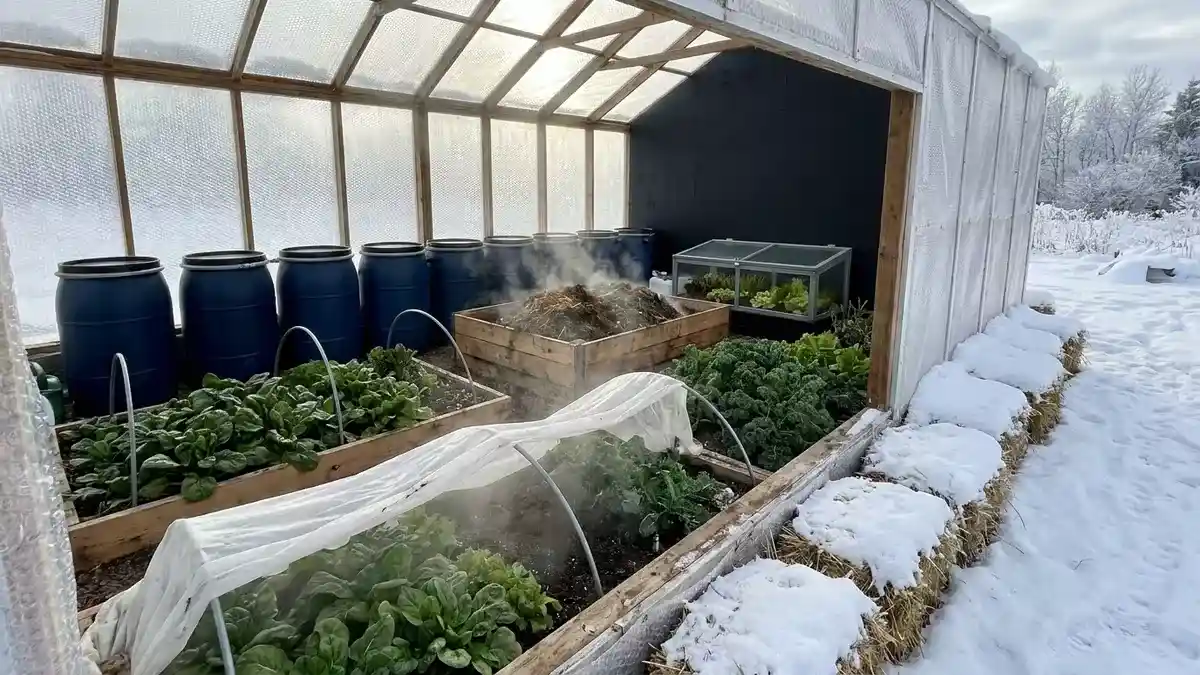
The Blue Barrel Method: Fill dark-colored, 55-gallon steel or plastic drums with water and line them along the interior north wall of your greenhouse.
How it Works: The dark surface absorbs the sun’s rays all day, heating the water inside. At night, as the air temperature drops, the water slowly releases that stored energy, acting like a gentle, natural radiator when your plants need it most.
2. Build a High-Heat Active Compost Pile
A well-maintained compost pile is much more than a way to recycle kitchen scraps—it is a literal biological engine.
As microbes, fungi, and bacteria break down organic matter like straw, autumn leaves, food waste, and animal manure, the chemical process generates significant energy. A healthy, active compost pile can easily reach internal temperatures of $130^\circ\text{F}$ to $160^\circ\text{F}$ ($54^\circ\text{C}$ to $71^\circ\text{C}$). By building a sizable pile directly inside a center trench or along a wall in your greenhouse, you can enjoy a reliable source of ambient radiant heat for weeks on end.
3. Implement Traditional Manure Hotbeds
Long before modern electrical heating pads existed, traditional market gardeners relied on “hotbeds” to jump-start their spring vegetables and protect delicate root systems from freezing conditions.
To build a hotbed, dig a trench beneath your planting zones and layer 6 to 12 inches of fresh, uncomposted horse or cow manure mixed with straw. Cover this layer with 8 to 10 inches of premium, fertile topsoil. As the buried manure decomposes over the winter, it generates gentle, upward heat that warms the root zones from below, creating an ideal environment for seed germination and cold-weather greens.
4. Layer with Internal Floating Row Covers
When managing winter temperatures, think of dressing your crops in layers. Using lightweight frost blankets or floating row covers directly over your indoor garden beds provides an indispensable secondary line of defense.
Drape the fabric loosely over metal hoops or directly across the foliage, securing the edges tightly to the ground. This traps a pocket of ground warmth right at the soil level, raising the immediate temperature around tender herbs, spinach, and lettuce by several crucial degrees.
5. Construct a Dark Solar-Gain Wall
Maximizing solar collection during brief winter days can drastically change your nighttime minimum temperatures. If your greenhouse features a solid, southern-facing interior wall, paint it matte black or face it with dark bricks, slate, or heavy concrete blocks. These dark, dense materials act as a sponge for solar radiation, anchoring heat during the day and preventing drastic temperature swings that cause plant stress after twilight.
6. Create “Nesting Doll” Cold Frames
For ultra-vulnerable seedlings or out-of-season crops, doubling up your protection layers yields fantastic results. Building or placing a transparent-topped cold frame inside your already-insulated greenhouse creates a microclimate within a microclimate. The sun warms the inner frame during the afternoon, and the twin layers of glass or plastic work in tandem overnight to lock that warmth in place, keeping frost completely at bay.
7. Erect Straw Bale Windbreaks
Bitter winter winds can strip heat away from a greenhouse faster than almost anything else. To combat this, stack tight rows of heavy hay or straw bales around the exterior perimeter base of your structure. This creates an incredibly effective, dense windbreak that blocks freezing drafts from creeping in through the foundation or lower panels.
8. Optimize Daylight Ventilation Cycles
Managing passive solar energy requires active timing. On bright winter days, keep a close eye on the internal temperature. Crack the vents slightly during the peak afternoon sun to release excess moisture and prevent mold, but ensure everything is clamped down tightly an hour before sunset. Closing up shop early traps the maximum amount of daytime heat inside the structure before the outdoor temperature plummets.
Work with the Weather: Grow Cold-Hardy Crops
Ultimately, the easiest way to ensure winter gardening success is to stop fighting the seasons and start working with them. Instead of trying to keep summer-loving tomatoes or peppers alive through a freeze, pivot your focus toward exceptionally cold-tolerant varieties.
Vegetables like spinach, kale, arugula, chard, winter radishes, claytonia, and specific hardy lettuces are biologically built to survive frosty conditions. Many of these crops can easily tolerate temperatures dipping down to $30^\circ\text{F}$ or $40^\circ\text{F}$ (around $-1^\circ\text{C}$ to $4^\circ\text{C}$) with minimal assistance. By aligning your crop selection with your regional climate, your winter greenhouse will remain highly productive with a fraction of the effort.
Conclusion
Keeping your greenhouse warm through the depths of winter does not require a complex electrical grid or an expensive utility budget. By combining structural insulation with natural heat sources like water thermal mass, active composting, and secondary row covers, you can create a safe, self-sustaining sanctuary for your plants. Experiment with these passive methods to see which combination keeps your winter harvest bountiful and frost-free.
Frequently Asked Questions (FAQ)
How many water barrels do I need to heat my greenhouse?
As a general rule of thumb, aim for roughly 2 to 3 gallons of water for every square foot of greenhouse floor space. For a standard $8\times10$ foot greenhouse, placing three to four 55-gallon drums along the north wall will provide a substantial, noticeable thermal mass.
Does an indoor compost pile smell bad?
If your compost pile is correctly balanced with a proper ratio of “greens” (nitrogen-rich materials like food scraps and manure) and “browns” (carbon-rich materials like straw and dry leaves), it should have a pleasant, earthy aroma. If it begins to smell foul or like ammonia, it means it has become too wet or lacks enough carbon; simply turn the pile and mix in more dry straw to fix the issue.
Can I use black painted milk jugs instead of large barrels?
Absolutely! If you don’t have the space for massive 55-gallon drums, recycling 1-gallon plastic milk jugs or juice containers works great. Paint them with a matte black spray paint, fill them with water, and tuck them directly between your plant pots or along the edges of your raised beds for localized warmth.
Will bubble wrap block too much sunlight for my winter crops?
Not at all. Standard clear bubble wrap allows roughly 80% to 85% of natural sunlight to pass through, which is more than enough for low-light winter crops like kale, spinach, and root vegetables. The massive boost in heat retention far outweighs the negligible reduction in light.
At what temperature should I start using these passive heating methods?
You should have your insulation, windbreaks, and thermal masses established before your regional nighttime temperatures consistently drop below $45^\circ\text{F}$ ($7^\circ\text{C}$). Setting up early ensures your thermal mass can start storing daytime heat before the first true frost arrives.