
Table of Contents
- 1. What to Expect: The Anatomy of a Haworthiopsis Bloom
- 2. 1. Exercise Patience and Await Specimen Maturity
- 3. 2. Optimize Light Rhythms to Fuel Bud Formations
- 4. 3. Simulate a Proper Chilly Winter Dormancy
- 4.1. Drop the Temperature
- 4.2. Drastically Starve the Soil
- 4.3. Halt All Nutrition
- 5. 4. Repot Into Breathable, Gritty Terracotta
- 6. 5. Master the “Soak and Dry” Irrigation Method
- 7. 6. Apply a Low-Nitrogen, High-Phosphorus Fertilizer
- 8. 7. Prune Baseline Offsets to Conserve Core Resources
- 9. 8. Lock in Absolute Environmental Stability
- 10. Frequently Asked Questions
- 10.1. Does a Zebra Haworthia die after it finishes blooming?
- 10.2. What should I do with the long flower stalk once the blooms fade?
- 10.3. Why is my Zebra Haworthia growing tall and skinny instead of blooming?
- 10.4. Are the flowers of a Zebra Haworthia fragrant?
- 10.5. Can I grow a new Zebra Haworthia from the seeds inside the flowers?
8 Expert Care Tips to Trigger Zebra Haworthia Blooms
Characterized by its striking, architectural rosettes and bold, white-striped ridges, the Zebra Haworthia (historically known as Haworthia attenuata, now officially classified as Haworthiopsis attenuata) is an absolute staple for indoor succulent collections. Native to the rugged, arid landscapes of South Africa, this compact beauty is loved for its low-maintenance nature and ability to thrive in modest indoor conditions.
However, getting a Zebra Haworthia to produce flowers is notoriously difficult. For many indoor gardeners, a blooming stalk is a rare, almost mythical event. Yet, flowering isn’t an impossible feat—it is simply a biological reward reserved for plants that feel completely secure in their environment. By adjusting your care routine to mimic the natural, seasonal rhythms of its native habitat, you can gently coax your succulent into sending up its elusive, graceful blossoms.
8 Expert Care Tips to Trigger Zebra Haworthia Blooms
What to Expect: The Anatomy of a Haworthiopsis Bloom
Before embarking on a blooming regimen, it helps to understand what a Zebra Haworthia flower actually looks like. These succulents do not produce large, vibrant, or colorful petals. Instead, their reproductive display is beautifully minimalist and subtle.
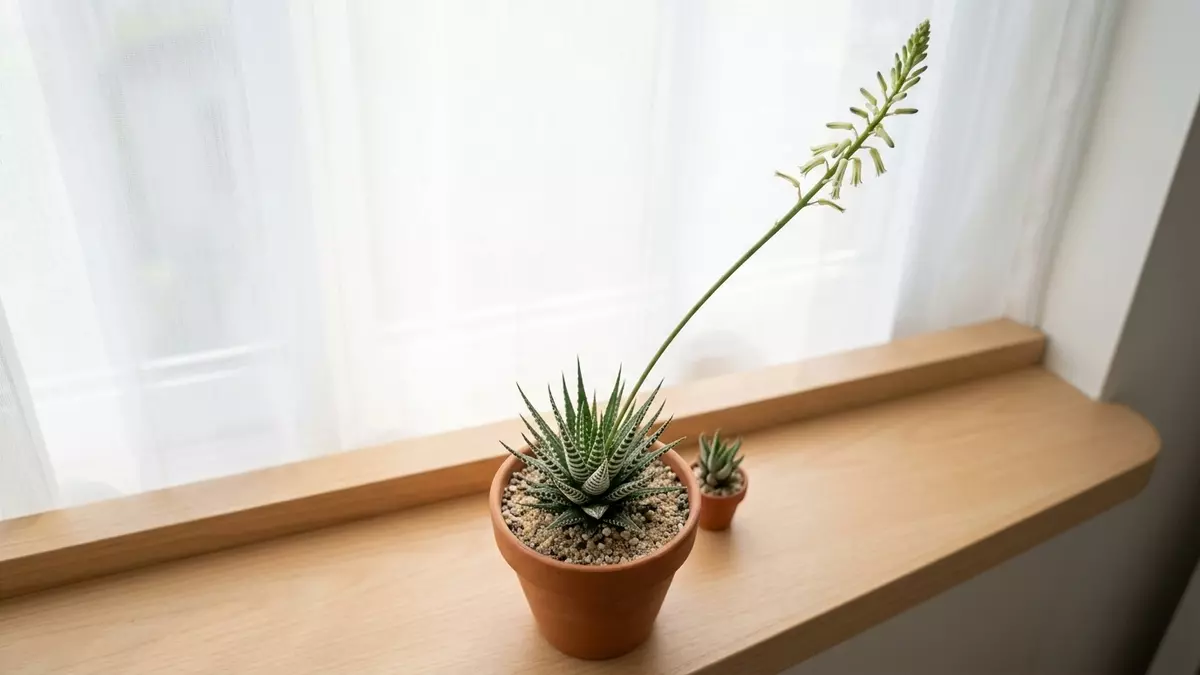
When a healthy plant prepares to reproduce, it pushes a single, incredibly long and slender green stalk directly out of its central rosette. This flower spike can stretch anywhere from 10 to 16 inches high. Dotted along the upper tip of this towering stem are tiny, tubular, bell-shaped flowers that open sequentially, displaying a delicate white or pale green hue.
These quiet blooms typically emerge in late spring or throughout the peak of summer. While they lack the dramatic flair of tropical flowers, witnessing one rise like a ribbon from your plant is the ultimate sign that you have successfully mastered its care.
1. Exercise Patience and Await Specimen Maturity
If you recently purchased a small, juvenile succulent from a nursery, you must accept that it will not bloom anytime soon. Zebra Haworthias are incredibly slow-growing plants. During their first few years of life, their internal cellular energy is directed entirely toward establishing a robust underground root network and building out their thick, water-storing leaves.
A Zebra Haworthia rarely considers flowering until it reaches absolute structural maturity:
Ages 0 to 3 Years: Juvenile phase; zero chance of reproductive blooms.
Ages 4 to 5+ Years: Mature, well-established phase; fully capable of flowering if environmental triggers are met.
Focus your early efforts entirely on building a structurally sound, healthy plant, and allow maturity to develop at its own natural pace.
2. Optimize Light Rhythms to Fuel Bud Formations
Because they originate in the scrublands of South Africa, Zebra Haworthias have evolved to grow in the partial shade of larger desert bushes or rocky crevices. This means you must find a delicate balance when setting up their light exposure.
[Too Dark: Survival Mode] <─── [Bright, Indirect Sun / East Window] ───> [Direct Midday Sun: Scorched Leaves]
Placing your succulent in direct, unshaded afternoon sunlight will rapidly overheat the plant tissue, bleaching the vivid green color and scorching the tips of the leaves. Conversely, leaving the pot in a dark corner forces the plant into a state of pure survival mode—it will stall its growth and completely refuse to waste valuable glucose on flower stalks.
To trigger a bloom, place your pot directly on the sill of an east-facing window to capture gentle morning sun, or set it slightly back from a south-facing window shielded by a sheer curtain. If your home lacks quality windows, a full-spectrum LED grow light positioned 6 to 8 inches above the rosette for 12 hours a day will provide the necessary light waves.
3. Simulate a Proper Chilly Winter Dormancy
The absolute greatest secret to triggering a spring succulent bloom is mimicking a traditional, native winter rest period. In the wild, changing seasonal temperatures and shifting daylight hours tell the plant to slow its metabolism, rest its roots, and store up energy for a massive reproductive push when spring arrives.
To successfully simulate an authentic winter dormancy indoors, follow these three adjustments from November through February:
Drop the Temperature
Move your plant to a noticeably cooler room in your house, such as a well-insulated basement, a chilly guest bedroom, or a bright enclosed porch. The ideal ambient temperature during this rest phase should hover consistently between 50°F and 55°F (10°C to 13°C).
Drastically Starve the Soil
Drop your watering schedule to an absolute bare minimum. You only want to provide enough residual moisture to prevent the main roots from desiccating entirely and the leaves from shriveling up. In most indoor settings, this means watering your plant just once every 5 to 6 weeks.
Halt All Nutrition
Never feed a dormant succulent. Introducing fertilizers during a winter rest will confuse the plant’s internal biological clock, forcing out weak, leggy, unseasonal growth that saps the energy needed for spring buds.
4. Repot Into Breathable, Gritty Terracotta
Your plant’s below-ground environment directly dictates its above-ground performance. To encourage flowering, the roots must feel snug but completely free from trapped, stagnant water.
Zebra Haworthias actually prefer being slightly root-bound. Planting a small succulent inside a massive container forces the root system to spend years trying to fill the void, delaying any potential flower production. Choose a small pot that leaves only a half-inch of clearing around the base of the rosette.
The Power of Clay: Always choose an unglazed terracotta clay pot outfitted with a wide, open drainage hole at the base. Terracotta is a highly porous, breathable material that pulls excess moisture outward through its walls, ensuring the soil dries out evenly and protecting the plant from fatal root rot.
Never use standard, dense potting soil straight from the bag. Instead, hand-mix a custom, ultra-gritty, fast-draining substrate using the following ratio:
| Substrate Component | Volume Ratio | Agricultural Purpose |
| Standard Cactus Soil | 1 Part | Provides organic base anchor and basic nutrient hold. |
| Coarse Sand or Pumice | 1 Part | Adds heavy structural grit to facilitate rapid drainage. |
| Perlite | 1 Part | Creates vital oxygen pockets around the root zone. |
5. Master the “Soak and Dry” Irrigation Method
Watering a succulent to encourage blooming requires mimicking natural desert flash-flood and drought cycles. During the active spring and summer growing seasons, utilize the classic soak and dry method.
When it is time to irrigate, pour water thoroughly onto the soil until it flows freely out of the bottom drainage holes, ensuring the entire root ball is completely saturated. Then, leave the plant alone. Do not water again until you have verified that the top two inches of the potting mix are completely, bone-dry to the touch—a cycle that usually takes anywhere from 10 to 14 days depending on your home’s internal humidity and airflow.
6. Apply a Low-Nitrogen, High-Phosphorus Fertilizer
While many houseplants respond beautifully to standard fertilizers, standard formulas will completely sabotage your attempts to get a Zebra Haworthia to bloom. High-nitrogen fertilizers (such as standard balanced 10-10-10 mixes) stimulate the plant to produce lush, rapid, vegetative leaf growth. Under a heavy nitrogen diet, the succulent will continuously push out new green leaves while ignoring flower production entirely.
[High Nitrogen Fertilizer] ──> Stimulates Leaf Offsets ──> Zero Flower Stalks
[Low Nitrogen / High Phosphorus] ──> Restricts Foliage ──> Signals Emergency Blooming
To support flower development, feed your plant once a month from late March through August using a specialized low-nitrogen, high-phosphorus bloom-boosting fertilizer (such as a 2-7-7 or 0-10-10 formulation). Always dilute the liquid fertilizer to half of the manufacturer’s recommended strength to avoid chemically scorching the sensitive, slow-growing roots.
7. Prune Baseline Offsets to Conserve Core Resources
A mature, thriving Zebra Haworthia is incredibly prolific when it comes to producing “pups”—miniature clone plants that sprout directly from the base of the mother rosette. While these baby succulents are adorable, leaving too many attached to the parent creates a massive energy drain.
The mother plant must split her limited intake of water and nutrients among an entire colony of surrounding pups, leaving her without the surplus caloric energy required to build a massive 16-inch flower spike.
In the early weeks of spring, use a sharp, sterile crafting knife to carefully slice away these baseline offsets. Cut as close to the main stem as possible, ideally preserving any tiny roots the pup has already started to throw out. Let the detached pups sit on a dry counter for 24 hours to form a protective callous over the open wound, then pot them up into their own mini terracotta containers. By clearing away this resource competition, you signal to the primary rosette that it is safe to redirect its focus toward central blooming.
8. Lock in Absolute Environmental Stability
The moment you see a tiny, nub-like growth begin to peek out from the very center of your Haworthia’s rosette, your plant has officially entered the initial stages of blooming. This is the most critical window of the entire lifecycle.
Succulents are highly sensitive to sudden environmental shock. If you stress the plant during this delicate transition, it will instantly enter an emergency defense state and abort the bloom stalk, causing the nascent stem to wither and dry up before opening.
To ensure success, lock in complete stability:
Do Not Move the Pot: Keep the container in its exact geographic position and orientation. Do not rotate it or move it to a different room.
Halt Structural Work: Completely avoid repotting, upgrading containers, or aggressively cleaning the leaves.
Maintain Watering Consistency: Stick strictly to your established soak-and-dry irrigation timeline. Do not overwater out of excitement or allow the soil to stay parched for too long.
By giving your Zebra Haworthia a stable, unchanging environment, the flower spike will continue its steady, skyward ascent, eventually rewarding your long-term dedication with a beautiful display of delicate, desert blossoms.
Frequently Asked Questions
Does a Zebra Haworthia die after it finishes blooming?
No. Unlike monocarpic succulents (such as Agaves or many Sempervivum varieties) that experience a “death bloom” and perish after reproducing, Haworthiopsis attenuata is polycarpic. It can safely bloom year after year throughout its decades-long lifespan without sustaining any damage to the core rosette.
What should I do with the long flower stalk once the blooms fade?
Once the tiny white flowers have completely withered and fallen away, the long green stalk will naturally begin to turn brown, dry, and woody. Use a pair of sharp, sterile pruning shears to cleanly snip the dead stalk off as close to the center base of the rosette as possible, which prevents the dead tissue from drawing fungal pathogens.
Why is my Zebra Haworthia growing tall and skinny instead of blooming?
If your succulent’s rosette is stretching upward, developing wide gaps between its leaves, and losing its compact shape, it is suffering from a condition called etiolation. This is a direct indicator that the plant is trapped in a low-light environment and is desperately stretching toward the nearest light source. It will not bloom under these conditions and needs to be slowly transitioned to a brighter window.
Are the flowers of a Zebra Haworthia fragrant?
No. The small, tubular white blossoms of the Zebra Haworthia lack any noticeable scent or perfume. In their native South African environment, they are structurally engineered to attract small local insect pollinators via shape and nectar placement rather than aromatic tracking.
Can I grow a new Zebra Haworthia from the seeds inside the flowers?
Yes, if the flowers are successfully cross-pollinated with a separate, non-related Haworthia specimen blooming at the same time, they will produce tiny seed pods. However, because succulent seeds have low germination rates and grow exceptionally slow, propagating the plant via baseline pups or leaf cuttings remains a significantly faster and more reliable method for home gardeners.