
Table of Contents
- 1. The Science of Genicular Artery Embolization
- 2. Real-World Data: Tracking Nearly 200 Patients
- 3. Substantial Pain Reduction and Restored Mobility
- 4. Shifting the Narrative: Osteoarthritis is More Than “Wear and Tear”
- 5. A Promising Treatment Bridge, Not a Universal Cure
- 6. Frequently Asked Questions (FAQs)
- 6.1. Is genicular artery embolization an inpatient surgery or an outpatient procedure?
- 6.2. Does the GAE procedure permanently cure knee osteoarthritis?
- 6.3. Are there any side effects or risks associated with blocking blood vessels in the knee?
- 6.4. How long does it take to feel the pain-relieving benefits after the procedure?
- 6.5. Who is the ideal candidate for genicular artery embolization?
Image-Guided Treatment Offers Lasting Knee Arthritis Relief Without Surgery
For millions of people living with severe knee osteoarthritis, the most frustrating part of the disease isn’t receiving the initial diagnosis. It is the exhausting reality of living in a painful treatment gap. This is the awkward middle ground where over-the-counter pain pills, rigorous physical therapy, and localized joint injections no longer provide adequate relief, yet a total knee replacement still feels too drastic, too risky, or simply too premature.
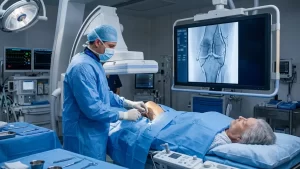
Image-Guided Treatment Offers Lasting Knee Arthritis Relief Without Surgery
Fortunately, a groundbreaking medical study suggests that a minimally invasive, image-guided treatment can help patients comfortably bridge this gap. The sophisticated procedure, known as genicular artery embolization (GAE), has been shown to substantially reduce chronic joint pain and restore physical mobility for at least one full year in adults who had completely exhausted traditional, non-surgical treatment options.
Osteoarthritis is the most prevalent form of arthritis across the globe, occurring when a joint undergoes progressive, degenerative structural changes over time. This leads to chronic pain, localized swelling, structural stiffness, and a profound loss of physical freedom. The knee joint is uniquely vulnerable to this decay; data from the World Health Organization (WHO) reveals that more than 528 million people worldwide live with osteoarthritis, with the knee accounting for an astronomical 365 million of those cases. This massive global burden is precisely why a safe, effective option in the middle of the treatment spectrum is capturing the intense attention of orthopedic specialists and interventional radiologists alike.

The Science of Genicular Artery Embolization
While “genicular artery embolization” sounds like an intimidating medical mouthful, the underlying biological concept is straightforward. The term “genicular” refers explicitly to the network of blood vessels that wrap around and supply the knee joint, while “embolization” is the deliberate, therapeutic blocking of specific blood vessels.
[Arthritic Knee Joint] ──► Inflamed Tissue Form Abnormal Blood Vessels
                                      │
                                      ▼
                      [Vessels Fuel Pain and Swelling]
                                      │
                                      ▼
[Micro-Catheter Insertion] ──► Gelatin Particles Safely Block Abnormal Flow
                                      │
                                      ▼
                        [Inflammation Drops; Pain Recedes]
In a healthy knee, blood flow is uniform and structured. However, as osteoarthritis advances and chronic inflammation takes hold, the body mistakenly grows an abundance of tiny, abnormal blood vessels near the degraded joint tissue. Instead of helping, these hyper-vascular networks actively feed localized swelling and hyper-sensitize local nerve endings—essentially acting as a biological fuel source that keeps a small, painful inflammatory fire smoldering inside your joint.
During the GAE procedure, a specialized interventional radiologist makes a microscopic incision, usually in the groin, and threads an incredibly thin, flexible tube called a micro-catheter into the arterial system. Utilizing real-time, live X-ray imaging, the physician navigates directly to the knee’s blood vessels.

Once positioned, the doctor introduces tiny, calibrated gelatin-based particles into the targeted abnormal vessels. These temporary microscopic particles instantly block the hyper-vascular, inflamed blood flow, cutting off the supply to the pain-generating nerves. Crucially, these specialized gelatin particles are engineered to safely dissolve within a matter of hours, allowing normal, healthy circulation to protect the surrounding tissue while leaving the chronic inflammation permanently dampened.
Real-World Data: Tracking Nearly 200 Patients
The clinical weight of this new treatment comes from a rigorous study that followed 194 real-world patients suffering from moderate-to-severe knee pain linked directly to documented osteoarthritis. The diverse cohort was comprised of 114 women and 80 men, with a median age of 69 years old.
Every single participant in this study represented a classic “treatment failure” case. They had all completed at least three consecutive months of intensive conservative care—including structured physical therapy regimens, maximum-dose anti-inflammatory medications, and direct intra-articular corticosteroid or hyaluronic acid injections—with little to no lasting success. These were not individuals exploring a first-line remedy; they were actively searching for a definitive next step to avoid major surgery.

According to Dr. Florian Nima Fleckenstein, deputy head of Interventional Radiology Campus Mitte at Charité – Universitätsmedizin Berlin, the study’s findings carry immense clinical authority because they reflect everyday medicine. “Our participants are exactly the patients that physicians encounter every day in their practices,” he noted, emphasizing that the data translates directly to the average patient walking into an orthopedic clinic.
Substantial Pain Reduction and Restored Mobility
The results of the study, which analyzed a total of 239 individual procedures (as several patients elected to have both arthritic knees treated), demonstrated remarkable success. Every single procedure was deemed a 100% technical success, and incredibly, the researchers reported zero moderate or severe adverse events or clinical complications.
The physical relief experienced by the participants was rapid, substantial, and remarkably durable. Patients rated their daily joint discomfort on a standard 0-to-10 pain scale, yielding a clear timeline of recovery:
Before Treatment: The group maintained a severe median pain score of 7 out of 10.
6 Weeks Post-Procedure: The median pain score plummeted down to 4 out of 10.
6 Months Post-Procedure: The score dropped further, stabilizing at a manageable 3 out of 10.
12 Months Post-Procedure: The relief held firm, remaining at a median score of 3 out of 10.
| Clinical Milestone | Median Pain Score (0-10 Scale) | Impact on Daily Mobility |
| Pre-Treatment Baseline | 7 / 10 | Severe pain; stairs difficult; constant walking limitations |
| 6 Weeks Post-GAE | 4 / 10 | Noticeable relief; easier daily errands; reduced stiffness |
| 6 Months Post-GAE | 3 / 10 | Sustained comfort; walks around the block feel accessible |
| 12 Months Post-GAE | 3 / 10 | Durable relief; clinically meaningful quality of life boost |
While these figures look impressive on a medical chart, their true value lies in everyday human experiences. For an individual who must meticulously plan their entire afternoon around their physical knee limitations, dropping from a 7 to a 3 on a pain scale is life-altering. It represents the difference between wincing in agony while climbing household stairs and walking around the block without a second thought.
In tandem with pain reduction, the researchers documented widespread improvements across all secondary quality-of-life metrics. Participants scored significantly higher in their ability to perform daily activities, engage in recreational sports, and manage general stiffness. At the formal one-year mark, an astounding 80% of the participants achieved a pain reduction so substantial that it crossed the formal scientific threshold for a clinically meaningful real-world change.
Shifting the Narrative: Osteoarthritis is More Than “Wear and Tear”
For generations, both patients and physicians have described knee osteoarthritis using the ubiquitous phrase “wear and tear.” While this simple analogy effectively captures the mechanical erosion of structural joint cartilage, modern medical science recognizes that it leaves out a massive piece of the physiological puzzle.
Today, advanced research treats osteoarthritis as a complex, whole-joint disease. It is a condition that simultaneously involves the structural breakdown of cartilage, underlying bone remodeling, localized nerve hypersensitivity, and intense, vascular-driven inflammation.
A 2026 formal position statement reinforced that genicular artery embolization serves as a highly precise tool because it targets the inflammatory and vascular drivers of the disease rather than just the mechanical degeneration. Interventional radiologists are not attempting to shut down the knee’s normal, healthy circulatory system; rather, they are using advanced imaging to selectively eliminate the hyper-inflamed, abnormal micro-vessels while completely preserving the healthy blood flow required to sustain the joint.
A Promising Treatment Bridge, Not a Universal Cure
While these real-world findings are incredibly encouraging, medical experts emphasize that GAE is not a guaranteed cure-all for every arthritic knee. The published study followed a specific group of patients forward in time, but it was conducted at a single medical institution and did not compare the treated group against a placebo control group or an alternative medical therapy.
Furthermore, a comprehensive 2025 systematic review analyzing data across 23 independent medical studies labeled the image-guided approach as immensely promising for patients who fail conservative care or face too many health risks for major surgery. However, the authors also offered a necessary note of scientific caution, stating that larger, multi-center randomized controlled trials are still vital to definitively lock in the therapy’s long-term, multi-year efficacy profile.
[ Conservative Care Failures ] ──► [ Genicular Artery Embolization ] ──► [ Delays Total Knee Replacement ]
Genicular artery embolization does not magically regrow worn-out joint cartilage or straighten a severely misaligned bone structure. Because of this, the outpatient procedure is best understood as a highly effective biological bridge designed to give patients a year or more of profound relief, potentially pushing the need for a major, invasive total knee replacement much further down the road.
At the end of the day, this interventional radiology breakthrough solves a deeply practical medical dilemma. It gives physicians a powerful, low-risk tool to offer patients when their knees hurt constantly, but major open surgery isn’t the right next step. A simple, daytime procedure that guarantees a year of easier stairs, pain-free walks, and minimal pills isn’t a miracle—but to the person suffering in the treatment gap, it feels incredibly close to one. The comprehensive clinical study detailing these findings can be read in full in the peer-reviewed medical journal Radiology.
Frequently Asked Questions (FAQs)
Is genicular artery embolization an inpatient surgery or an outpatient procedure?
GAE is a minimally invasive, outpatient procedure performed in an interventional radiology suite under twilight sedation, meaning you do not require general anesthesia. The entire process typically takes less than an hour, and the vast majority of patients are able to walk out of the clinic and return home the exact same day with only a small adhesive bandage over the incision site.
Does the GAE procedure permanently cure knee osteoarthritis?
No. GAE is highly effective at reducing chronic pain and localized inflammation, but it does not reverse the physical degeneration of the joint, nor does it regrow lost structural cartilage. It is designed to act as a long-term management tool and a protective bridge to delay the need for a major total knee replacement surgery.
Are there any side effects or risks associated with blocking blood vessels in the knee?
Because interventional radiologists utilize high-definition, live X-ray imaging to precisely target only the abnormal, inflammatory blood vessels, the risks are exceptionally low. The temporary gelatin particles dissolve completely within a few hours, ensuring normal, healthy baseline circulation is preserved. Minor, transient side effects can include mild bruising at the skin incision site or temporary skin discoloration over the knee.
How long does it take to feel the pain-relieving benefits after the procedure?
While a few patients report a noticeable decrease in their baseline joint throbbing within the first 48 hours, most individuals experience a gradual, steady reduction in pain and stiffness over the course of two to six weeks as the hyper-vascular network fully recedes and the localized inflammation inside the joint drops.
Who is the ideal candidate for genicular artery embolization?
The ideal candidate is an adult diagnosed with moderate-to-severe knee osteoarthritis who has failed at least three months of conservative care (such as physical therapy, anti-inflammatory medications, and cortisone injections) but is either a poor candidate for major surgery due to underlying health conditions, or wishes to safely delay a total knee replacement. A thorough evaluation by an interventional radiologist is required to ensure your specific pain is driven by vascular inflammation.